Tag Archives: leadership

All it takes is everyone

On Tuesday I posted about the need for good leaders to perceive when their own and others behaviour is verging on stubborn so they can de-escalate the scenario and move to circumstances that are a benefit to all.

It was noted in later comments (keep those cards and letters coming they are appreciated) that everyone should practice eliminating stubbornness, this is not just a task for leaders.

In Principal, In Reality

I can imagine a place or state of things in which everything is perfect, in fact  not only imagine it but act in ways that will contribute to the development of a Utopia for all.

Unfortunately though, my own experience  and failures in this regard lead me to a more pragmatic perspective.  Seeking Utopia is a worthwhile endeavour but a very difficult if not improbable achievement, at least in the near term.

Thus, well it is true everyone should avoid stubborn behaviour, both for their own and others benefit a leader by dint of the responsibilities they accepted has an obligation to do this.

A realistic approach

Leaders are best positioned to guide us to utopian circumstances and while this should preclude universal participation the reality (at least in current times) is that motivation and direction from a central source (i.e. leader) is needed.

The damage caused by a powerful in transient belief, from terrorist acts to all out war, often has a leader at its heart motivating followers to act in unsavoury ways sometimes simply by first recognizing and then encouraging their innate stubbornness.

This is not to say effective leadership is a way to solve all of humankind’s problems, but it could be a start.   In the final denouement though it does take everyone’s participation’s
 

Pride in Leadership

To become an effective leader, in-most cases, significant effort is needed.  Achieving leadership roles is natural to lead to a  feeling of deep pleasure or satisfaction derived from one’s own achievements.

Basically this applies to the achievements of those with whom one is closely associated, or from qualities or possessions that are widely admired.  The leader recognizes this and is proud.

Pride and Self Confidence

Leadership is created through the practiced balance of many skills and competencies.  Being able to trust in one’s abilities, qualities, and judgment is one of these.

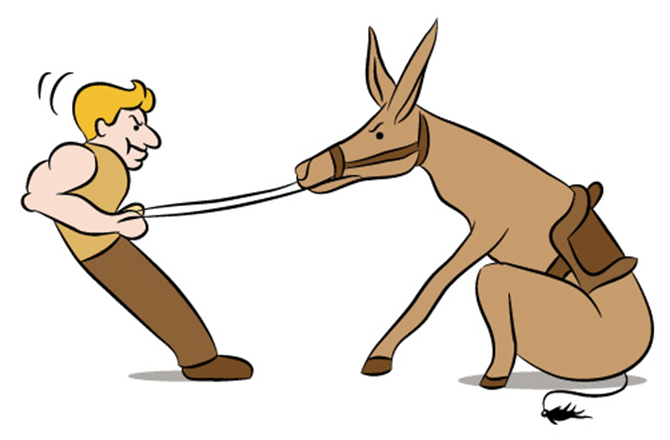
Unfortunately an unequal balance between pride and self confidence can lead to having or showing dogged determination not to change one’s attitude or position on something, especially in spite of any arguments or reasons to do so.

Avoiding Stubbornness

The caveat to being self confident  is the potential to evolve to a framework of insurmountable belief.  That is the leader develops an irrevocable understanding that their personal judgement should not be challenged.

They are proud of their demonstrated capabilities and proven success and contend that it should not be questioned.  Can they be wrong?  By dint of their granted power and responsibilities  a belief in personal ominicience develops.

This is a danger to be carefully guarded against, often evidenced by others perceiving stubborn behaviour and reacting stubborn in turn.   Self aware leaders identify and react to this scenario quite quickly.

Win Win

Diversity of perception and associated opinions represents an opportunity for moving forward with powerful positive solutions rather than being stuck in the cult of authoritative leadership albeit a balance of some authority is needed to avoid anarchy.

The next time you are presented with a situation of apparently intractable positions take time to consider,  is there an opportunity for you to change the context and lead to something beyond the butting of heads.

The big picture

I have often posted about leaders traits.  The focus have been on skills that define effective and powerful leaders.  The other day in a conversation with some friends I came to the realization knowing  things not to do is as important as knowing what to do.

That is even if you are aware of and consciously work on being an exceptional leader practising behaviours that are known to work, what if unconsciously your core philosophy on how to interact with others is flawed.

What matters most

The underlying tenant of leadership is ability to enable greatness across all stakeholders be it followers ,peers, subordinates or whatever defined relationship you  have with everyone you interact with.

A leaders power is derived from others and to be effective leaders need to focus those stakeholders needs.  Leaders who believe at their core “it’s all about me” will definitely fail over time.

Others recognize the inward focus and ultimately even if they continue to “follow” the leader it is not because they want to but rather some less powerful motivation which may continue for sometime but will likely be unsustainable over the long term.

It’s about others first

Both consciously and unconsciously leaders must not focus on their needs first.  Outstanding leaders value everyone and focus on t(e greater good rather than personal avarice.

Exaggerated examples of this concept are evident throughout history when considering dictators like the infamous  Adolph Hitler who clearly focused on his own needs.  He demonstrated time and again, to his detriment the world revolved around him.

There are many skills to help us be great leaders there are many skills we can leverage but if at the core are focus is inward facing we will fail.

Is it you?

Many times through out our lives we will experience conflict.  At times our exchange of information with others will appear adversarial.

We may be criticized or perceive others behaviour to be rude or unfriendly.   Often in these cases we assign fault to the others and use this determination to justify our own righteous behaviour.

Solution Based Action

Regardless of the cause, which usually involves every one to some extent, overcoming unpleasant situations is most easily done by avoiding blame and focusing on behaviours that will resolve the conflict in a way that everyone wins.

When we are wronged or at least believe we have been wronged it is relatively easy to focus on ourselves and our needs We are in the right and dam it others need to know they have wronged us.

This approach results in us acting in ways that do not defuse conflict but rather result in escalation.  Although not our intention we become a contributor to the problem.  And through our actions the problem becomes worse.

Get over it

Perhaps you are not at fault, perhaps you have been mistreated by others.  Reacting to their rudeness or inappropriate actions in a retaliatory way might be good for you but it is unlikely to lead to a resolution.

Most likely your actions lead to a response which will just make the situation worse.  Accepting that shit happens, focusing on ways to work with others to achieve a state of happiness for everyone is a far more logical approach.

Work Together

Is it you, is it me, who cares.  Conflict is best resolved through joint actions.  Lashing out in spite might give you a brief satisfaction but it will not be sustainable.

Leveraging Humor

Though technically wit is defined as mental sharpness, inventiveness and keen intelligence I personally associate it with a special kind of humor as well as everything else.

The quick wit’s I normally encounter display the quality of being amusing or comic in the way they behave.  Their feedback might be pointed but it is usually presented in a very acceptable way.  Humor is a great way to make a point.

Feeling Good

When I am amused I feel good and get pleasure out of the message even if overall the content is not optimal for me.  Presentation really matters and using your wits to communicate in ways others can chuckle about leads to more sustainable results.

One wit in the crowd can breakout a 1000 smiles, happiness will reign, so put your talent to use when you have the chance. Whether a formal meeting or a chance conversation inflecting humor makes everything seem lighter and more palatable.

Leadership is Serious

I am surprised on occasion when friends and colleagues express the need to be serious as the best way to accomplish a goal.  They are missing a key point about humor, it can contain messages and define actions just like the direct communication can but it is easier to take.

Leaders have a serious role.  They must use careful consideration to arrive at the best options, that is approach the role seriously, but how they communicate to others can often be more effective when underpinned by good humor, not ridiculous but certainly practical.

So, take every opportunity to laugh with others, everyone will feel better.

Leading Change

One of the biggest dilemmas is how to best communicate major changes to their followers.  Specifically what to communicate and when is a  tough choice.

In fact, this can put the leader in a very difficult situation, and often each option looks equally bad.  This can appear like a problem with no satisfactory solution.  Tell too much and people might react inappropriately, too little and fear and uncertainty set in.

I don’t know

During my working career, I have experienced many major changes within the organization I have been a part of.  Also significant changes in government and culture have occurred over time.

In each case, my observation is the worst possible response for leaders of the change is “I don’t know, haven’t figured it out yet”.  While this may be accurate it is very disconcerting to the followers and usually erodes trust and creates additional anxiety.

The dilemma in this situation is often about disclosure.  Perhaps it is too early to disclose all you know and you don’t want to lie or perhaps you really don’t know.

How you say it

I agree lying or making stuff up to calm people at the moment is the worst possible tactic but straight-up waffling or giving political answers that really do not address the question to just saying I don’t know directly is really a bad approach.

There are many ways to communicate about things you don’t know or are unwilling to share at a given time that put a positive spin on the situation and most importantly do not imply the presence of secrecy ( secrecy can be very disturbing to followers).

So don’t prevaricate but also be clear about what and when you will disclose, listen closely to the messages of your followers and be empathetic to their needs in your responses.

Leading without Followers is not Leading

Each of us has a variety of people whom we consider to be our leaders from time to time depending on the context (i.e., our group, organization, geographic region)

These leaders might be our choice or by a combination of appointment and personal selection.  Their power might have been earned by them, granted to them, or a combination of earned and granted.

Power Base

To lead you must have a power base.  This can be something you developed through your actions or perhaps you are designated the leader by dint of organization or election.

More often than not guile, wit and intellectual prowess versus physical strength are the cornerstones of effective leadership although the use of brute force has been known to be somewhat effective if not usually sustainable over long periods.

Followers

Even if you are designated as a leader, without followers you are nothing.   Typically if you disaffect your followers because of inappropriate behavior your leadership days will be numbered.

This applies whether you earn your power base or start with it by default.  If you are not able to gather and retain followers there is nothing to lead and by definition, you are no longer a leader.

Observe

Effective leaders are aware of how their followers view them and most importantly are empathetic with how their followers are feeling.

Without empathy, followers will view you as a narcissist.  This adulation will most likely be brief and accompanied by mass defection.  Leaders need to be focused on their followers not on themselves

The most effective leaders, those that both retain and build their followers observe carefully and then act accordingly.


Not Me!

I fondly remember a very collaborative team I was part of more than a decade ago.  Our boss used to gather us together regularly and discuss upcoming activities and opportunities.
His goal was to assign work in a very democratic way.  The team would somehow collectively come up with the best assignments.  This approach did not elicit a lot of volunteers and often ended up with our boss just making the assignments.

Will the Spaghetti Stick?

Early on as I learned to cook I was taught to test when spaghetti was ready by throwing it against the wall.  It stuck, it was ready (spaghetti was a favorite dish of mine because it was so easy to prepare).

Tossing the ball (and hoping it will stick) might lead to successful outcomes, but passing the ball in a planned and scheduled way is far more likely to work well.
My aforementioned boss often tossed the ball into our court and regularly found it just bounced back.  His choice to work as a thoroughly integrated team through full-on involvement of everyone was well-intentioned if not well executed.

Rigidity Sucks

Setting the approach in stone and firing the ball at the troops demanding specific action or just tossing the ball and praying are two useful analogies to illustrate the best approach might well be somewhere in the middle.

Be prepared.  Do some planning advance but include both flexibility and real (not lip service) opportunity for feedback before casting the approach in stone.

Group determinations are the hardest to achieve but usually, they are the most satisfying.

Making Assumptions

From time to time most of us will accept something as true or as certain to happen, even though we do not have absolute proof (it is possible definitive evidence of the truth does not exist.

Making assumptions can be expedient but it could also result in inappropriate behaviour or doing the wrong activity because things we not actually as you assumed them to be.

Speculation

A close cousin to the making of assumptions occurs when we form a theory or conjecture without firm evidence, i.e., speculate.  Combining speculation with assumptions can lead to a very dangerous combination.

Basically, inadequate quality of facts and inconclusive information leads us to actions that appear to be supported by feelings or beliefs that we can firmly trust, although in fact they are based a bit on smoke and mirrors, (i.e., what appears to be, not necessarily what is).

Easy and Simple

The prime motivation for acting on speculative information and assumptions is simplicity.  It is easier to assume you know the answer and proceed than step back, dig in and investigate.

We can achieve our goals by knowing how to proceed and assumptions provide us with that direction.  Sometimes it works and of course, our level of false confidence drives our ability to make assumptions comfortably.

The thinking goes “We are good at this, it’s unlikely we are wrong.  Why wait, why do more work?  Let’s get it done.”  Unfortunately, this approach does not always work out.  Worse when it misfires you can really make an ass of yourself (or worse).

How do you feel?

We all have a natural instinctive state of mind deriving from our circumstances, mood, or relationships with others.  These emotions drive our behavior.
Our feelings are not based on logic but rather they are intuitive and can even be hereditary reactions.   Our emotional response will not always result in optimal behavior based on the situation.

Logic or Emotion

The interesting paradigm presented by emotional behavior was cleverly illustrated in the original Star Trek television show.  One of the crew members belonged to a race (Vulcan) which could not experience emotion.

Amn oft viewed scenario on the show was the Vulcan character (Spock) opining on others behavior as being illogical.  Sometimes the emotional behavior proved best and sometimes disastrous.

Life Without Emotion

Seeing life without emotion, as envisioned by the TV shows creative talent was fascinating to say the least (another perspective oft spoken by Spock when observing others act emotionally).

The show very much put emotional behaviour into perspective and helped me understand the value of checking your feelings before acting.

Behave to Achieve

By checking my emotions before reacting I enabled myself the opportunity of acting in the optimal way to satisfy my desires.  Often the ungaurded reaction, based on how you are feeling at any given time, is not the best approach.

Logical analysis can often help determine the better way.

Surprisingly, determining how you feel e.g., anger, saddness, happy, excited is not difficult.  Holding your actions in check until you are ready to act appropriately is a little more difficult given the energy associated with emotion, but doable and worth it.