Tag Archives: emotions

How do you feel?

We all have a natural instinctive state of mind deriving from our circumstances, mood, or relationships with others.  These emotions drive our behavior.
Our feelings are not based on logic but rather they are intuitive and can even be hereditary reactions.   Our emotional response will not always result in optimal behavior based on the situation.

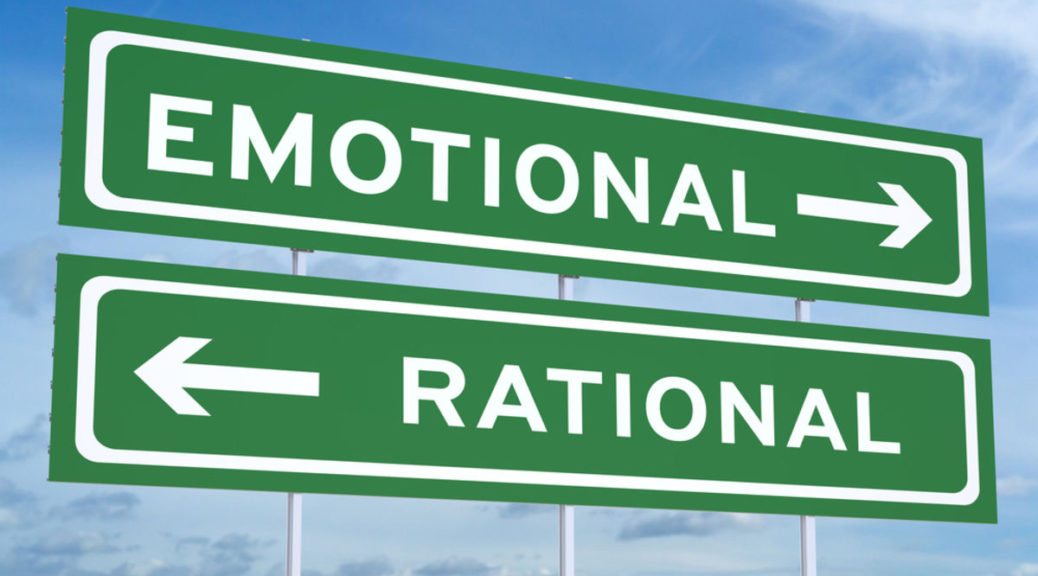
Logic or Emotion

The interesting paradigm presented by emotional behavior was cleverly illustrated in the original Star Trek television show.  One of the crew members belonged to a race (Vulcan) which could not experience emotion.

Amn oft viewed scenario on the show was the Vulcan character (Spock) opining on others behavior as being illogical.  Sometimes the emotional behavior proved best and sometimes disastrous.

Life Without Emotion

Seeing life without emotion, as envisioned by the TV shows creative talent was fascinating to say the least (another perspective oft spoken by Spock when observing others act emotionally).

The show very much put emotional behaviour into perspective and helped me understand the value of checking your feelings before acting.

Behave to Achieve

By checking my emotions before reacting I enabled myself the opportunity of acting in the optimal way to satisfy my desires.  Often the ungaurded reaction, based on how you are feeling at any given time, is not the best approach.

Logical analysis can often help determine the better way.

Surprisingly, determining how you feel e.g., anger, saddness, happy, excited is not difficult.  Holding your actions in check until you are ready to act appropriately is a little more difficult given the energy associated with emotion, but doable and worth it.

 

Metrics versus Emotions

Decision analysis and review is the process that is followed, whether well or ill defined, when options exist and a choice must be made. That is, a decision of some sort is required.

Typically, pertinent factors are considered, weighed in contrast to each other and the overall objective.  The outcome is usually chosen because it best supports the desired results. 

Level of Rigor

The amount of effort put into the decision process can vary depending on the magnitude of the impact and the urgency.  Ultimately though the chances of positive outcomes rises with the level of rigor applied. 

The methodology for interpreting the decision influencing factors can cover the spectrum from clearly defined measurable attributes (e.g., it is 10 inches long) to subject intangible factors, important but less quantifiable. 

The subjective factors can be influenced by emotions.  Basically, the criteria applied is based on the questions “How do I feel about this?”  This is a basic human behaviour, that is emotions overriding logic. 

How do I feel/ What do I think?

The quality of a decision is very much dependent on the balance between how you feel about something and the tangible measures – reality.  Once the tangible versus the intangible are tallied, there is still the ultimate decision process itself which often favors the emotional. 

For the best decisions, regardless of impact and time constraints attempting to place a lower priority on the emotional aspects, at least initially, allows for the reasoned solution to appear first, the emotional filters can then be applied – they are relevant and important.  

This approach will ensure the decision was arrived at with a conscious understanding of how much was measured and how much was emoted.