Wasted Effort

Forward motion does not necessarily equate to positive results.  Humans in motion is normal and practical but taking action might have an effect and alas it might have no impact. 

The point is the importance of recognizing doing something might not be a worthwhile expenditure of energy, in and of itself.   Unfortunately acting without due care and caution could result not only in no impact but also in a negative impact causing the need for rework.

Planning, Focus, Validation

Ideally all behaviour and activity you undertake should be with a concious purpose.  Understanding the reason to put things in motion makes the effort more likely to succeed.

If you are not clear on what the purpose is the outcome may be good, bad or indifferent.  In this case luck is the predominent predictor of the outcome.

Driving Achievement

There are times when you may choose to go with the flow and let fate determine what happens.  As long as that maps to your initial expectations, you shouldn’t be disappointed.

More often you have a sense of purpose.  To help reduce the risk of wasted effort, the first step is to clarify in your mind what success will look like.

That is to be very definitive about what you intend to have occur.  This leads of course to planning how to do it and finally execution.

Mistakes

One of your top objectives should not only be to follow your plan but to check along the way things are proceeding as expected.  

This is a critical requirement to avoid wasted effort and rework.  Recently I spent days working on a task, with a great deal of forward momentum, only to find I had made a significant error early on.

Sadly, I had to start all over again.  I was busy do the work, but not productive.  I knew what and how but forgot to validate along the way to confirm I was on track.

It’s worth giving some thought before leaping ahead toward your next goal.

Enlightenment

An enlightened state is probably more a concept than a reality.  That is, to achieve freedom from all ignorance and misinformation, enabling full accurate comprehension of everything, is more something to seek than to actually find.

The search for enlightenment requires acceptance of reality.  Philosophically we can question reality as a concept, does it really exist and if so what is it?

For me, reality is neither derivative nor dependent but exists and is tangible.  True enlightenment must be based on reality, ergo, to be enlightened you must accept that reality exists.

An Alien Experiment

It has been postulated humanity is simply an experiment devised by a super intelligent alien race.  Of a pre-programmed series of events generated by a computer where the players are just computer simulations. 

The potential for alternate theories of existence is obviously broad, perhaps infinite and can be fun to contemplate and explore, however, at some point reality intrudes. 

Pragmatically, be guided by what’s real

If we focus on the tangible, what we know and can prove, the reality we construct can guide our comprehension of everything, leading us to an enlightened state.

The underlying principle is we must accept reality, that is to say, although possibilities exist beyond the tangible, it is the tangible that has the real impact on what we do, how we behave, how we feel.

We ignore reality at our peril and our chances of success in our continuing quest for enlightenment (a stretch goal probably never to be achieved) is diminished.  

Deep Thoughts

The recovery of gold usually involves digging of some sort, whether tunnels underground or open pit mining.  Gold has a perceived value high enough to make the recovery effort worth it. 

What about your deep thoughts? 

Thinking

Thoughts are defined as the action or process of thinking.  In the normal course of events we develop a thought, interpret it and act.  More profound thoughts, that is thoughts that are complex and require interpretation can be classified as deep thoughts.

Deep thoughts are, by definition, any thoughts that are complex, somewhat buried and not readily accessible.  This type of thinking is often overlooked by us and not considered worth the effort to retrieve or interpret. 

Like gold, the intrinsic value of a deep thought must be recognized and understood to motivate us to take the time and effort for search and recovery. 

Seek Them Out

Your deep thoughts might be hidden just below the surface of your conscious, (i.e., within the unconscious states of your brain) but they are almost always ever present, just easily ignored (because they are not part of your consciousness). 

Typically the results of deep thinking can be very powerful and rewarding.  Of course, the effort to extract, interpret and implement them is not trivial.  In essence, it is a balanced effort/reward equation.  

Extra effort is required.  Extra benefits are accrued. 

Acquiring your deep thoughts

Grasping onto those buried complex thoughts mainly requires concentration.  Recognizing the presence of deep thoughts within the unconscious spaces of your mind is the first step. 

After grasping onto the thoughts and pulling it into your conscious mind, the next step is taking the time to unpack them into a state you can use, that is, understand their intent/meaning and act accordingly.

Like mining for gold, it is likely you will find this a worthwhile exercise. 


Focus on Mental Well Being

While diet and exercise can be two key methods of maintaining good physical health, mental tranquility is the foundation of good health.  

Stress on your brain can weaken your entire body and regardless of your overall physical health, make you susceptible to disease or inexplicable aches and pains.

Managing Stress

Contrary to common belief, all stress is not harmful to your well being, in fact, a lack of good stress or eustress can be detrimental.  

The research of Hungarian/Canadian endocrinologist Hans Selye into our response to stressors showed that certain stress events led to positive biological reactions, while others, which can be labeled distress, were negative. 

(Note:  I  have simplified his concepts) 

When managing your stress it is important to classify the stressor a eustress or distress (this can vary by individual) and calculate your response accordingly.  

Eustress or Distress

Consider the retiree.  Eustress studies revealed those who retired and did not replace their daily purpose (work) with other activities (hobbies, travel, etc), were likely to die within 9 to 12 months of retirement.  

While some talk about the stress of work, worries about events, schedules, finances, in fact, these provide a biological incentive to the body and thus in a sense are life-sustaining, their lack is detrimental.

On the other hand, stresses with the negative impact that we consider out of our control (e.g. loss of a loved one, loss of employment) are the ones to both avoid if possible, or if unavoidable, (at a very minimum) accept and move on. 

Distress spirals out of control and can be very damaging to our well-being unless we can defuse it.  Basically accepts those things that just “are what they are” and move on. 

Checking your missteps

When you make an error in judgment or actual execution of an activity, this is a misstep.   In essence, you could have made a mistake due to poor reasoning, carelessness or possibly it is just the result of insufficient knowledge or perhaps just an unintentional oversight.

Whether as a result of Murphy’s law (i.e., things can and will go wrong) or due to your own actions or judgment being flawed, missteps will happen.  Avoiding the risk of a misstep is a planning exercise, and taking action when they occur is risk mitigation. 

Avoidance

Planning for the unexpected is a great way to enable potential missteps to be identified.  Checkpoint activities can be scheduled to identify actions if things are going off track.  This allows for actions to be taken to remedy mistakes before they become obvious or impactful. 

Risk Mitigation

Sometimes, regardless of how detailed the planning is misstepping will occur.  Recognizing this and being prepared, that is outlining what the action will be to correct the mistake, will enable a quick and effective response to errors. 

Ignore

A common reaction to mistakes is to ignore their occurrence and hope no one will notice. This approach is a little like gambling if your luck prevails no one will notice and there will be no negative consequences, particularly against you. 

Or even when noticed, blame and associated consequences will not be associated with you.  The downside is, like gambling, the winning result is rare and intermittent, although psychologically the intermittent reward  reinforces this behaviour it is not optimal. 

Avoiding the mistake or properly mitigating when a mistake occurs are by far the best approach.  Hiding and hoping, not so much. 

Anticipation

When you predict, foresee or just believe something will occur in the future you are anticipating.  Anticipation can be exhilarating or in some contexts worrisome.

The object of the anticipation drives the associated emotions, for example, fear, excitement or foreboding or any number of other emotions.

Disappointment

If the predicted event does not occur or the results are different from expected anticipation can lead to heightened level of saddness.

If you expected little and recieved little you might not be that upset.  However failed anticipation can magnify your level of disappointment.

Surprising Others

Anticipating the needs of someone or a group of people can raise your profile.  This can be particularly impactful in a heirachical organization.

By acting before asked on an anticipated need can impress others particularly those at a more senior level of the organization.

Assuming of course you accurately predicted or forecast what as needed and your resulting actions mapped to expectation.

Typically, self-motivated individuals with a high level of initiative are highly regarded and anticipating, acting on your predication and achieving a desired outcome puts in that category.

Anticipating things that relate to you can result in postive or negative outcomes.  Anticipating correctly the needs of others is mostly likely to have positive results.


What’s Holding you Back?

Your power to achieve is only limited by your fear of success.  Often this phrase is stated “…..as fear of failure” but surprisingly unconciously we are often cautious about achievement.

The thought process includes things like:
– Do I really want this change, it seems better, but?
– What will others think of me if I am successful?
– What happens next after this accomplishment?
– If I succeed, things will be different, do I really want that?

Change is Constant

A lot of the reticence to moving forward is related to change itself.  Change represents the unknown and although your objectives are things you desire (by definition) there is always the ever-present anxiety around making a change.  

As I have noted before, in numerous posts, change is inevitable.  Controlling the changes and managing your destiny might be a better approach but often the default to accept and move on is easier. 

Change is going to occur with or without you, would you not rather it be with you?  

Unconcious Anxiety

If your goal is to have a better entertainment experience you may consider replacing your current home entertainment centre.  Success will mean the existing electronics and technology will need to change. 

New skills will be needed to use the new equipment.  How you access and view entertainment will likely improve (that’s the goal) but the current state will be gone.

Do you really want to succeed with this goal?  Is not the current state comfortable, acceptable and easier?  Why make the effort?  There is a fear that success will tear you out of your comfort zone (in this case, relative to home entertainment).

Go For It

Ultimately, moving forward, making the effort and experiencing the results of your success might not always be as expected and could lead for some nostalgia for the pre-success state of things.  However, in the long run  do you really want to stagnate in the past?


Clear Sailing

Clear sailing is a common English idiom used to describe a situation that is free of obstacles or challenges.  This can be especially relevant after said obstacles or challenges have been overcome.

In this case the challenges (or as optimists say – the opportunities) are identified, plans to overcome them are created and then executed.  Once completed, with a sigh of relieve a state of clear sailing is declared. 

Historic Reference

Travel by sailing ship was a common practice in the 19th century and earlier, it was not until the early 20th century that self powered ships (steam, gas or otherwise) became common.  

Sailing ships were very much at the mercy of the weather.  Motive power was derived from the wind and if there was no wind then their was no power.  

Additionally of course the level of sea turbulence (a factor dictated by weather) also determined the ease of a journey by sailing vessel.  Rough weather led to rough unpleasant trips, even dangerous ones. 

Planning to avoid rough sailing, or if it was encountered overcoming it, led to clear sailing and ultimately today’s idiom which is based on the conceptually meaning but does not necessarily apply to sailing alone. 

Setting yourself up for clear sailing

The concept of clear sailing can help with planning.  The primary goal of any plan, first and foremost (a little redundant emphasis) is for execution to proceed smoothly (i.e., smooth sailing).

Keeping this objective top of mind during planning can make it more likely for risks to occur to you as you draft the activities, schedule and resources.  Remembering the trip will not be clear sailing if things go wrong, focus tasks that contain on low risk, high probability of success. 

And then, sit back and enjoy clear sailing. 


Concision

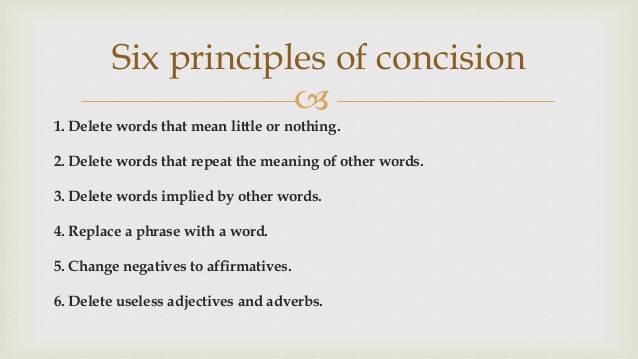
By minimizing the words used in conveying an idea we should enhance the ability of other to attain full understanding.    By eliminating redundancy without omitting important information clarity increases.

This is the practice of concision.  Being concise is not mainly about using fewer words but rather focusing on being meaningful with fewer words. This applies to both spoken and written communications.

The key skill associated with being concise is the ability to identify and then convey the critical meaning without requiring the recipient to expend much effort.

For Example

I enjoyed crafting the above paragraphs, but I admit they are not concise.  It is easier to write without concision but when the message is critical and the impact potential is high, being concise is a wise approach. 

I believe the lead to this post could have conveyed the same message with fewer words, for example:

Concision is a critical communication practice whereby important information, verbally or written, is relayed in as few words as possible. 

Unpack that for me

When explaining something or sharing an idea or concept when someone responds “could you please unpack that for me” or similar words, it is a virtual certainty you were not concise.

The path to concision almost always requires review and reconstruction before delivery.  This applies whether it is to be averbal or written format.  

Think about your key messages and remove all the extraneous stuff (i.e. unpack the message) before you proceed with delivery. 

In a verbal discussion this means being silent until you have atightly formulated message and in the case of written comminication try rewriting it for brevity several times before issuing.

Anticipation

When you expect with a high probability that an event will occur, you are experiencing anticipation.  This can be something pleasant or not so pleasant and the anticipation reflects that prediction.

Positive anticipation is associated with excitement, in fact it seeds it.  Anticipation can be also be worrisome particularly if there is uncertainty about the outcomes.  This can be stressful. 

Anticipate – Manage

Recognizing circumstances which are underpinned by your anticipation of the ultimate results is a worthwhile skill.  Conscious identification of an anticipatory situation enables you to control your behavior. 

Often associated with the unknown is worry.  Consider the case where you have left your car with a repair shop.  You expect the result will be a resolution to your car trouble (a good thing) but worry it might take longer than you anticipated and/ or cost more. 

To a large extent worrying about this has little impact on the end result, it will be what it will be.  The danger is in the effect it has on your behavior.  You may have trouble concentrating or be vague or curt in your interactions with others as you worry about what is going to happen. 

Common Sense

Applying common sense, anticipating bad results probably will not change anything but can negatively affect your reactions/ behaviors.   So concentrate on the positive, anticipate good outcomes, be happy, after all, why not?

Let your anticipation be exciting (a positive emotion).  Or more forcefully put, anticipate the positive, be excited, act accordingly. 

Don’t worry about unexpected results, according to Murphy’s Law they can and will occur.