Individual or Team Player

Teams need high performing individuals to achieve top results.  High performing individuals need strong teams to attain the best results.  Individuals can be successful on their own of course but, intuitively, support of a group of people enhances the opportunity  attain the greatest achievement.

Most organizations seek “team players” when they are adding additional resources.  This buzz word is used to describe a required skill.  What exactly does it mean?

Teams are?

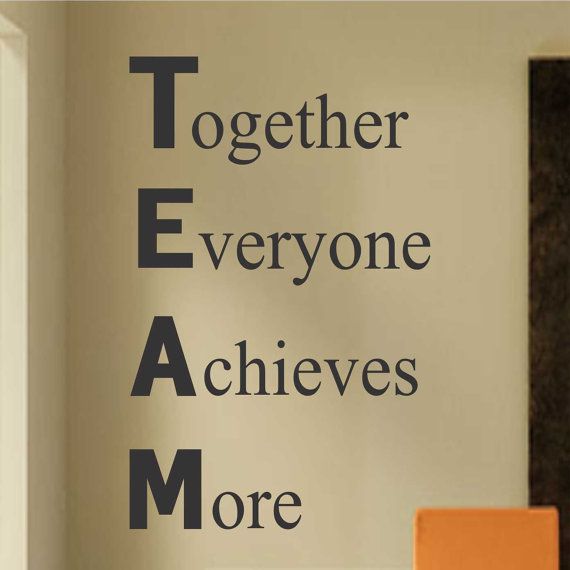
To dissect the skill described by the term  “team player” the first question is what is a team?  Simply put, teams are groups that have come together to achieve a common goal.

Player describes a member of the team whom actively supports the achievement of the goal. This is different from a person participating within the group, but in pursuit of their own goals.

Teams largely composed of members that focus on their own individual goals rarely achieve their full potential.  The individuals might exceed their goals but probably at the expense of the players.

For Example

The 1984 Edmonton Oilers hockey team was voted by NHL fans as the greatest hockey team in the past 100 years.  The team had a large number of highly skilled performers, proven by their lifetime carreers.

They were rated as the greatest team ever because of everyones ability to focus on team versus personal success.  This fact is highlighted over and over by the stories, videos and testimonials about the team.

I believe having a group of team players feels good for the participants and enables superior performance.  Unfortunately, although often given lots of lip service, true groups made up of real team players are rare.

Influence versus Manipulate

We all have power to influence others.  You are exerting influence when you effect a change (the change you desire) on the character, development, or behavior of someone or something, or the effect itself.

Manipulation is simply influencing a change in a clever or unscrupulous way.  Manipulation characterizes the way influence is applied.

Unscrupulous  practices are not about being fair or moral.

Unscrupulous behaviour is targeted at getting what you want without a huge amount of constraint on the behavioural practices beyond the fact they generally do not employ brute force but are rather well planned intelligent and ingenious (i.e., clever).

Effective Manipulation

I often have discussions with others who immediately classify manipulation as inappropriate while influence and impact skills are considered powerful positive tools.

This is not surprising as unscrupulous behaviours have a negative connotation.  On the other hand, manipulation is really just a sub-set of influence.

Additionally it is important to note the determination of  “fair” and “ morale” can be very subjective.  Manipulation can often just define influence behaviour where you have chosen not to let arbritrary constraints hold you back.

Influencers follow the rules, manipulators rule.  Often the rules are framed to be in favour of those you are trying to influence.  Playing within these boundaries will most likely lead to failure.

I acknowledge manipulation is a technique I use, but for me , the key is not to practice it in nefarious ways or with obvious disregard to morales, fairness or others beliefs.

Rather the point is to be clever, not evil, not  disrespectful but really clever.  And it works.

Common Objectives

Collaboration can be one aspect of being a team player.  Typically if you collaborate well with others in general it is not a stretch to imagine you play or work well as a member of a team or group.

I do however distinguish those who collaborate solely or largely for their own purposes as individualists not team players.  Collaboration with intent to fullfill your own goals can look like you are working well in a team but it is really illusory.

Common Goals or Objectives

For the individual (versus a true team player) to collaborate they require the motivation of getting something they want.  If the common goal or objective no longer applies the collaborative behaviour disappears.

A common enemy is a good example of this.  I have worked with groups or teams that bonded by their dislike of someone.  As long as the common goal of attacking the enemy existed the team collaborated.

When the enemy was defeated the collaboration stopped and individulistic behaviour returned.  Cooperation quickly  dissapeared and the team crumbled.

High Performing Teams

A key attribute of high performing teams is the ability to sustain high performance.  The teams  bond is formed by the teaming behaviour by each member of the group.

Like the musketeers of  Alexander Dumas famous novel, every member of high performing teams believe “one for all, all for one” is not a catch phrase but a way to behave.

The behaviour evident in these teams does not discount individuality but it leverages the power of diversity and shared skill.  This is something the individualistic collaborator does not do.

What do people think about you

Your reputation is basically what others think about you.  Over the last couple of posts my key postulate has been about the value of  managing your reputation (in marketing terms, your brand).

The basic framework for personal reputation management is to first understand what you want your reputation to be, then what it is and finally craft a plan to either maintain it or change it.

Maintaining,changing or a combination, is both audience and current state dependent.  The key here is to not submit and hope but to be proactive.

So, what is my reputation?

Asking others this question directly usually does not work.  Most people are conscious of thier own reputation and treat the question more as an opportunity to advance their own agenda.

The best way is anonymous surveys overseen by an independent party that does not know you and has research based experience to craft and interpret insightful questions.

The internet offers a variety of options for this kind of service from free to costly and of course their are many consulting agencies you can pay to do this for you ( of varying quality).

Observation

Independent feedback is not always practical or feasible.  Do not give up, personal observation is a tool that can be just as effective.

This entails activities like:

  • watching  how people behave around you or in context of activities you are involved in.  Peoples body language and they things they do and say in the normal course can be very telling.
  • indirect probing about things that appear to be about something else. ( e.g., How are you enjoying this project?) As a project participant you can leverage the reponses as indicative of your own reputation.
  • gently guide various people you interract with to share what they hear others saying about you, albeit indirectly.

In short observe how people behave relative to things you have involment in and course directly toward you.  Don’t be superficial in your self assessment.  Think deeply.

Reputation Part 2

Yesterdays post explored the concept of personal reputation.  In summary, it is of great value to you to understand your own reputation (as varied by audience).

Leveraging your reputation is an invaluable tool in supporting achievement of your goals.  Managing your behaviour (how you act and what you do) will manage your reputation.

Group Think

Groups of people achieve gang mentality  by sharing their perceptions about others with each other.  The communication methods can include social media, public media, in person, water cooler gossip and a variety of other ways.

The group is not logical and underlying bias can influence the perceptions.  That is for example a group may have a conservative or liberal bias.

The reputation you have within the group is mostly not openly shared with you so you need to figure it out through observation.  This can include conversational ploys to determine what others think of you.

Behaviour and Reputation

Reputational behaviour is not only what you say and do but ranges from the clothes you wear to the cut of your the cut of your hair.  How loud you speak or the effectiveness of your deodorant all inluence reputation.

Since a lot of your reputation can be derived from gossip and peoples bias the trick is to figure out what those bias are (through logic and intuition) and use them to craft the reputation you seek.

Your reputational goal could be respect, isolation (just leave me alone) , a trusted advisor or any of a plethoria of things.  Whatever it is, you can craft your behaviour to formulate the matching perceptions.

Reputation

What others believe (their opinion) of you informs your personal reputation.  Reputation generally applies in a broader sense to what groups or collections of people think of you.

Different groups or random collections of people will often view a persons reputation differently and not surprising most often from their perspective.

Who Cares

Reputation is a powerful tool to leverage in achieving your goals.  Ideally you are keenly aware of your own reputation as it applies within a specific group or collection of people.

Understanding the required reputation to support your goals, coupled with an understanding with what your reputation is, allows you to modify your behaviour in ways to enhance your reputation to what you want it to be.

The viewing lens

Of course a critical aspect of knowing how to change your behaviour is understanding the audience.  If you are playing to an audience of folk music fans, playing electrified rock and roll will affect your reputation.

Bob Dylan did exactly this at the Newport Folk festival in 1965.  Predictably, on the whole the initial impact on  Dylans reputation  was negative.

For Dylan, he was fully aware of the effect this behaviour change would have on this audience, however, his personal goals required him to change his reputation.

History supports his decision.  His fame grew and he cemented his reputation across multiple music genres and fan bases.  Dylans approach was simple, he wanted to change his reputation and so planned and executed an approach to do so.

Of course this might not have worked, had that been the case I am pretty sure he would have tried another approach, until he achieved his goal.

More on this topic tomorrow.

Death walks in front of you

I heard a phrase many years ago, I don’t remember the source or the exact wording so this is not exactly a quote.  Death walks in front of you, so slow down you don’t want to catch up.

I think the more common view is death is stalking us from behind.  The opposite of this, the idea of slowing down so you don’t catch death is intriguing to me.

Contemplation

As with so many of my posts, events of the day often become the topic.  I just found out that one of my closest university friends (and my wifes roommate) died.

She was my age and of course this can bring thoughts of my own mortality.  We were not close in recent years but I did know her well.  This led me to the opening quote.

Death and Taxes

I just completed my annual tax return yesterday so there is an interesting symetry to the two events, death and taxes, being the things often stated as inevitable.

Of course change is probably the most truly inevitable occurance in everyones life and death does fall into that category.  It is a very significant change.

A Life Enjoyed

Not catching up with death is not intended to imply avoidence but rather it is about focus.  Enjoy each moment, don’t rush, there will, at some unknown point, be an ending.

It just is.  You can’t stop it, so little point in chasing it down.  A line from one of my favorite Black Sabbath songs can be perverted to express this sentiment.

Enjoy, don’t waste your life “Killing yourself to live”.


Logic or Emotions

I received some terrific feedbck about yesterdays post.  In summary of my post, I postulated a world based solely on logic would be peaceful.  That is to say, the things that break the peace have an emotional driver.

This idea was explored in the original 1960’s version of the sci-fi TV show Star Trek.  Vulcan characters could not feel, express or act on emotions.

Feedback Recieved

What would live be like without emotion.  Emotions motivate, create pleasure (not logical but nice to feel) and pain or sadness (again not logical but certainly motivating)

Also the question arises whether a fully logic based race would in fact be peaceful.  Could violence not be logically justified under certain conditions?

The answer to whether violence can be a logical outcome of any situation is probably an interesting discussion for debate.  I think strong arguments exist for both sides.

Motivation

The lack of feeling, pleasure or pain, does on the surface seem very detrimental.  Interestingly this topic was explored in a number of the Star Trek episodes.

Having watched these episodes with pleasure, I believe the ideas expressed promoted both lack of emotion as best and on the oppisite side,  the need for emotion as critical.  In short, it was inconclusive.

Of course A fictional drama cannot provide definitive conclusions; however, it can certainly be thought provoking.  As I hope is this blog post.

Personally the discussion I had about yesterdays blog, that is emotionless world might not be the peaceful paridise I postulated, certainly has strong suporting arguments.

That being said I do truly wonder if this emotional world we live in, with it’s mass murders, war, personal attacks, bullies and so on,  is really worth having the pleasure of emotions.

Peace

Peace is a state of contentment and tranquility.  By definition a peaceful condition is free from war and violence.  Seems like a good place to be.  This raises the questions as to why everyone in the world is not in a state of peace.

Sounnds good, where do I sign up?

From a purely logical perspective (think of the fictional Vulcan race from the Star Trek TV series) everyones individual goal should be to attain a peaceful state.

It feels good, enhances your pleasure and enjoyment of life itself.  If everyone was in a peaceful state; war, violence and other conditions which break the peace would be non existent.

Terrorists , mass murderers, warring states, individual conflicts that lead to grief, none of these concepts would exist.  If everyone was at peace things that represent unpeaceful conditions would have no place.

Reality Intrudes

Although the fictional Vulcan race achieved this peaceful Nirvana by the consistent and uninterupted practice of behaving logically, we on Earth seem eons away from achieving it.

But why?  It makes no sense to not be peaceful always to everybody without exception.  It is logical.  And there is the rub, logical behaviour makes up only a very small part of the human psyche.

For this I have no explanation.   If I were in charge of evolution of the human species I would remove the brains capacity for all emotional and illogical thinking, thus eliminating the associated behaviors which do nothing but disturb the peace.

Sadly, I am not in charge.


Using Data

Computers have been collecting data since the 1940’s.  In the last 20 years digital storage technology and processing capacity far exceed utilization.

Corporations, organizations and individuals have probably massed more data about individuals than the individual would be able to review about themselves in a lifetime.

It is probably just physically impossible, there is so much.  There is no metric on this I am aware of but even if not completely true it is intended to be illustrative of the volume of digital data.

We used to have warehouses full of stored documents, whole buildings rented to keep records stored.  This physical storage capacity limited how many and how long records could be kept.

That limitation is no longer an issue.

Mining the Data

Having large amounts of data available is not, in and of itself, necessarily of great value.  Without the ability to collate and analyze the data within reasonable durations, it is not usefull.

This also is a problem computing power has solved.  We can now develop software programs to sort, group, interpret and finally summarize the answers to our questions about the data, in relatively short order.

The computing software and hardware are great tools for enabling us to use the data effectively but human intelligence is still needed to know what questions to ask  (at least for now) and to action the results.

Our decisions, things like whether to buy, spend, create new products, services (and so on) are greatly improved by our incredible  data storage and processing capabilities.