Tag Archives: results

How do you feel?

We all have a natural instinctive state of mind deriving from our circumstances, mood, or relationships with others.  These emotions drive our behavior.
Our feelings are not based on logic but rather they are intuitive and can even be hereditary reactions.   Our emotional response will not always result in optimal behavior based on the situation.

Logic or Emotion

The interesting paradigm presented by emotional behavior was cleverly illustrated in the original Star Trek television show.  One of the crew members belonged to a race (Vulcan) which could not experience emotion.

Amn oft viewed scenario on the show was the Vulcan character (Spock) opining on others behavior as being illogical.  Sometimes the emotional behavior proved best and sometimes disastrous.

Life Without Emotion

Seeing life without emotion, as envisioned by the TV shows creative talent was fascinating to say the least (another perspective oft spoken by Spock when observing others act emotionally).

The show very much put emotional behaviour into perspective and helped me understand the value of checking your feelings before acting.

Behave to Achieve

By checking my emotions before reacting I enabled myself the opportunity of acting in the optimal way to satisfy my desires.  Often the ungaurded reaction, based on how you are feeling at any given time, is not the best approach.

Logical analysis can often help determine the better way.

Surprisingly, determining how you feel e.g., anger, saddness, happy, excited is not difficult.  Holding your actions in check until you are ready to act appropriately is a little more difficult given the energy associated with emotion, but doable and worth it.

 

Anticipation

Predicting what is probable relative to others’ expectations is the first step in being proactive versus reactive.  The anticipation and provision of other people’s needs and desires before they ask is a great way to impress them.

The primary purpose of this kind of pro-active behaviour does not necessarily need to be making others happy (although that is good) but rather can be simply to position yourself for gains by gathering their support.

Help Others/ Help Yourself

Personal enjoyment and self satisfaction can often go hand in hand.  For example I often find giving a gift and seeing others joy is often better than receiving one (and based on my observations I am not alone in this)

The act of gift giving is a win-win situation (everybody is happy.). Similarly providing help or acting before being asked has value both for the anticipator as well as the recipient.

Those whose needs you anticipate benefit directly from the outcome,i.e., they got what they wanted or needed with little effort on their part. You both feel a good and create a positive impression.

Self Directed

Will power is a highly valued personal trait for leaders.  This can actually apply to everyone as we use our initiative to get things done (albeit they should be perceived by the majority as worthwhile accomplishments)

By anticipating others needs and using our own believes and self determination as foundations to help ensure these are achieved, often even before they are clearly elucidated,  we demonstrate our leadership capabilities.

Don’t wait, anticipate.

Compromise

One method of getting everyone involved to arrive at problem resolution is for the stakeholders to reach a settlement of the disputed items by each side making concessions.

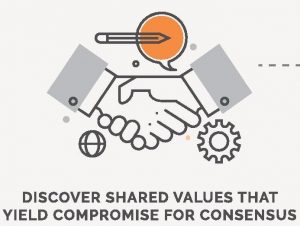
This approach varies from consensus agreement, which is not about anyone giving anything up but rather finding a solution that satisfies everyone, albeit to different extents.

Passive Aggressive

Compromise  is often a hallmark of situations where although resolution appears to have been achieved in reality discontent lurksclose to the surface.

Giving up or giving in can be motivated by a number of things like frustration ,disenchantment, boredom, etc.  None of these are really positive nor leave the giver in a positive mood.

Often the giving in (passive behaviour) leads to a hidden agressive response.  We haven’t actually given up, we just make it seem so to give us time to prepare our resources for attack.

Consensus

Although not true in every case consensus agreement  provides an opportunity for all parties to buy-in to the solution.  That is, there can be real satisfaction to participating in the outcomes if you were involved in their creation (not so much when you feel pushed).

Strangely, although a much more effective approach with outcomes proven to be more sustainable I often see agreements forged through compromise.

I believe this is largely because achieving consensus is much harder than either through compromise or of course the easiest method, pure force (also the least sustainable).

When working with groups to arrive at common goals and strategies,  facilitatIng  consensus over compromise Is always best.


The key to leadership success

The responses to the current covid – 19 pandemic provide an opportunity to observe and rate leadership.  The crises present a chance for leaders of all types (whether political or otherwise) to exercise their power (earned and granted) to good or bad effect.

As observers, we can gauge the effectiveness of the leader’s efforts and use this information to build on our existing personal inventory of effective leadership strategies.

It’s Not What You Do

Not surprisingly for me, the most effective leaders are leveraging the power of the populous.  It is not what the leaders do individually, rather what things they are able to motivate everyone to do collectively.

A key response to stopping the spread of the illness is to keep those who are disease-free away from carriers.   Of course, this is a herculean task when carriers are not easily identified nor is the transmission vector well defined.

This task requires consistent behavior among the entire populous (even the leaders) and the best leaders are the ones able to do this.  Again it’s not what they do but what they are able to get everyone to do.

Faith/ Trust

The second key observation I have made relative to those leaders with the greatest success is they are believed and trusted (i.e., the covid-19 spread is flat versus an exponential curve).

The actions being asked of everyone are both disruptive and full of unknowns.  Will they resolve the problem?  What are the impacts of these actions and how will we ever overcome them.

Leadership is not only about facilitating actions to achieve successful results but engendering faith that those results will be achieved.


Expectation

When interracting with others there is always a a belief that they will or should support achievment of something. The thing could be tangible or intangible, but the expectation exists.

Failed or unsatisfactory interactions, whether individual, team or a large group, often stem from unmet expectations. Others might not be aware of your expectation and hence the unsatifactory performance might be fully unknowingly.

Share Openly

A good start to avoiding cases of unmet expectations is to make sure they are not hidden. Let others know what you expect. Although just because you expect it does not mean it will be accepted.

Your expectations and those of others may differ. A mutual understanding enables the forging of outcomes that are acceptable to all, even if not optimal.

Understand Your Expectations

Often what we believe should occur has an unconcious component and even though it might not be in the forefront of our thoughts we will be dissapointed if it does not happen.

In order to share your expectation with others you must have a conscious understanding and most importantly it needs to be feasible.

Eliminate Disappointment

If you are aware of what you expect to occur, have shared it with others and discussed variations that are acceptable it is unlikely to be dissappointed.

This does not mean the outcomes will always delight you but they won’t surprise you.

Don’t keep your expectations secret, they should not be demands but reasonable desires. Following this practice eliminates unpleasant surprises and the associated negative emotions

Connecting the Results

People, both individually and in teams spend a significant amount of time and effort working to accomplish something.  Hopefully the achievement is both admirable and creditable.

The process of accomplishment usually starts with conception – what is the goal.  This is the ideation phase.  Planning is next, that is how are we going to proceed?

Once the plan is in place execution occurs and voila, the results are heralded as an accomplishment.  In the case of a group accomplishment this often entails back patting and declarations of achievement (i.e., we did it).

Measuring the Results

During ideation and planning work, the reasons for pursuing a particular achievement are paraded as motivators.  In essence the point is “I/we are going to accomplish this thing because it is worth doing”

Sadly, although the tasks arising from the idea are often completed the desired results are not achieved.  In these cases just the fact something was accomplished is paraded as success.

Checking the Achievement

Wondering how actual results mapped to the imagined benefits of a number of accomplishments I once totaled all the monetary benefits from a years worth of initiatives at a large corporation.

The value of increased revenue estimated for all the completed projects was less than the company’s total revenue for the company. Clearly, for some of these initiatives what seemed like a good idea at the time did not turn out to be all it was sold as.

For me, over this just highlights the value of confirming the accomplishment rather than just assuming it.  This is not to punish but rather to guide future directions.

Whatever you are seeking to accomplish, personal or business, check how you did before leaping to the next attempt.  Completion is not necessarily accomplishment.

Prioritizing effort

You might have an idea of your overall goal associated with a specific strategy.  At a very top level, it could be something like; attaining the most recognized brand,  having total customer loyalty (100%) or the most efficient operations (profitable).

Next

The next step is to determine the objectives that support your goals and the associated implementation activities.  You can blue sky the objective gathering and hope for the best or you can be a bit more rigorous in your methodology

Blue Sky

Innovation and creativity are typically present when there is no bad idea.  Just gather up all the thoughts, throw them in the wide opening of the funnel and hope they don’t get stuck on the way down.

Of course this method, while it is highly collaborative, is not efficient.  It can work where efficiency is not a priority, creativity is.  The result might really knock the overall goal out of the park once it oozes out of the neck of the funnel.

In many cases though analysis paralysis and too many cooks collaborating without direction leaves the output wanting.

Planned and Controlled

Filtering the ideas and objectives, through the use of defined filtering criteria, before they get into the funnel, improves the flow through the neck of the funnel.

These might not be highly innovative and creative ideas but they will work and it is a good probability the overall goal can be attained.

Working in Front/Leading from Behind

Wayne Gretsky, the hockey player known as “the great one” coupled two key leadership atrributes.  The concept of working in front and leading from behind.

These practices are available to anyone.  The behavioural concept is not skill based, in and of itself, although ultimately skill will be need to execute at the level of greatness.

Work in Front

Wayne used to say he anticipated where the puck was going to be, got there first and thus was able to work the puck very efficiently.  In the context of leadership this equates to anticipating the need and acting.

Think of the individual who has twelve strategic requests put before him by his boss and every one was anticipated (like the puck) and completed before being asked.

This is a form of leadership by example.

Leading from behind

Sticking with Gretsky, while he was known for his play out front he was equaly admired for inspiring his teammates.  This is leading from behind.

Combining leading by example together with leading from behind is a key catalyst to development of a high performing team.  The Edmonton Oilers are surely a good example of a high performing team.

Doing the work of others , directly leading them may be effictive to some extent but combing an example of high performance coupled with inspiring, motovating and encouraging greatness in others is a very powerful path to exceptional results.

Leaders can inspire greatness but a great team is needed to achieve it.


Measuring Leadership

A multitude of behaviours are needed to be a successful leader.  The balance exercised around which actions to use, how and when is key to achieving success.

Leadership behaviour and being in a leadership role can be distinctly different.  In in leadership roles the expectation is you will exercise the optimal balance, but being in the role does not guarantee that will be the case.

Use leadership behaviours anywhere, anytime.

Behaving in a way that results in others perceiving you as a leader is not context, location or role specific.  The only distinction is the outcomes are achieved because of the way you behaved.

Unfortunately the outcomes leaders inspire and are accountable for initiating  can be good (e.g, Martin Luther Kings achievements) or bad (e.g. Adolph Hitlers achievement) but the leadership behaviour accountable for the achievement (good or bad result) is actually the same behaviour.

Behaviour

Being a successful leader is always associated with strong behavioural skills.  The key behaviours of communication, empathy, self awareness self confidence and self motivation are practices that can be executed at a variety of levels of competence.

Typically, if you think of a leader you know and admire and consider their behaviors together with the level at which they practice these behaviours, it will most likely be very skilled.

The Ultimate Level of Leadership

Leadership is not necessarily aligned with your role and having a leadership role is not indicative of anyones level of leadership skills.  A powerful measure of whether others considered you a great leader during your lifetime is not what you achieved during your life,  but rather how many people attend your funeral.

Judging Results

Is it good or is it bad.  Judging the answer can be based on or influenced by your personal feelings, tastes, or opinions.  That is a subjective view.

Alternatively the decision can be based on facts, putting opinions aside.  This is considered to be an objective perspective. The challenge with this approach is first obtaining facts at all Hsometimes these are not readily available) and secondly to interpret the facts logically and without bias is not always easy.

Measuring Results

Achievements and successes  whether arrived at through your individual or collaberative efforts, or perhaps by others efforts entirely, can be viewed positively or negatively.

The results can range from extremely bad to exceptionally good and everything inbetween.    The ranking method can range from subjective to objective and everything in between.

To assess results in the most objective way defining the specific and measurable expectations before hand is the best approach.

For example, the expectation could be defined as running a distance of one mile in four minutes.  When you start running a timer can be initiated and stopped when you reach a mile (the distance needs to be measured and marked in advance).

The timer provides an accurate result which could equal four minutes or more or less.  Whatever the result, it can be compared to the four minute objective to determine success or failure and even the degree of same.

This works well when objective measures are available, sadly for many things, from taste in food to your day to day behaviour the measure is often subjective.

That is things like, you look good, good work, nice tie.  Without a clear target to measure against ( define looking good, performing well, etc],  disagreement with the assessment of the result can be rampant.