Tag Archives: perspective

How do you feel?

We all have a natural instinctive state of mind deriving from our circumstances, mood, or relationships with others.  These emotions drive our behavior.
Our feelings are not based on logic but rather they are intuitive and can even be hereditary reactions.   Our emotional response will not always result in optimal behavior based on the situation.

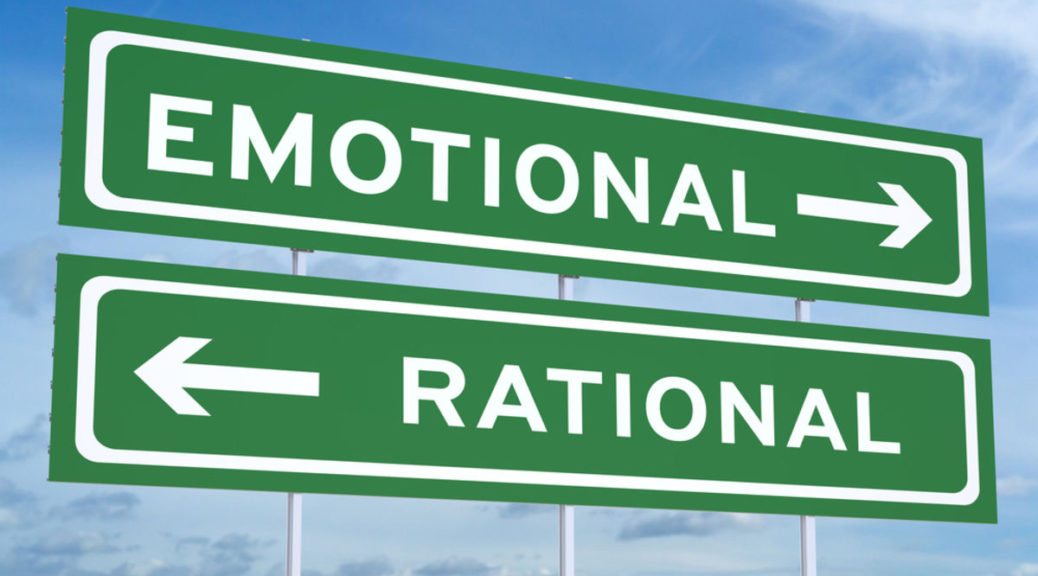
Logic or Emotion

The interesting paradigm presented by emotional behavior was cleverly illustrated in the original Star Trek television show.  One of the crew members belonged to a race (Vulcan) which could not experience emotion.

Amn oft viewed scenario on the show was the Vulcan character (Spock) opining on others behavior as being illogical.  Sometimes the emotional behavior proved best and sometimes disastrous.

Life Without Emotion

Seeing life without emotion, as envisioned by the TV shows creative talent was fascinating to say the least (another perspective oft spoken by Spock when observing others act emotionally).

The show very much put emotional behaviour into perspective and helped me understand the value of checking your feelings before acting.

Behave to Achieve

By checking my emotions before reacting I enabled myself the opportunity of acting in the optimal way to satisfy my desires.  Often the ungaurded reaction, based on how you are feeling at any given time, is not the best approach.

Logical analysis can often help determine the better way.

Surprisingly, determining how you feel e.g., anger, saddness, happy, excited is not difficult.  Holding your actions in check until you are ready to act appropriately is a little more difficult given the energy associated with emotion, but doable and worth it.


 

Attitude

Your personal behavior is largely driven by your attitude.  That is your core perspective, what you think and feel about things.  A positive attitude is can drive success.

By focusing on the positive, understanding and believing what you desire is within your grasp, you are more likely to attain altitude and soar. (Positive attitude will result in altitude).

You don’t need drugs or other artificial stimulants to get high.  The right attitude can take you there all on your own.

Perception Matters

The classic example of attitude is illustrated through the description of the glass that contains water to its mid-point.   Some respond the glass is half-empty (a pessimistic attitude). While others view the glass as half-full (an optimistic attitude).

To stretch the metaphor, our attitude toward the glass will influence our subsequent behavior.  The pessimistic view might lead you to sip the remaining contents slowly and drink them slowly over time.

The optimistic person will likely drink fully and quickly expecting additional supplies to arrive when needed.

With Caution

A positive attitude will most certainly include a dose of optimism.  Sometimes blindly believing in a positive outcome can be helpful but there is a risk optimism that could lead you to be careless and open to consequences.

A balance of appropriate caution well still believing positive results can be achieved is better than wild uncontrollable belief that you cannot fail.

A carefully tempered but largely positive attitude will always outweigh a negative and pessimistic approach but a small amount of doubt can be useful in preventing calamities.

Overcoming Adversity

Captain Edward Murphy is attributed as originator of the famous quote “If anything can go wrong, it will”.  This has become known as Murphy’s law.

It resonates with everyone because it is pragmatic and allows us to shrug off unfortunate events.  This much like it’s sister phrase “it is what it is” (which I believe arose organically).  Both concepts can let us accept the challenge and move on (shit happens is another good example).

Perspective

In the case of Murphy he was an army engineer and at the point in his career when he was quoted he was working on military projects at Edwards Airforce base.

His experience included many unexpected set backs and he became a bit of a pessimist with a purpose, that is acknowledge, accept and move on to success.

Murphy very much believed that in the face of adversity the best approach was not to break down in despair but rather accept that shit happens, fix it and move on.

Prevention

A key concept of project management is recognizing and being prepared for risks.  Murphys law is not about risks you can recognize and prepare to overcome in advance.

Rather it is a recognition that the unexpected can, and will, rear it’s ugly head from time to time.  This phrase is not about preparing for these problems but rather not panicking when they occur.

In my experience adversity can also be resolved to our personal satisfaction in a reasoned and logical way.  Accept that bad stuff can and will occur and deal with it.

What is it?

It’s not what you see that matters, you are impacted more by what you think you see.  One of your brain’s key functions in interpreting the data received via your eyes.

Vision is the ability to perceive things with your eyes (i.e., sight).  What you see is based on perception, not the truth.  However, from a personal perspective what you perceive is the reality of the moment so perhaps it is the truth.

Avoiding Confusion

We co-habit the world with a multitude of other people.  If everything we see is subject to personal interpretation rampant confusion will reign.

From birth we learn from our parents and others how to recognize and provide common labels.  For example we don’t see the colour green and label it as such.  It is learned.

The basic parameters for interpreting things, from labels to the definition of what it is, (e.g., thats an animal) is all part of the learning experience.

Perception/Perspective

Although we learn common names and meanings for the things we see obviously the learned items form just a baseline.  It is not possible for every single thing you in your lifetime to be identified and taught.

This need to figure out and define what we are seeing (i.e., not seen or experienced before) applies to everyone.  Hence there are times when we use our baseline knowledge to decide what we are seeing.

Our perception will have commonalities but each of us could see the same data input and arrive and dramatically different conclusions as to what we see.

When viewing and describing things to others keep in mind there is always room for interpretation and open discussion to clarify can help avoid confusion.


Changing Views

A view can be communicated as a noun describing what can be taken in by the eye from a particular place or perspective.  Typically an object with some fascination or attraction.

Or it can be referring to the action of how you look or see something, usually in a particular light or with a particular attitude.  View is a word which (whether the object or the action) is colored by your own perspective.

Interpretation

What you see is translated through your thought processes into specific meanings.  These interpretations are heavily influenced by your personal bias, both conscious and unconscious.

Your view can change instantly depending on minor changes in circumstance.  For example, you may be viewing a tranquil scene in the woods lakeside.

You perceive the view as calming until a bear is sighted and instantly the calm of the situation is disturbed and the way you see and how you consider the view and its impacts are changed.

Innovation and Creativity

Changing your view, overcoming built-in bias and seeing things differently is at the core of innovation and creativity.  Flexibility in how you view things enables you to see alternatives that might not otherwise be apparent to you.

Changing views is often the key to improvement.  Being able to see things from a variety of perspectives, with a willingness to adopt the best alternative puts you on the path to positive change.

Openness in how you view things focuses on seeing the multiple possibilities which exist for most things.  Do not discard these out of turn.  Take time and settle on the perspective that provide the best results (e.g., enjoy the scenery, avoid the bear)


Managing your Self Image

Not surprisingly how you perceive yourself is a foundational aspect of how others perceive you.  As with most things, it is the extreme aspects of how you see yourself that are most impactful, balanced behaviour is often overlooked. 

The mental picture you have of yourself is intricately in-twined with your values and personality.  It’s also impacted by the way you believe others view you. 

Self Worth

Your interpretation of the intent of other peoples actions can drive your behavioural responses to them.   You believe their actions represent what they think of you, coupled with how you wish to be viewed (your self image) if their is a gap, a strong emotional response can occur.

To a large extent the your mental image of what you are and how you should be perceived is unconscious and the associated emotion laden response might not be well thought out. 

In fact, without consciously realizing you may believe the others are making an attack on your self worth.  They think less of you than they should.  The reality could be quite different and their behaviour was just innocuous (to you it was ferocious). 

Think about it!

Pride, in the negative sense, can lead to an irrationally corrupt sense of your personal value.   In this case, your pride can be the driver of inappropriate behavior and in a vicious cycle of truth, this leads the others to develop a negative perspective of you, when in fact none existed before, you only thought it did.   

Judging Behaviour

All our interactions with other people entail some interpretation of their behaviour.  In real time we decide what their actions mean and how we feel about it.

Overtime we categorize people we regularly interract with by type.  While a persons behaviour may vary by context out perception of their personality (go to behaviours) colors all our interractions with them.

Viewed by Extremes

In reality most  people balance their behaviors across a spectrum from one extreme to the other.  For example, moderating from flexible to stubborn so overall taking the middle ground..

Our classifications typically focus on one end of the spectrum or the other.   That is,  a person mght naturally fluctuate from one extreme to the other (e.g., flexible to stubborn).

We tend to classify them based on one end of the spectrum or the other.  Our perception is usually set as a result of a few limited interactions.

Misconceptions

Unfortunately our subjective behavioural classification boxes those we deal with by type (e.g., agressive, unreasonable, meek, childish, etc).

Whilemost people practice a number of behavioural variations across a spectrum of options we often leap to conclusions based on our pre-conceptions of the behavioural extreme.

Unfortunately this can negatively affect the effectiveness of our interpersonal communications.

Judging and categorizing others can be helpful to us in streamlining the communication process, but it can also create a risk of misunderstandings.

When we do not listen fully or think through what we hear and see there is a real danger of poor and ineffective outcomes. 

Enjoyment

Taking pleasure in things leads to enjoyment.  On of my own personal goals is to be in a constant state of enjoyment.  From a practical perspective pleasure can be subjective to a degree (although for the majority there is general consistency about what leads to enjoyment).

This does not mean opportunities for enjoyment are constantly available to everyone, it just might vary.

The Bottom Line

The practice of enjoyment, taking pleasure in things, is a choice.  Simply put, you can control whether you are in a state of enjoyment. It is afterall about perspective and if you perceive life occurrences in a particular way, arguably every thing could have a pleasurable aspect.

Life is a series of pleasurable events, if you want it to be.  Why not?  The fact that stress and distress can worm its way  into our daily routines is always puzzling to me.

Maximizing Pleasure

That is not to say every life event provides the same level of pleasure and working towards a goal of maximizing your personal pleasure (not at the expense of others, of course) is both an admirable and obtainable goal.

To some extent it requires conscious control of your emotional well being.  The positive or pleasurable aspects of a thing sometimes require some effort to achieve, but I would argue, regardless of what you are up against, some form of enjoyment opportunity exists.

You just need to both recognize and embrace it.

Optimism

Optimism describes an attitude.  When you feel hopefulness and confidence about the future, your perspective is said to be optimistic.  Is this a sustainable perspective?

Personal attitude is yours to control.  Optimism can be a fabulous way to approach each day, why not.  By it very nature optimism is positive and associated with good feelings.

Approaching each day feeling good is not a bad thing.  Consistent and persisent optimism is positive so why not adopt this a a permanent attitude.?

Trouble on the horizon

When hiking you run into a bear.  Your optimistic attitude leads you not to react, after all everything will work out.  Although an exaggerated example, there probably are cases where optimisum should be temporarily suspended.

Proactively worrying or predicting negative attitudes (pessimism) is probably not a good replacement for an optimistic attitude but realistically recognizing  the potential for bad results is probably not a bad thing.

Attitude Drives Outcomes

Whatever your underlying perspective, for example positive, negative, worried or optimistic; the way you behave is directly impacted.

If you are feeling good your eaction is typically more positive than if you are worried or fearful.  This is a good argument to strive for an optimistic viewpoint as your go to attitude.

Believe and Succeed

Athletes and sale people are well familiar that visualizing and believing in sucess to come can be a significant driver of results.  So don’t just be hopeful but believe it will be good.

You can get what you wish for.

Line or Staff

Professionals with a proven skills, training and a strong track record are often hired to provide expert advice.  These consultants can assist organizations in valuable ways, but there are some caveats.

Roles Based Management

Armies typically classify their officers as either line or staff.  At a very high level the two types exist to distinguish between those that manage the battles (line) and those that provide support and strategy (staff).

In the military model, line mangers are at the front line of the organizational goals.  They execute the strategy.  Their performance can be directly aligned with the organizations outcomes.

Staff managers have specific expertise and focus on doing what is needed to enable line managers to succeed .  In this context, quality of advice and support provided is the performance measure.

Usually staff managers success is not linked to that of line managers directly.  Typically the highest levels of organizational power lie with line managers.  Staff managers input is important but the decision and action falls to the line.

Back to consultants

The  work of consultants is very much, using the armys model, staff work.  It is important and necessary work but there is no accountability for results.

If the advice works, the consultants reputation is enhanced, if not they probably don’t stay in the business long.  Although over the years I have frequently seen consultants dodge the qaulity bullet.

Staff Managers in Line Management roles

One of the most frustrating experiences is when a line manager operates with a consultanting or staff managers mind set.   Although they are in a role that is intended to oversee the deliverly of strategic results, their consulting mindset is focused on advice not execution.

Typically, this leads to high turnover in that area of the organization.