Tag Archives: leadership

Which comes first

I often run into people seeking answers.  My counsel to them is unlike the popular game show, Jeopardy, it does not make sense to start with the answer.

The answers we seek cannot be uncovered without a clear understanding of the question.  That is where to begin.  Spending time and effort seeking to find answers is a much more efficient process if it is focused.

Clarity of Purpose

Taking the time to fully understand the question is an effort well worth undertaking.  It helps us avoid responses that are not really relevant to what we seek, but appear to be.

Sometimes digging into what the question really is can provide answers.  For example, consider the simple question “Why is the sky blue”.

Are we really trying to determine the reason for the sky’s color or is it what the sky is composed of (which results in blue color) the answer we seek.

Or do we want to understand why the region starting from land and reaching outer space exists, that is what is the purpose of the sky and why does it exist and do we need it, can we use it for something?

Solid Foundation

Research into a topic is best conducted when the object of the research is well defined.  This process of determining what we are actually trying to answer, that is creating the question is not only a critical beginning but also time-consuming.

The value equation, spending time up front to think through and clarify the question more often than not results in clear and high-quality answers.

Without understanding the question we really cannot arrive at an answer.



Planning for the Unknown

It is hard to deal with things you do not know enough about or perhaps they are unfamiliar.  Risk management is a good example of developing plans to address or avoid the unknown, basically preparing actions just in case.

In general, planning for the unknown can have many applications in our daily lives and is not limited to mitigating potential or anticipated risk.  Sometimes our personal objectives relate to an unclear future.

Being that as it may be, we need to forge ahead as best we can.  Plans based on the unknown or as much as we do know with assumptions and guesses about the rest are needed if we are to be effective as we move on.

Objective Focused

Planning for the future, which is full of potential surprises starts best with a clear idea of what you want to achieve, that is the direction in which you are headed.

Building from these objectives, and using sound judgment founded on the consideration of optimistic, most likely, and pessimistic futures, you can craft an approach to reach your goals.

As time goes on things both become clearer and also change relative to your initial estimations of the possible.  To address these factors requires flexibility and the original plan you form will not work well if you intended it to be carved in stone.

Focus on the probable and the possible

When creating your plan of actions to achieve your goals and objectives, even if many relatively unknown factors exist, remember to always apply the litmus test, “could this happen and is it likely to do so?” (i.e., both probable and possible).

Don’t Let Fear Overwhelm You

Our actions can be motivated by many factors both internal and external.  Our environment and other people can exert a strong influence
Fear driven behavior might not be the most appropriate, in these cases, it is best to take time to think through your options although this is often easier said than done given the presence of a sense of urgency.

Think

Some of our reactions to danger are an innate action and can be hard to control, in some cases controlling these is not the best option.

However, in many circumstances, taking the time to contemplate our fears will produce much better outcomes.  We cannot always control our external influences but how we respond is within our ability to manage, just not always easily done.

Allowing our fear or anxiety to take control of us and dictate our behavior might achieve acceptable results but in those cases, it is purely by accident.  Retaining control of your destiny at all times is a much smarter approach.

Choose

While sometimes external factors are out of your control, you can always choose how to react.  Overriding instinctive action is difficult and occasionally not appropriate but generally more satisfying.

Without a doubt, our choices are influenced by circumstances.  Picking the best alternative for any given situation, sometimes at the moment, is often overlooked due to expediency or just because the effort appears too great.

In reality, taking time to get it right is always a high-value proposition and worth the effort.  Avoid being stampeded by your fear, you won’t regret it.


Get Over It

Interacting with other people can lead to feelings of being upset or annoyed.  This can often stem from our own inability to change or influence change to achieve something.

When we need to get things done through others because we are either not capable or don’t have the access we need to do it ourselves, frustration will rear its ugly head.

Taming Frustration

Anxiety, stress, and anger are probably the most prominent emotions associated with frustration.  We find ourselves prevented from making progress and achieving success simply because others are not doing what we want.

This is one of the perks of having power, it is generally easier to influence others to do what you desire.  Even though they may not be in accord with your direction, through physical or organizational power you can drive to your goal, usually without frustration.

Having power is not always an option and being able to finesse what you need is a skill that can save you a lot of frustrating moments.   Getting things done through others is most effective when they want to do it, not because they must.

Core Tenants of Influencing

Understanding others’ wants and desires is the first step toward your goal.  What motivates them?  What are the kinds of things that will drive them to want to behave in a way that will satisfy your desires?

Listening carefully, observing, perhaps conducting some historical research will help you answer these questions.   Your approach to influencing is best founded on what others want, need, and believe.

It is that simple.

Customer Service

From time to time organizations are called on to provide assistance and advice to those people who buy or use its products or services. This can include people who work for the organization as long as they also purchase goods or services from the organization.

The prime motivation of this action of helping or doing work for someone is most likely primarily the monetary compensation received from the organization.   The customer must be dealt with because that is the specified task they are paid to do.

Company or Client

The biggest challenge in customer service is balancing the needs of the organization against those of the customer.  Loyalty to the company is imperative but effective customer service requires more than simply empathy.  The customer must be satisfied.

The most successful organization have empowered their front-line employees allowing them to act logically (within reasonable constraints) rather than simply preaching the corporate gospel, particularly when it does not make sense to them.

Using Common Sense

I recently encountered an example of a lack of common sense in a customer exchange with BMO (my former employer for 33 years).  The customer service representative I was dealing with blindly insisted on something that made no sense.

I insisted on speaking to her manager.  She reviewed the case with her boss and told me the manager would review and call me in 15 minutes.  They did not.

Ultimately the situation was resolved to my satisfaction, what I was proposing was accepted as totally reasonable, but the hoops I needed to go through left a pretty bad taste in my mouth.

Find the Balance

Disaffecting customers through blind stupidity is caused by a lack of empowerment.  The risk of not acquiring or retaining a customer needs to be balanced against the blind adherence to policy (or what the service provider thinks is policy).

Organizations with top-flight customer service understand this and enable their employees to do what is right without jumping through a series of silly hoops.


Balancing Duty with Responsibility

Occasionally we run into situations the person who commands our group, organization, or country (i.e., a leader) makes decisions we do not agree with.

For some of us, these proclamations or approaches to action can be patently incorrect but we need to deal with them.  This raises a question of accountability, do we diligently work to make changes or just buckle under and support the leader?

What is Right?

Our personal decision as to what is right may be valid, however,  based on the relationship and agreed societal or social norms we have some obligations to support our leaders regardless.

It is critical though that this should not equate to the practice of god-like idolization, however, hierarchical groups require boundaries to operate and acceptance of the need for leadership roles is part of this.

There is an important balance between mindless adherence to others’ directions when they are simply role-based.  The exercise of appropriate change influence to promote the best alternative (if not the right one) is needed.

The Leader Says

An early lesson my father taught me many years ago that still sticks in my mind related specifically to follow the leader syndrome.  He asked, “If your leaders jump off a bridge will you follow them”?

Unfortunately, most things are not that simple or straightforward or easy to decipher but the message is clear and has been very relevant to me throughout my life.

There may be times when our leaders should be questioned.  This needs to be in a reasoned and carefully thought out way but you could regret blindly following the leader so giving it some thought is well worth it.

Picking a Leader

Democracies enable control over the organization or group to be driven by the majority of it’s members.  In most cases this occurs by creation of a governing body with representatives selected by a majority vote.

One of the key risks with this system lies with the ability of unqualified leaders to be selected.  The process for the members to select a candidate is often as much a popularity contest as it is a selection of the most capable and skilled representative.

Worshipped or Valued

The current president of the United States is a good example of inadequate leader selection.  Worshipped by many as a reality TV star and  his ability to speak the language of the uneducated Donald Trump has been instrumental in creating a very sick country.

While not to blame for a global pandemic the inadequate response and disastrous results currentl being experienced by Americans can be laid squarely on his doorstep.   For example, the pandemic will not be eliminated if we stop testing as he has publicly suggested.

Bad Example

Instead of promoting public safety through his own behaviour President Trump is in fact doing the opposite, behaving as if the covid 19 outbreak is not serious and acting as if our reactions our overblown.

As the number of cases and the death count mounts he continues to display a strong disregard of the need to stay safe by wearing a mask and limiting in person social contact.

In the face of his constituents mortality Trump encourages dangerous behaviours that only fan the flames of the epidemic and in the long run will crush their economy.

And yet, he is still a contender in the upcoming presidential election. In spite of his massive failures his worshippers continue their support. Wow.


Behaviour Governance

You have the authority over your personal deportment, that is your behaviour or manners.  Self governance does not mean you can act any way you wish.

It simply means you chose (under your personal authority) which boundaries apply to you.  This decision must be undertaken with consideration paid to the influence of social and cultural norms ( both legally defined, and common sense ).

Impact and Influence

Your personal choices which guide your daily deportment define how others perceive you.  Taking control of these choices and being sure to practice good governance is a simple way  ensure others view you in a positive context.

Acting in the moment or solely according to your personality (i.e., your go to behaviours) without applying some level of constraint can result in others discounting your value to some extent.

Conforming to both your needs and others

Individuals perceived by others to provide  high levels of value typically are under control.  That is their behaviours satisfies everyone (including themselves).

They  have developed an inner code of personal behavioural governance which allows them to tailor their action most appropriately both to the situation and to other peoples needs.

Not a Bad Word

Often I run into people that describe governance as a necessary evil.  Something to avoid if possible.  While this is usually focused on corporate governance it does apply to the concept of governance holistically.

I respectfully disagree, the practice of good governance will almost always, if practiced judiciously, lead to positive outcomes.  Personal governance underpins personal greatness.


What by When?

Clarity of purpose, understood by everyone involved or impacted by your plans and objectives, is core to their achievement.  It has been asked many times but if you don’t know where you are going do you ever arrive?

Leadership first and foremost is about ensuring that clarity exists – universally.  The clearly and broader the message is spread the greater the likelihood of arriving at the destination but at least you will know if you are not there yet.

What by When

For everything we set out to do there is always the question “What are we doing?” and co-existing with the objective is timing “When will we finish?”  These two simple pieces of information completely define any and all tasks we undertake.

This is not to say plans are absolute and inflexible.  Both the what and when parameters can change as you meander along your journey.   Starting without knowing what you are attempting to achieve leads to chaos, changing it as you learn more does not.

Motivation

Everything we do , how we behave, our desires, all have some underlying motivation.  Nothing happens without motivation.  Both what you are seeking to achieve and the time frame underpin motivation and drive urgency.

Having a solid understanding of the strategy and direction can be very high level or intricately detailed but without some definition of purpose  why would we do anything.

Of course even doing nothing requires motivation.  That is to say nothing can be defined and so is something.  The level of motivation to do nothing (possibly the default activity) does not need to be strong but still must be present.


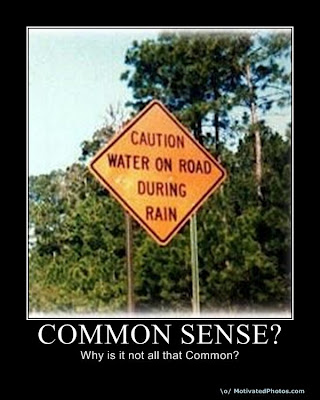
Common Sense

Yesterdays post about empowerment contained the suggestion to practice common sense.  I received some excellent feedback questioning the validity of my recommendation.

After all common sense can be a very subjective term with a multitude of interpretations.   As a decision support tool, does it really have value or is it just an easy motherhood type recommendation.

In Principle

My intent was to consider the practice of common sense more as a principle and strategy than a definitive action.   Common sense is the ability to perceive, understand, and judge things in a way that is shared by nearly all people. (i.e., in common)

An individual feeling that something is the case is of course subjective to an extent.  Good sense is the ability to under those feelings that are shared by the majority.

This is not an absolute method to making the best choices but it is a validation technique with proven value.  Reacting the way most others would is often best (but not always)

Not Absolute

The practice of common sense needs to be considered as a guide not the definitive way to decide how to proceed.  The approach is just one of many ways you can help validate the veracity of your conclusions.

While this is not a litmus test which will always lead to the best results casting aside common sense can lead to disastrous results.

For example, each year the Darwin awards go to people who have lost their lives through silly actions.   Clearly they were not practicing common sense and if they had, they may still be alive today.