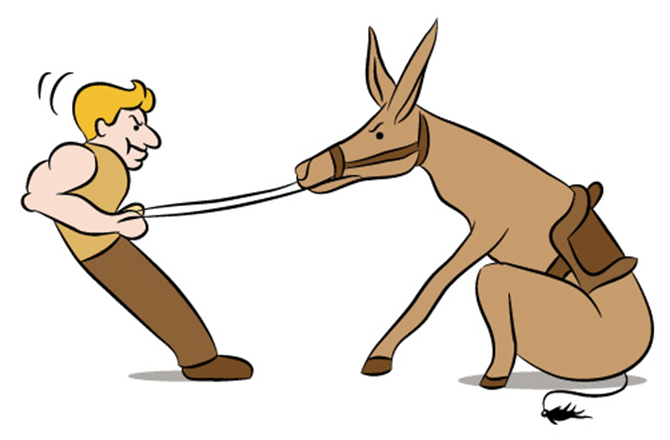
Tag Archives: stubborn behaviour

Pride in Leadership

To become an effective leader, in-most cases, significant effort is needed.  Achieving leadership roles is natural to lead to a  feeling of deep pleasure or satisfaction derived from one’s own achievements.

Basically this applies to the achievements of those with whom one is closely associated, or from qualities or possessions that are widely admired.  The leader recognizes this and is proud.

Pride and Self Confidence

Leadership is created through the practiced balance of many skills and competencies.  Being able to trust in one’s abilities, qualities, and judgment is one of these.

Unfortunately an unequal balance between pride and self confidence can lead to having or showing dogged determination not to change one’s attitude or position on something, especially in spite of any arguments or reasons to do so.

Avoiding Stubbornness

The caveat to being self confident  is the potential to evolve to a framework of insurmountable belief.  That is the leader develops an irrevocable understanding that their personal judgement should not be challenged.

They are proud of their demonstrated capabilities and proven success and contend that it should not be questioned.  Can they be wrong?  By dint of their granted power and responsibilities  a belief in personal ominicience develops.

This is a danger to be carefully guarded against, often evidenced by others perceiving stubborn behaviour and reacting stubborn in turn.   Self aware leaders identify and react to this scenario quite quickly.

Win Win

Diversity of perception and associated opinions represents an opportunity for moving forward with powerful positive solutions rather than being stuck in the cult of authoritative leadership albeit a balance of some authority is needed to avoid anarchy.

The next time you are presented with a situation of apparently intractable positions take time to consider,  is there an opportunity for you to change the context and lead to something beyond the butting of heads.

Choosing to be percieved as Stubborn

Stubborn describes a behaviour that is considered inappropriate by most people.  More to the point, when we characterize someones behaviour as stubborn it’s not a compliment.

When a person is percieved to display dogged determination not to change their attitude or position on something, especially in spite of good arguments or reasons to do so, we lable them stubborn.

Subjectivity

Like so many things related to behaviour classification, stubborness has a significant subjective quality.  The assessment is largely based on the assessors perception and opinion.

The most subjective part of the assessment relates to the motivation of the resistance to change.  That is, deciding the stubborn person is resisting change, though there is no good reason for them to do so.

The subjective  part hinges around an opinion relative to the quality of the arguments for changing anothers attitude.  Typically the “stubborn” person does not see it that way.

Ergo, someone who behaves stubbornly from your perspective might not agree with you.  This can lead to entrenched positions by all parties, a situation not conducive to resolution.

Seeking Positive Outcomes

Not surprisingly when one person percieves stubborn behaviour in another the natural response is to develop their own stubborn behaviour.  Ultimately, to an outside observer, the discussion begins to resemble two brick walls with strong foundations, spouting barbs.

Help is at hand.  This is where your self awareness is a key tool.  Recognize the rising stubborness in yourself and in the moment use self talk to remind yourself escalating stubborness on the part of all parties never leads to resolution.

Relax, agree with the party you view as stubborn.  This technique invariably creates a small opening where your opponent become slightly receptive.  After all they now believe you get it.

Slowly  using continued reinforcement of agreement you ply your points and with time and patience a place of mutual agreement can be achieved.  The key here is iteratively building receptivity to discussion (softly) and using this to slowly achieve common ground.