Living for the future

Being focused and engaged in the here and now, that is being consistently present and mindful of each living moment is a desirable quality often recommended as a technique for mental health.  Don’t focus on the past or future, live in the moment.

While this sentiment does have merit and I would not ignore it, for me the bigger picture consists of the time periods surrounding the present, i.e., the past and the future, neither of which is easily dismissed.

Taking Control

The past cannot be changed, it out of your control.    Valuable lessons can be taken from the past to influence present and future actions but it cannot be changed.

The present, living in the moment, offers limited opportunities for control, that is to say most often occurrences are like a whirling vortex swirling around us for which we have limited control.

Our destiny lies in the future and fortunately that is pretty much a time period we can largely control or at a minimum plan for achieving maximum personal pleasure while limiting risk of unpleasantness.

Owning the Future

Each of us has full accountability and ownership of our futures.  We can treat the future as a surprise or plan for it, or some combination of these approaches.

Whatever method we adopt for living in the future it is a personal choice and our greatest successes are consistently achieved when treating our approach to the future as belonging to us and pro-actively and consciously embracing it.

The past is done, the present is here in your face, to control your life you must own the future.


Don’t Get Swept Away

Sometimes when it feels like you are swimming against the waters flow and will be swept downstream at any moment, don’t forget you are in control and making it to the other side is your choice.

It is often easier to just go along with others.  In many cases, this is the best approach, least stressful, and it can be fully satisfying.   However, that is not always true.

Most importantly following the crowd or going with the flow should be a conscious choice.  Do it because you want to not because others want you to.

Sheep Mentality

Sheep are often used to describe the follower mentality.  This animal species is well known for traveling in a pack.  The rare sheep that does not stay with the herd is labeled the black sheep (to highlight that they are different and perhaps not in a positive way).

Being part of a group can be the best approach for you but it should not be the default selection.  The group should not decide for you unless you want them to.

Social Animals

Humans are correctly classified as social animals and numerous psychology studies have demonstrated our need for positive interaction with others to maintain our mental health.

This does not mean you cannot swim upstream against the flow if that is the best thing for you.  However, it does require initiative and determination both of which are usually considered to be positive traits, within circumstantial constraints.

Unfortunately open but respectful independence should be a right but depending on your geographic location this is not always the case.

Notwithstanding the challenges, if you choose to take a different path because it is right for you, I applaud you.

Understand me, please

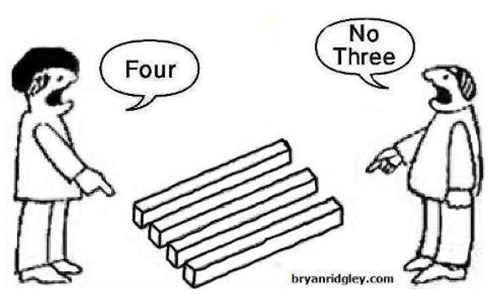
The act of imparting or exchanging information, providing direction, or passing on the news is more of an art than it is a science.  Clarity is founded on an individual perspective and to some extent, it is unique to each of us.

Strangely, because of the subjective quality implicit in any message the being coherent and intelligible with what we perceive to be full transparency can still result in misunderstanding.

Assumptions

In almost every communication both the sender and the receiver include things they accept as true or certain without the need for elucidation (i.e., assumptions)

Without assumptions being explicitly identified and defined it is easy for parties to believe the information being exchanged has a unique and clear meaning.  Sigh, sadly this is often not the case.  Depending on the assumptions the message could be very different.

Avoiding Miscommunication

One way communication is most likely to be misinterpreted.  Without the opportunity to test the message (i.e., two-way exchange), combined with a message that appears complete and clear it is easy for the recipient to assume they understood.

This situation applies to the information provider as well.  Without receiving feedback they can only assume the everyone understood the point and all is well.

In these situations, surprises occur frequently and the result is often by choruses of “that is not what I meant” and “well that is what you said”.    The intent of the message is not achieved.

Keeping the content simple is obviously one way to achieve clarity but most important is testing/validating the communication on multiple sources, getting feedback, and modifying accordingly.

This of course is really critical when providing directions or instructions on how to do something.  Misunderstandings can lead to costly mistakes.


Life Events – Changes

In March 2020 the world population was subject to a life-changing event in the form of a global pandemic.  The current advanced state of communications technology-enabled rapid response in virtually every corner of the globe.

 What began as an adventure to avoid illness has become a way of life, albeit with limited success relative to avoiding illness.  Although the first peak of infection was addressed as more people sought to return to more normal day to day routine, the peak returned.

What Next?

The drastic steps to lock down our interaction with others did work but at a significant cost to both our economies and quality of life. The gradual return to commercial activity worldwide has been accompanied by a commensurate rise in the number of viral cases.

Another severe lock-down on travel, restaurants, and retail shopping will likely be another shock for a stuttering economy.   On the good news, front looms the upcoming U.S. election with hoped for the ejection of the current abysmal leadership.

A Way of Life

The search for a vaccine and even better a cure is ongoing and could (optimistically speaking) start to change the way we interact with each other as early as the spring of 2021.

Even then though, I believe it is likely many of the freedoms and little pleasures we once took for granted will continue to be curtailed for some time, perhaps another six months.

Social gatherings, travel, and the workplace are going to be impacted by sometimes as returning to less stringent public health practices and normal transaction volumes is probably not going to occur overnight.

Answers begin with the Question, or do they?

When we don’t have all the information we need or are not sure of it’s validity we will elicit additional information from other sources, that is human, virtual, experimentation and so on.

Hopefully this process of investigation will yield the answers we seek in response.  Sometimes the answers are not the information we seek.  This can be because the question is wrong, and there is the rub,

Question or Answer/ Chicken or Egg

Without some information we can not be sure what the question is and without the question information is lacking.  The question answer dance is founded on what we know when we begin.

Neither the initial question or subsequent answers is the starting point, rather, what we know about what we don’t know is the best place to begin.

Assuming questions are intended to gather things we don’t know or validate information we are uncertain of the beginning is not to seek answers or formulate questions but rather understand what it is you don’t know.

Understanding Requirements

The process of seeking information using questions as the prime technique begins with understanding what you seek.  Valid quality questions begin with requirement, that is defining what you seek.

Formulating the question is often best managed as a multi-step process building on the information uncovered during the journey for answers.  Critical to the success of this journey is the starting point, the first question.

Seeking Information/creating Knowledge

Asking questions and analyzing the answers will provide you with the information you need to create knowledge.  The value of knowledge to you depends on your requirements.

Asking questions is only of value when you have a solid understanding of why you are asking them.  What is the information you are lacking and why is it of value should always be the starting point of your interrogations.


Celebration time

For each of us, throughout our lives, there can be moments when we decide to take action and display our pleasure by engaging in enjoyable, typically social, activity.

For me, today I am celebrating a couple of weeks of technical activity cleaning up my home network, improving security, cleansing data and implementing a number of new features.

Updated Kerrzone Website

I mark the celebration of this milestone with a launch of an updated website for Kerrzone.com.  You will notice I have greatly simplified the interface and changed the content focus.

The work on my home technology continues with more enhancements planned for the future including adding SSL certificates for the websites, however,  modernizing kerrzone.com has been a goal of mine for awhile, so time to celebrate.

Hacking versus Managed Development

As I have engaged on my journey of technological improvement of my fairly extensive home technology I have really noticed the difference between development approaches.

In the workplace my experience had always included a high level of structured methodology while I would characterize my home development as more like hacking.

Methodology based technology starts with documented practices intended to be followed like recipes with check and balances to ensure that is the case.

Conversely my hacking journey begins with figuring it out (based on an underlying technical aptitude). In this case reference to documentation is only a last resort and even then a bit haphazard.

This of course is the higher risk approach but somehow I do seem to manage to figure it out in the end although some frustration might ensue while doing so.

Anyway, I reached one of my goals, so today I celebrate.

Recovery is Possible with Patience

Back in April, one of my QNAP network access storage (NAS) devices was subject to a ransomeware attack.  The cause was identified as a vulnerability in the built in media streaming application.

The company (QNAP) acknowledged the issue and very quickly fixed the flaw and issued a firmware update including enhanced malware detection and removal.

Nice try

They also disabled the old media ware software on all devices using their cloud (myqnapcloud.) in an attempt to deter the virus from infecting machines it had not got to yet.

For me the good news /bad news was one of my devices was not protected in time but the other largely was with only one file impacted (which I had a copy of elsewhere).

For the other device however basically all the user files were encrypted.  I did not purchase the encryption key (about $500 in bit coin) but rather decided to wait and see if a recovery approach would be devised by someone.

QNAP comes through

I recently contacted QNAP support because I found on the web they had developed a recovery process which they would run for you remotely if desired.

Unfortunately after several tries we could not get a stable remote access to my device so I just decided to follow the instructions and attempt recovery myself.

I was able to recover about 70% of the files and many others I had copies of on other drives.  Bottom line I was able to recover the majority of my lost data as well as taking the opportunity to clean-up  my data storage overall.

Moral to the story, the evil hackers can be defeated although I understand it is estimated they made almost half a million of the attack from those that did pay.