Visualization

Visualization is a communication technique.  It is a very effective way to communicate both abstract and concrete ideas and has been employed since the dawn of humanity.

The key to effective visualization is the ability to create mental imagery.  Basically the message is converted by enabling the recipient to view the concept without physically seeing it. 

Maps

Maps have long been used by people to present geographic information that allows the visualization of locations, for example terrain, boundaries, landmarks.

Maps are a great visualization tool  that can be used to determine things like plan of attack (historically this was an important use), travel plans, ownership and so on.   

The key here is not the physical map (just a tool) but the ability of the viewer to create a mental image of the unknown based on the map.  This increases the likelihood decisions based on the information will be good ones.  

The Minds Eye

While tools, that is images or templates are valuable in the process of visualization the technique relies on a persons ability to “see with their minds eye”

A physical presence is not needed to actually view the object of visualization.  You may be in an empty room and see it in your mind as furnished.  Based on the mental imagery you can build a design plan that will be appealing to you without a lot of trial and error.

Not Always Easy

The technique can be very powerful but is not always easily executed.  You need to train your mind to see things without using your eyes.  This is a great skill and well worth cultivating but you will probably need to practice to create proficiency.

The first step is accepting the value of visualization and the second is focusing your mind on the concept you want to visualize.  That will get you started. 

Polarizing Personality

The ability to unite or divide people just through the power of your personality, that is to become larger than life, are key attributes of those with a polarizing personality.

These individuals tend to attract followers who form a cult of personality around them.   Detractors, also form strong emotional opinions.  For those with a polarizing personality, there is typically no middle ground.  

Love ’em or Hate ’em

Polarization is about migration to one pole, negative or the other positive.  There is no middle. 

For some leaders or a well known public figures, using the sheer power of personality to capture a large group of supporters in agreement with their clear and usually absorbing views, is imperative.

The combination of characteristics or qualities forming their distinctive character drive support.  Forceful communication and clarity of purpose are hallmarks of their methodology. 

Good leaders or Bad

Polarizing personalities can be used to support a leaders agenda.  Some will view the agenda as good and some will be diametrically opposed.  Typically though there is little middle ground (i.e., it’s okay or I can live with that usually do not apply).

Leaders who leverage their personality to enable the exercise of power can be very effective but typically this approach is dictatorial and one-sided.  This means it is only sustainable while the leader continues to polarize a majority of the followers. 

Dissatisfaction with the pole (positive or negative) to which the populous is being driven ultimately ends the influence and the polarizing leader succumbs to defeat. 

Accountability

Often when a team is working on a common objective we assign roles to help clarify the expectations of each participant.  Two of these role designations are accountability and responsibility. 

I have found many friends, colleagues and acquaintances have different perspectives relative to the roles defined by these terms.  As well, there can be a different interpretation of the term between team members. 

Responsible or Accountable 

To be responsible means to be answerable for something within one’s power or control. Notice the two aspects of this definition – the ability to control plus being able to answer for something.

To be accountable means to be subject to giving an account or having the obligation to report, explain or justify something.  Ultimately this accountable role is “where the buck stops”.

That is, questions, decisions, collaboration can occur among the team, and should, but ultimately the person accountable needs to buy in as they will be the one in the hot seat. 

Or Both

It may be semantics but the tricky part is the interrelation between accountable and responsible.   Accountability probably means delegation of responsibility to someone else for the actual work, while retaining answerability.

So while the execution of the work is not directly under control of the accountable role, in essence, the shit could hit their fan harder than that of the designated responsible entity, so along with their accountability comes responsibility.

On the other hand

Those designated as responsible are answerable for the tasks assigned and so while they could sit back and watch the accountable person squirm they do have a real stake in the outcome, so in a way, for the piece under their control, they are accountable too.

The real differentiation

For me, the true differentiator for these two terms is who is actually doing the work.  Basically the accountable role assigns and oversees while the responsible role does the work.  Beyond that, both are answerable for results. 


Thinking

Thinking begins in your mind.  Thinking is the process of using one’s mind to consider or reason about something.  Typically thought is constrained by pre-defined concepts.  

That is, you need something to think about and normally that is already defined.  Based on the already known concepts you use reasoning to develop an understanding that goes beyond, or perhaps just validates what is know. 

Unconstrained Thinking

Given most thoughts begin on the foundation of an already recognized concept truly free thinking is difficult to engineer.  In essence the thought process begins from nothing.  

There is no starting point or beginning.  Thinking without reference or conceived understanding of something is the most innovative and creative.  

As there is no defined starting point or goal, free form thinking almost needs to start from a point of unconscious awareness (two contradictory concepts).

Manage your Thoughts

While you can use your mind both consciously and unconsciously, control of the process typically requires some conscious oversight to be a fully formed idea you can act on.

To avoid constraints, migrating the idea from your sub-conscious to fully conscious state of mind enables you to initiate the thought process without casting out the apparently unrealistic thoughts.  

Unfortunately our conscious minds apply pre-conceived constraints, assuming they are valid, which causes ideas which do not conform to known concepts to be cast aside arbitrarily.  

Unconstrained thinking does not always lead to results but if you shut ideas down without some thought, good things can be overlooked. 

Why worry

I often post about emotions that I do not believe add great value to our lives.  These are real emotions and often driven unconsciously.  That is, we have to exert real conscious effort to take control of how we feel and ultimately govern our associated behaviours. 

Today’s pick is “worry” (closely related to anxiety).  Worry occurs when we allow our minds to dwell on difficulty or troubles.  In essence, this is a state of anxiety and uncertainty over actual or potential problems.

Unpleasant

Worry is not a pleasant feeling.  Basically  by assuming the uncertain future is possibly or even probably going to be bad we create personal unhappiness  (worry is about things that have not happened yet, ergo uncertain).

If we share our worries with others personal unhappiness might spread like an epidemic.  Doing this might allow us to spread the burden of angst, thus lowering our own worry, but unfortunately raising that of others. 

Why Worry

Given worry is not pleasant, but a valid human emotion, what is the value?  

In short, we pay attention to the things we worry about, that is they become either top of mind or an omnipresent unsettling conscious thought that sticks with you until the worrisome thing occurs (or doesn’t).

The positive value can be attained if you consciously plan a solution to your worry and then executing on the plan.   This addresses the object of worry and mitigates or even fully removes the risk of negative consequence.

And, if unable to create a plan of attack to remove the worry, why bother continuing to worry, there is nothing you can do anyway.  Suck it up, toss the unpleasant feeling out the window and move on. 

Perspective

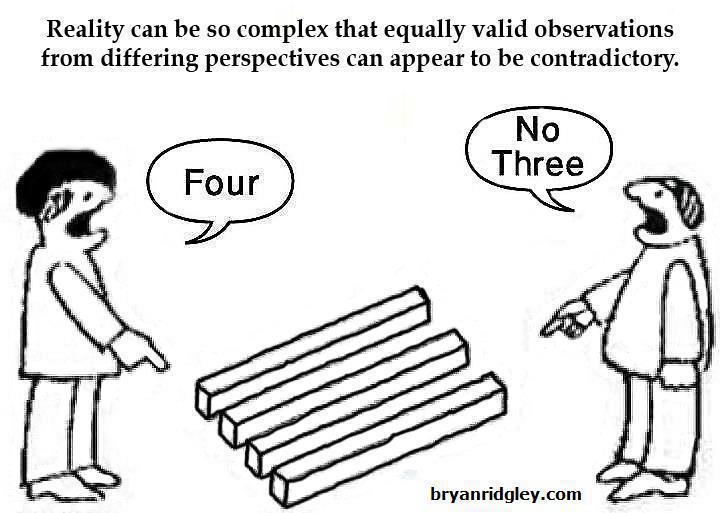
Your personal particular attitude toward something (i.e., a point of view) could be unique to you or it could be shared by many others.  This perspective defines how you interpret information about the object of your attention. 

When the perspective is largely the same among a group, the attitude becomes a truth – i.e., lots of people see it that way so it must be correct. 

Of course, this is not necessarily the case and perceptions can be both illusory and bias based.

It’s an Illusion

For example, an optical illusion can be interpreted by most in the same way but by its very definition, it is not real.  In this case, the majority perspective would not match reality.  

It does raise the question though, if the majority perceive a thing to be so, does it become fact?  Facts are provable and examination of the illusion would prove it not to be true, therefore the majority perspective might be indicative but it should not be accepted as fact.

The world is flat

A classic example of this is a common belief that the world was flat and if you traveled to the horizon you would fall off.  At a time this was believed to be true by the majority (and still a few even today – e.g., the flat earth society) but it was not true. 

Understanding perspective is important to both interpret what others are communicating to you as well as avoiding the trap of believing in a false truth. 

Your Driving Wheel

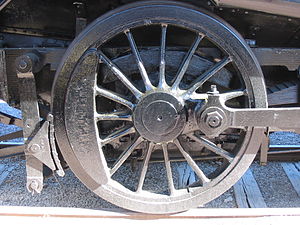
The large wheels of a locomotive, to which power is applied either directly or via coupling rods is defined as the driving wheel.  In terms of personification, the driving wheel represents motivation. 

Don’t lose your driving wheel

A life without purpose or motivation can impact your health.  We are alive for a reason, albeit philosophers are constantly searching to define what that is.  Without belief in the existence of some kind of meaning, our lives would be purposeless. 

Each of us owns our driving wheel and need to nurture and protect it.  It has been well documented how the will to survive can have a very real impact on recovery from illness and adversity. 

Your driving wheel is a concept which can help you persevere, recognizing it exists and making sure you continually maintain the power needed to keep it spinning, is critical.

Change is needed

Sometimes change is a way you can keep your driving wheel powered.  The boredom from becoming comfortably numb can be reversed by the excitement of change.  Change can be invigorating and start your wheel spinning fast and hard again.

In the interests of full disclosure I should note the phrases “becoming comfortably numb” and “lose your driving wheel” are derived from classic blues rock songs by Pink Floyd and Blodwyn Pig.

Music lyrics are sometimes profound and both of these strongly resonate with me.  I recently experienced the life giving motivation associated with change when relocating to a new personal resonance.

It certainly got my driving wheel spinning and although maybe not in the moment, I really appreciate the excitement of the change and the invigoration it brought me.

Why wait?

Waiting occurs when you have an expectation toward something but do not act immediately or perhaps at all (i.e., stay in place).  This is not necessarily a bad thing. 

However, on the other side of the coin, Nike’s icon add campaign of 30 years ago suggested, “Just do it”.  This campaign put the company on the map and took them from a small start-up to a huge large cap corporation. 

Enticing Thought

“Just do it” resonated with the athletic shoe makers target audience.  In essence, activity and waiting are opposite concepts and for an activity-oriented product, encouragement to get going makes a lot of sense. 

How does this work as a general concept?  Is there a time when waiting is a good idea or as a general rule should we just forge ahead?  There is no simple answer to this question – it depends. 

Waiting can result in lost opportunity, on the flip side a precipitous decision could bring negative results.  In any case, the concept of proceeding actively is usually more motivating, hence why the slogan “just do it” resonated so strongly. 

In the balance

Most importantly, aggressively getting around waiting, for example butting into a line or forcing your car ahead in a traffic jam can provide an emotional high, but also could lead to trouble. 

On the whole taking action is more likely to bring results (you need to do something to achieve something) so waiting should be a balanced response where the risk considerations are too high.  

If the risk of action is likely to be detrimental and the negative impact is high, it probably is worth “not just doing it” rather wait and see.  

Managing your Journey

Traveling from one place to another is the standard definition of journey.  In the context of living your life, each day is a journey, in that you progress through change. 

That is you move from one context (place) to another continuously.  This might not be physical movement but rather conceptual.  Regardless it occurs each living moment. 

Who is in charge?

Only you are fully accountable for your progress, as you travel along the path of life (this is metaphorical) everything is a choice and although there is a myriad of influencers, ultimately nothing changes without your participation.

Some argue participation in change is sometimes involuntary, that is the influencing factor is so powerful there is no choice. 

In fact, there is always the opportunity for you to decide, however, there are cases where only one alternative seems viable.

Obviously, if you are being ordered at gunpoint it is probable you will accept that direction, you could accept the consequences of choosing not too,  although, since they could be fatal, you might conclude there actually was no choice. 

Choosing Direction

Your life journey will not be short and taking charge of the overall direction, measuring your progress and choosing to change course is personal.  Only you can do it. 

While during a particular moment, choosing an alternative can be difficult (like the aforementioned gun incident) due to time constraints and outside pressures, determining the overall direction of your journey, that is where you are going and how you will get there is your choice and yours alone. 

Hanging On

Stuff bugs us, that is normal.   Letting irritants fester like a wound is more damaging than the cause of the issue in the first place.  At the risk of sounding like the hit song from the movie Frozen, “Let it go”.

Resolving things that bother you is much easier said than done, but consciously reaching an acceptable solution, something you can live with, is far less painful than hanging on. 

It’s a process

The process to resolve those things that are bugging you is a standard series of steps:

  • What’s the issue and why does it bug you?
  • What is the optimal solution?
  • What is the minimum you could accept to consider the problem resolved?
  • What steps do you need to take to achieve either the best or minimally acceptable solution or something in between? 

Asking yourself the four questions, in the order presented, will provide you with a way to close the issue.  The key, of course, is making sure the minimally acceptable solution is positively something that will allow you to “let it go”.

Execution

Identifying the problem, the way to resolve it and the steps to do so, leads to execution.  That is actually taking the action to conclude and close the thing that is bugging you.

This needs to be precipitous.  The longer you wait the more chance that the problem will fester into something larger and the cure will be more difficult.  Heal yourself while you can, don’t wait for septicemia to set in.