Colour My World

Whether a family, corporate, volunteer or other types, an organized group always has a personality (aka group culture).   The group’s standards and values define the “go to”behavior.

The group’s culture is formed by its members and with time (the team members get older and perhaps wiser) and with turnover (people come and go) the culture can change.

Of course with some groups, for example, family or religious groups, people typically can not leave easily but they still can leave.  That is through ways like divorce or excommunication.

Becoming Them

A very interesting attribute of organized groups is their power to influence and impact members as a whole.  It is normal for new members to adopt the team’s personality.  Often this cannot be avoided.

This is not a form of peer pressure but more a regular human behavior, that is the desire to conform, to be like others – no pressure required it is just natural for us to behave as others do (in a broad general sense).

People who don’t naturally adapt and act like those around them are often considered abnormal or strange.  As is often said, the human animal is a social animal.

The Color Analogy

By arbitrarily assigning default behaviors a color we can illustrate how this morphing to a teams culture works.  Consider someone with a dynamic, forceful personality, we will label them red.

They join a team that is largely blue, that is relaxed, patient, slow moving.  Over time, usually within 6 months, the new members  “red” traits will begin to be suppressed (unconsciously) and a more blue approach adopted.

Seek to maintain Diverersity

Given the natural inclination for diverse team members to adapt, team diversity is ultimately watered down.  Therefore, it is important to collaborate within your organization to recognize, reward and encourage diverse behaviors.

Of course, there is some value to all acting within the constraints of a common color but there are downsides to this as well.  Try to keep the diversity balance if you can, the teams personality is a rainbow.
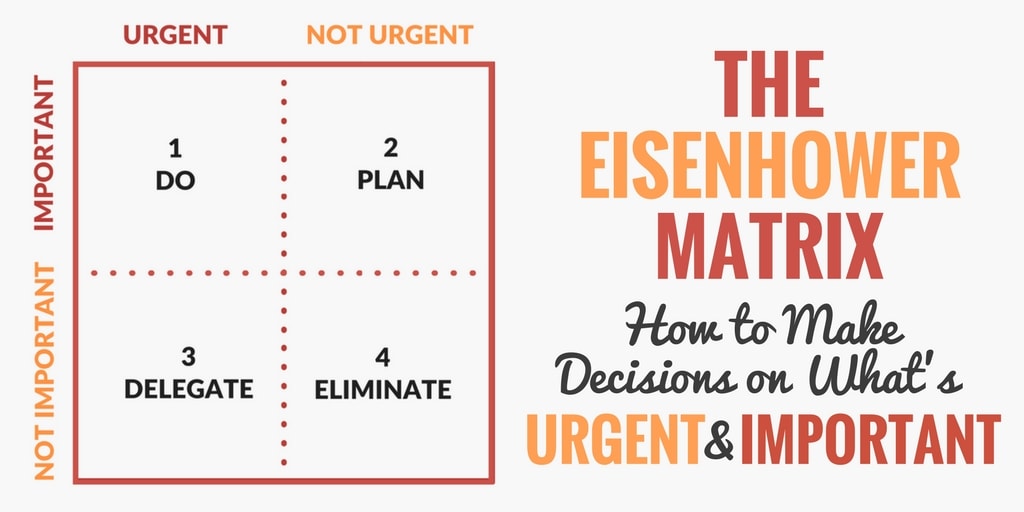
 

Eisenhower Decision Matrix

Yesterdays post about patience got me thinking  a littlebit more about when it is appropriate for the urgency/ impatience balance to favour urgency.

This reminded me of the Eisenhower matrix which classifies activity based on it’s urgency and importance.  The simple question to ask is, how important is what I am going to do  (i.e.,  task, activity, strategy, behavior and so on)?

The combination of urgency/importance can help guide the best mix of patience or perhaps impatiece, that is need to get it done right now.

Importance speaks to value, spending lots of time on less important activities is obviously less value than spending little time on important actions.

Definitions

Important tasks are things that clearly contribute to our strategy and objectives.  We know they add value because they specifically solve a specific defined objective.

Urgent refers to any activity or task that seems to require require immediate attention. These are the things that we percieve to be  shouting “Now!”.

The Matrix

Eisenhower’s matrix classifies things we want to do based on a Y axis of low to high urgency.  The x axis is low to high importance.  This results in four main quadrents:

  • Low importance/low urgency – spend a lot a patience on these, in fact why even do them at all.
  • High Importance/High Urgency – based on the classification obviously worth doing quickly, don’t waste patience on these.  It is not appropriate and maybe detrimental.
  • Low Importance/ High Urgency – You kind of wonder whats the urgency if it is not important.  This is a category to be carefull with and a modicum of patience does not hurt.
  • Low Urgency/ High Importance – there is good value here, they are important but be patient as you complete the work.  Focus on getting the best value, patience is an asset.


Patience

A valuable but often overlooked personal skill is the ability to accept or tolerate delay, trouble, or suffering without getting angry or upset.

Some demonstrate little patience and even proclaim “I don’t have the patience for this”.  This is not necessarily considered a negative trait  (i.e., lack of patience), but maybe to some degree, it should be.

Balanced Approach

Like so many things, the extreme approach is seldom most effective.  Which is better, being direct, forward and focused on quick results versus the analytic, patient approach?  This question has no definitive answer and the best way is often contextually driven (i.e., what is the overall situation).

A complete lack of patience can lead to presumptuous actions while too much patience is not only frustrating but can be the result can be dissappointing as well. Carefully considering the options of each approach and employing the best mix is likely to lead to better results.

Waiting Patiently

Waiting patiently is an interesting approach.  Initially, it can appear indecisive, just waiting for the default to occur.  On the other hand, it can be a calculated method to gather enough data to inform proactive behavior, before actually acting.

Patience, by and large, results in either acceptance or a deliberate alternate action with a full understanding as to why.  As time progresses you have the ability to consider and ultimately decide to live with the way things are going or take an alternate.


Is that what you really think?

Cultural expectations can drive how we communicate with each other.  Etiquette is the term for  describing expected/polite behaviour in your cultural grouping (i.e,. your social setting).

Traditional forms of written and verbal communications are constrained by this cultural code.  Meanings are be softened or expressed indirectly so as not to offend.

In this senario, when someone communicates more openly than polite expectations allow,   the phrase “ tell me what you really think” is sometimes used as a sarcastic or humerous reminder or caution.

This is a rejoinder to respect the boundaries of polite society relative to ongoing discourse.  The principle is, we should avoid offending others.

Enter Social Media

A very interesting consequence of the easily created and distributed forms of social media is this faceless and indirect format has less limitations (i.e., facebook, twitter, linkedin to name a few).

I am regularly reading comments where the social media authors describe the behaviour of others in no uncertain terms.  The really unsettling part is the viewers of this content often ascribe a validity to the authors assertions that, for me anyway, is  questionable.

While I might, on occassion, slag others or euphimistically “throw them under the bus” as a rule, I always do it to their face.  This gives them an opportunity to rebutt or correct my statements.

Using social media as a platform to vent, spout off self righteuosly  or self identify as a subject matter expert, is just self demeaning to the originator..

Difficult conversations, behavioural justifications or personal attacks, however justified you believe they are, have no place in open forums.

Changing Direction

One theme running through many of my posts is about setting objectives, planning how to achieve them and then executing the plan.  Three simple steps.

As a basic approach, whether the goals are personal or organizational, the sequence; define, plan, implement is tantamount.

A new route

The path, and even the objectives, might need to change depending on circumstances.  The road might be washed out along the way or need extensive repairs.

In these cases finding another way, perhaps even a better way, makes sense.  This is does not mean a wholesale change or to throw the baby out with the bathwater.

Rather, recognizing the methodolgy being employed and even the outcomes being sought sometimes need adjustment, to avoid failure or at least increase the chance of success.

Control your destiny

One priority, on route to your goals should be controlling your own destiny.  As issues arise you want to avoid letting the external factors drive your actions.

This could necessitate changing direction (either or both the how and what) but the big value is avoiding being forced down a route you might not be 100% comfortable with.

There is a better way

My own experience has been, there is always a better way.  Often we get locked and loaded on a plan and dynamite is needed to stop and re-evaluate.

Sadly, there is always a better way (continuous improvement is real). I say sadly, as we work and analyze to get the absolute best approach, and yes sadly, I guarantee you there is a better way.

The sad part is how hard it is for us to pause, relax and then make the change for the better.

The Right Answer

Living your live is all about doing stuff.  There are a wide range of activities we do every day, each has an outcome, that is they produce something.  For example we could be thinking, behaving, reacting, creating and so on.

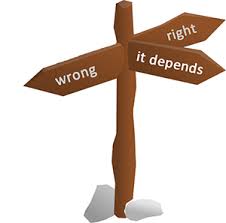
A very interesting and important question about all the things we do, “Is it right?”.   Do our actions conform with fact, reason, truth, or some standard or principle?

Subjective Analysis

Usually the right answer does not exist in a consistant and absolute sense.  It would be unusual for a group to be in complete agreement about whether an approach or outcome was right, largely that assessment is dependant on majority or by consensus of the group.

The questions leading to the right answer always have a subjective component, hence the individual perspectives colour any assessment of “right”.

The word right implies correctness, the challenge is the fact this almost always has an individual spin.

This does not mean the right answer does not exist, rather just that it might not be the same for everyone.  The key aspect of determining “right” is to acknowledge it is not necessarily unique.

Finding the Answer

Acting the right way, (i.e., appropriate, logical, reasonable, accurate, etc) is founded on knowledge.  Understanding can be a guide to determining the right option and the greater the knowledge and understandibg the smaller the risk of being wrong.

Assuming there is an absolute right way can lead down a tumultuous path.  Seeking the best way for you , recognizing  there is often more than one choice will often lead to the best results.


Usurping Granted Power

Organizations are structured hierarchically.  Whether a sharp pyramid or a flattened triangle the person at the top has power by dint of their position in the organization.

This is known as positional or granted power.  It may represent their entire power base or they may also have earned power, simply put the ability to get things down through others because they let you, usually out of respect, admiration or belief in your capability.

Using Others Granted Power

Throughout many years spent in many organizational environments it has never ceased to amaze me how people attempt to exercise power, that is get things down, by referencing someone higher in the organization.

For example, imagine a team meeting where collaboration is underway and there is an active discussion about which options or approach the group should adopt.

Almost without fail one of the arguments someone will use to support their position will go something like “our boss said we she do it this way”  Or some similar reference to someone in the organization with greater power than anyone in the group.

This can often be someone at a very senior level in the organization.  What never ceases to amaze me is how it can be a persuasive argument.

Me, doubting Thomas that I am usually asks for written verification or even offers to call or otherwise contact the aforementioned power broker.  Most often this breaks up the play.

It Works, Yike!

As I noted though it is stunning how often this ploy is successful.  So basically there is your granted or positional power, your earned power and the one often overlooked, leveraged power (totally made up).

Ideas, the journey begins

Ideas are thoughts about a potential course of action, typically for beneficial purposes.  Ideas can also be philisophical and highly conceputal both with a mental image or etherial perspective.

For todays post I am focusing on the more material form of ideas, those that can be converted to reality.  That is, the potential is acted on and ultimately beneficial gain is realized (monetary or otherwise).

Inventing

Often the conversion of an idea to reality is termed as the process of invention but this is not always the case.  Invention implies the idea has a newness to it, i.e, never seen before, unique, innovative.

Inventing can be a profession ranging from creating and patenting the idea without making it a reality, to actual building and implementing the idea, that is acting as an entreupreneur.

 Implementing Ideas

Arguably  the most satisfying process is not the ideas inception, rather implementing the action arising from the idea and of course reaping the benefits thereof.

This is the journey from the germination of the idea to conceptualization and finally reality.  Like many journeys it can be long and tiring, can have frustrating moments and even times when you wonder why you even started.

The key here is overcoming the motivation not to act.  Often the getting the idea is as far as it goes.  For those few that take the journey and overcome the challenges the satisfaction can be high.

Of course it could lead to failure, willingness to accept the risk is, of course, one of the key barriers to taking an idea to fruition.  Ths can be offset by the pleasure of the journey.


Team Chemistry

Often a group, department, or team within an organization develops overtime.  That is, ongoing turnover changes the shape of the team.  People leave, new people join.

Rarely does a leader get the opportunity to build a team from the ground up, selecting every member.  I have had this rare opportunity once in my career.

It was a very illuminating experience.  Each team member I selected had a chemistry with me.  Unconcious bias plays a factor in this, it is only natural and hard not to select candidates with whom you emote.

This is true even when you are carefully filtering on merit (i.e., skills and abilities).  While the team might not be widely diverse the commonality created by the selection being based on a single hiring  leader does have some benefits.

Interpersonal Chemistry

In the broadest sense interpersonal chemistry is the way two individuals relate to each other.  The term implies a positive interraction.

This is typically related to common values and personal perspectives.  These attributes are not necessarily openly communicated,  rather felt more on an emotional level.

In my experience, the team of about twenty people for which I was the single hiring manager interacted seemlessly.  The bond was largely based on the common filtering I had done resulting in a team full of interpersonal chemistry.

Putting your stamp on a team

I have often observed new  leaders forcebly turn over their direct reports, the ones they inherited, and replacie them with new subordinates  they have better chemistry with.

This practice stems from a desire to work/play with others that have “go to” behaviours that are similar.  As I have noted there is some merit to this approach, on the down side it often limits creativity and innovation to some degree.


Governance

Over the past twenty years I have found myself in governance roles.  That is I have had the opportunity to participate in both interaction and decision-making among the various stakeholders involved in the creation and  reinforcement, of organizational norms.

In simpler terms, this involves ensuring everyone understands what the boundaries are and adheres to them (whether related to processes,  policies or behaviours).

Bad Word

Frequently governance is viewed with distaste both by practitioners and victims ( at least they see themselves as victims).  So why do we bother?

To be clear, as a practitioner I personally found my own involvement in governance unpleasant regardless of the fact some viewed my role as the easier one.

Why bother?

The motivation for implementing and maintaining governance practices is  avoidance of cost impacts and  reputational risks. Governance leads to cost effective consistency and sustainability.

The downside mainly arises from the fact that governance is restrictive.  It is a control process.

We all love control

Not surprisingly, whether it’s an  editor  controling the consistency and clarity of a communication or an  auditor advising how operations are deficient and creating unacceptable risks, people grit their teeth and bear it, but seldom like it.

Who among us likes to be corrected.  Pick me, please pick me.  I think not.  Most people think who are you to say I am wrong.  Bloody control freak!

Emotional remonstration aside, the reality is this governance.control practices can guide us to success.  As distasteful as it may be to actually perform the role of editor or auditor,(policeman, bureaucrat , etc., without them anarchy would rein.  Quality would suffer greatly.

Sadly, we need to be governed for our own good.