If your happy and you know it …….

A childrens ditty from my childhood, simple as it seemed, actually contained some real insight. Happiness is a state of mind, however, to be happy this state of mind must be both acknowledged and accepted.

Situations or material things may influence your state of mind but in and of themselves they do not constitute happiness. Only you can do that by embracing the associated positve emotions.

No Clapping, No Happiness

The childrens song encourages you to acknowledge your state of happiness by clapping. This is a symbolic lyric. The key is acknowledgement.

Happiness is personal (it is about you after all) but letting others know how joyous you are feeling is all part of the condition. Being happy shows and if it does not you are probably not truly happy.

Pursuit of Happiness

The active seeking of happiness, although enshrined as a right in the U.S. constitution has always fallen flat for me. Happiness is not an object or treasure to be sought.

Rather it is a state of being, you don’t find it , recieve it or have it given to you, happiness is attained. You must consciously arrive at a state of happiness through mental processes.

Of course the physical world, other people and your own condition will affect your state of mind and could make achieving a state of happiness difficult, but it is never impossible.

You are in Control

You, and only you, can determine the conditions that lead to a state of happiness. While is is not always obvious how to create these conditions, it is always possible.




Expectation

When interracting with others there is always a a belief that they will or should support achievment of something. The thing could be tangible or intangible, but the expectation exists.

Failed or unsatisfactory interactions, whether individual, team or a large group, often stem from unmet expectations. Others might not be aware of your expectation and hence the unsatifactory performance might be fully unknowingly.

Share Openly

A good start to avoiding cases of unmet expectations is to make sure they are not hidden. Let others know what you expect. Although just because you expect it does not mean it will be accepted.

Your expectations and those of others may differ. A mutual understanding enables the forging of outcomes that are acceptable to all, even if not optimal.

Understand Your Expectations

Often what we believe should occur has an unconcious component and even though it might not be in the forefront of our thoughts we will be dissapointed if it does not happen.

In order to share your expectation with others you must have a conscious understanding and most importantly it needs to be feasible.

Eliminate Disappointment

If you are aware of what you expect to occur, have shared it with others and discussed variations that are acceptable it is unlikely to be dissappointed.

This does not mean the outcomes will always delight you but they won’t surprise you.

Don’t keep your expectations secret, they should not be demands but reasonable desires. Following this practice eliminates unpleasant surprises and the associated negative emotions

common sense – please

Blind completion of any activity, focusing only on a “do this, than that” approach, can result in disastrous outcomes. Actually, the product of your efforts should be the priority.

Process is a foundation of efficiency and reaptable, sustainable quality, but process in and of itself does not dictate good results. For this common sense must be included in the mix.

Rules are made to be Broken

A simple overused phrase has been a personal mantra for years. I do not interpret this literally but rather it is indicative of the need for flexibility versus blind conformance, for optimal results.

As usual I have an exagerrated example of this. The rule is stop at a red light. Say you were approaching an intersection with a red light, no other traffic in sight from any direction execpt behind you a vehicle obviously travelling at an excessive high speed.

Would you stop and be hit from behind or break the rule and steam through the intersection to avoid being rear ended. Only one right answer, common sense says, break the rule.

Why?

Taking action to achieve a goal should always be punctuated by understanding of the purpose. Blind adherence to a process without linkage to supporting rationale, that is understanding the reason for doing it, is often a wasted effort.

Linking cause and effect allows for reasonable varience in practice when the outcome is clearly better ( e.g., avoiding an accident). Completing a task for the sake of doing it serves little purpose.

To avoid this problem, always ask yourself, what purpose or goal does this action support, even for prescribed tasks. If the reason is not obvious, maybe a variation is needed.

Focus on why you are doing it, not what.


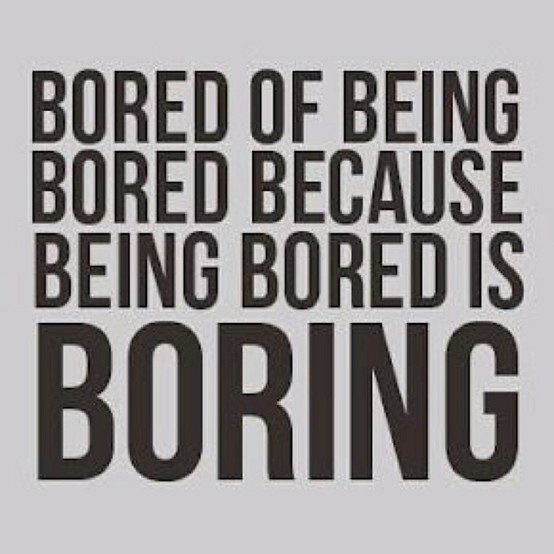
Boredom

Sometimes we have nothing particular to do or are not interested in whats going on around us. We are not stimulated nor motivated to become stimulated.

This is boredom (i.e., the state of being bored). Time passes slowly and is tedious. External factors can often create the opportunity for boredom but it’s presence always requires personal acceptance.

That is regardless of circumstances there is always an opportunity to choose not to be bored. Some argue entering a state of pervasive lack of interest (boredom) is not always a concious choice. I disagree.

Taking Control

Undoubtly circumstances can lead you to boredom. Mostly this process is unconcious, that is you don’t plan to be lacadasical nor do you actively work at being bored.

After all boredom is not a pleasant state so there is little motivation for one to go there. Perhaps you are sick, exhausted or recovering from so trauma.

Perhaps circumstantially you do not have the energy to focus or be interested in your surroundings. Your motivation for physical activity or deep thinking is low. in thiscase, going with the flow could well be boring.

Prehaps you are forced to be somewhere with little option for stimulating behaviour (e.g., a store clerk with no customers).

In these situations allowing boredom to set in is still a choice although probably the default choice. Break out. Take control, and exercise your ownership of your life.

Consider the options, there is always something feasible to do even if it is just writing a novel in your head. Boredom is a choice, decide not to select that option.

Mentoring

Mentoring describes the relationship between a more experienced/knowledgable person focused on imparting guidance to a less experienced/ knowledgable individual.

The mentor/ mentee relationship is two way with both parties satisfying a need. One to share experience and the other to gain. Ultimately both recieve value.

Not Mandated

Prescribed mentoring is usually doomed to failure. That is, the process really only works when desired and embraced by both people, a forced relationship really just does not work.


In the past I have been asked by a third party to mentor individuals they viewed as having high potential but lacking experience. My response has always been, this is not a request that is yours to make. They need to ask me directly.

My own experience has shown arranged mentoring has little chance of success.

In a similar vein, I would argue leaders/ managers have an accountability to create an environment for followers/ subordinates to develop and thrive but this practive is quite different from a mentoring relationship.

Two Way Strret

Effective mentoring involes a bond of respective from both participantsand is not heirarchical in nature but rather an exchange between equals. This is a key distinction.

It is critical for both persons to learn and improve, the key to mentoring is not treating it as a master/ student relationship. This is what amkes it a powerfully effective process for developing enhanced skills and capabilities.

Mentoring is mutual, everyone gain, is not authority or power based in any way. For these reasons it is a great approach is you but not simple to arrange, participate and create a good relationship.

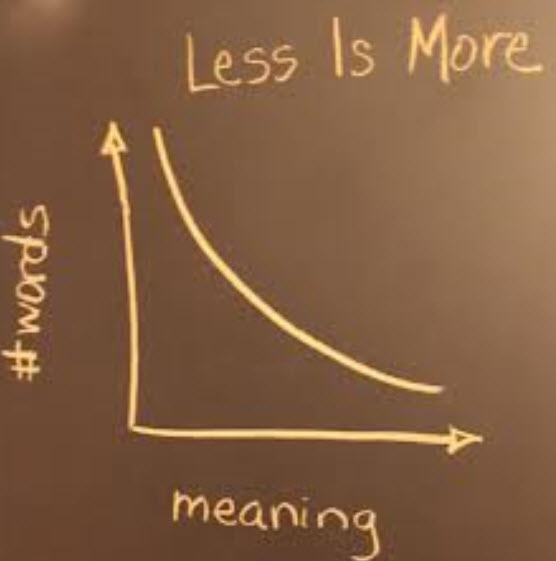
Fewer words

Communication is a key to personal success. Understanding the information you receive and having information you provide interpreted as intended is not easy.

When listening or observing we interpret we filter the input and the result is not always as intended. Similarly when we communicate verbally we regularly say more than is needed.

Filtering

It’s virtually impossible to communicate, whether incoming or outgoing without some level of filtering affecting the result. When sending a communication you can reduce the risk of filtering through brevity.

Many mistakenly believe detail will support clarity. In reality, the more information provided, the more filtering occurs on the recieving end and thus a greater likelyhood of misunderstanding.

Few words, carefully selected and crafted into short uderstandable groupings are far more likely to be interpreted as intended.

In fact, more information, longer explanations including many supporting details frequently just get filtered out. The multitude of words are simply are not heard.

Although there may appear to be receptivity on the the part of the listener, the filtering going on in their brain is invisible to you, but it is definately present.

Wait

Start with a few words and wait for a response. This is doing the listener a favour, they have less filtering to do (fewer words on your part) and more time to digest, absorb, analyze and understand.

Your pause should prompt a response which will give an idea of the level of understanding. These allows you to craft your next set of few words (if needed) in way targeted to enhance understanding.

Improve your communication, use fewer words and longer pauses inbetween. You’ll beamazed how quickly it works.

Needs and Wants

Things required to live a healthy life are needs, everything else you desire is optional, albeit might be required to maximize your happiness.

Separating needs and wants can be a difficult task, but having a clear idea which is which can be most helpful. Needs are clearly a priority and should receive your focus.

Focus

Avoiding conflict between needs and wants helps ensure your efforts are focused on the best value proposition. That is, attaining the goal that gives the best return.

This requires self awareness coupled with the ability to be brutally honest with yourself. Categorizing needs versus desires is easier if you take the timee to define the attributes of each from a personal perspective.

You can then map the object of your desire to the qualities you defined as required to live or nice to have. This makes labling things as wants or needs easier to do.

Want or Need

Determining if something is required, versus just desired, means drawing some lines to suite your own personal situation. One size does does not fit every case.

Your bar should depend on impact. If you don’t attain an objective, what happens? In many cases life as you know it will go on, but could be negatively impacted.

A deficit of positive results is obviously impactful as well. The key to whether a thing is required (whether to avoid the negative or accent the positive is somewhat objective but completely related to impact.

Things with impacts devestating to you are needs, everything else is not.


Performance Feedback

One of my pet peeves is the fact most feedback we provide to others about how they are doing is negative.

Social media is a great example of this, while positive reviews of things have a few positive comments typically negative reviews are both more common and more detailed.

My own experience, and many psychological experiments have proven humans first instinct is to provide negative feedback. Positive comments are usually the result of conscious effort, negative feedback flows naturally.

Focus on the Positive

Years ago I discovered my suggestions for behavioural change rarely worked when focusing on things I perceived to be below my expectations or basically in my view, bad.

On the other hand positive comments led to continuous improvement focused on the foundation of things that were perceived to be good.

In short, as an effective leader, I found little point in commenting on the negative or opportunities for improvement. By focusing on the winning behaviour I noticed consistently it not only became more frequent but also more effective.

Motivation

Success motivates us. Focusing on success when providing advice to others intrinsically includes an element of positive motivation. Not so when telling someone they are doing it wrong, usually in this case change is only motivated by consequences.

Consequences may work for a while to motivate change but observation shows this approach is typically not sustainable. The fear of negative impacts slowly fades away.

It may go against your natural instincts but I strongly urge you to give this approach a try. Drop the opportunities for improvement or changes in behaviour you want to and focus on the behaviours that are worked – provide positive feedback EXCLUSIVELY.

I think you will surprised by the results.

Happiness

The formula for a happy life is not a secret. Tal Ben-Shahar is a self proclaimed happiness researcher. He has a doctorate in organizational behaviour.

Mr. Ben-Shahar famously advised Michelle Obama at their first meeting, when asked what he did, that he was a happiness researcher. Her classic reply, “Oh, is that a thing?”

Ideas

Tal travels the world consulting and lecturing on happiness related behaviours and concepts. One of his several books on the subject, Learn the Secrets to Daily Joy and Lasting Fulfillment, led me to todays topic.

Happiness is of our own making, yet, as implied by the self help books title there is some secret to attaining it. Personally, there is no secret. I know what makes me happy, actually I would suggest most people do.

Choosing to be Happy

For me the hallmark of the work of Tal Ben-Shahar is not researching happiness itself but rather how to practice happiness focused behaviours.

Ultimately it is about choice. The first key step in the secret formula to happiness (which is not really a secret at all) is choosing to do so. Of course the cavet is, “Not at the expense of others”.

Knowing what mkes you happy and choosing to behave in ways that create personal happinessis in fact the simple bu effective secret formula.

The key to this is resisting the urge to let external factors, those out of your control impinge on your happiness. You can contro your own reaction to everything so whatever happens, perceive it correctly and you can be happy.


Monitoring and Control

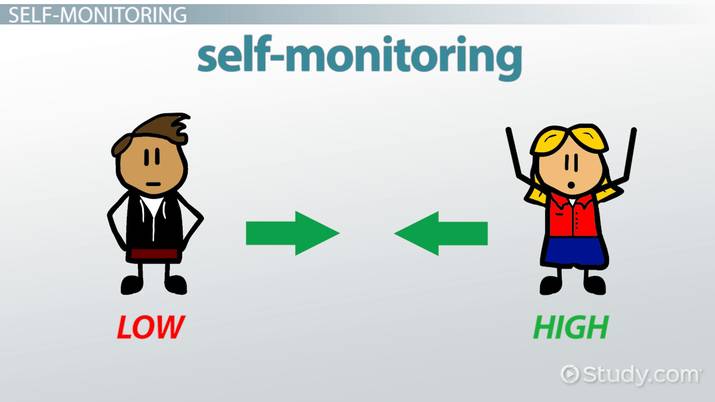
Keeping track of progress toward objectives is something we all do to various levels of intensity. In some cases we monitor only ourselves, sometimes ourselves, others and a variety of variables.

Monitoring is typically around information gathering. The observations are used as input to deciding what changes to influence and then executing (control)

Unseen

The best monitoring and control practices are those that get results but without most people even being aware they are subject to monitoring or control.

Strong direction and brute force should be reserved for the exception situations. These methods can work occassionally but typically are not sustainable.

A key trait of strong leaders, one that does not recieve a lot of direct attention, is the ability to monitor whats going on and influence positive change and motivation without being obvious.

The best leaders or influencers act as catalysts, not directly participating in the reaction but are a critical component required for the best results ( in many cases for the action to even occur).

Guidance versus Direction

Often we need to help both our own others performance without directly influencing. This involves understanding what is occuring (monitoring) and providing a focus (control)

The best results are derived from leaders that practice these behaviours (monitoring and contolling) in a seemless was such that it is not apparent.

One of the key reasons for these is because inate human behaviour ( even our own internal behaviours) rebel against authority. It is part of our genetic makeup and only natural.