Tag Archives: worry

Manage Risk Don’t Worry

There is almost always the potential for danger, harm or loss with everything we undertake, that is a risk.   This can lead to anxiety or unease as we allow ourselves to dwell on upcoming difficulties or troubles, that is worry.

Often when we are exposed to danger, harm, or loss our emotions kick in, and rather react in a logic-planned way we panic and get anxious.

Substitute Risk Management

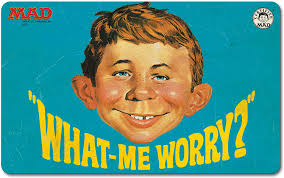
Some of you will remember the popular Mad magazine character from the sixties or seventies – Alfre E Neuman.  His tag line was “What?  Me worry”.  (Not sure what his motivation was.)

Personally, I emulate that motto but my rationale is based on constant and effective risk management.   Things we worry about stem from the risk of something untoward occurring and if we plan to prevent it or how we will manage if it occurs then, why worry?

Think Ahead

Basically when you undertake a goal or plan an activity think about possible outcomes.  Don’t overthink it, that in itself can be worrisome, but consider reasonable possibilities.

Some of the things that might occur might be less than pleasant, bothersome, or even totally undesirable.  Mitigating these risks, that is planning what to do if they occur to lessen the damage or even prevent occurrence are things you can do.

By preparing for risk and being ready to take action as needed you to remove the unknown, fear, anxiety, and uncertainty is tamed, and voila worry is gone.

Hard to believe but it is that simple.  What? Me worry.  Why would I engage in a needless and unsettling emotional activity?  I can see no rational reason to do so.

Panic

It is probably not a desirable event but on occasion, most if not all of us will experience sudden uncontrollable fear or anxiety, often causing wildly unthinking behavior.

Panic probably has a purpose although I am not sure how valuable it is given the often associated illogical or irrational behavior which is driven by the shock/stress associated with the fearful event.

Keep Calm, Carry On

During the second world war, the British Government prepared a campaign to use in the event of an invasion by Germany.  The tag line was “keep calm and carry on”.

The premise was, panic is not a useful behavior in a crisis.   England was not invaded and the campaign was never run although leftover posters were found a decade ago and the motto has become a popular phrase for modern posters, coffee mugs, etc.

Why Panic

Panic is driven by strong emotions.  Most typically is fear of undesirable consequences.  The greater the impact of the bad things we visualize potentially the greater the magnitude of our panic.

For me avoiding panic starts with a logical consideration of why it occurred in the first place.   Panic is an innate natural behavior for prioritization.

Prioritization is critical to determining when to react, how quickly and how forcefully.  In this context, panic makes sense in that it could help us prioritize the need for immediate action.

Avoiding Panic

The downside arises from emotional underpinning.   Our prioritization might not be logical and the reaction might not be the most appropriate.

That is urgency drives us to “GO” even when a little forethought might be more appropriate to arrive at the best resolution.

Simple to avoid, stop, ask why you are panicking, consider options, pick the best one and move on.


Let it Go

There are times when tenacity, that is the ability to firmly grip something and not let it go, is admirable.  Also, there are times when letting go is the better option.

The balance between determinedly following a course of action (e.g. a personal career path) and changing direction (taking a new career path) is not always an easy one to follow.

Just Move On

Holding on relentlessly can cause internal anxiety for you but can also color other peoples perspectives of you in a negative way.  Being perceived as the stubborn or intractable is a negative spin, it is better to be seen as firm or tenacious.

Managing how others view you is an important life skill.  Recognizing when to drop something is a key part of this.  That does not necessarily mean acquiescence, but rather closing a topic in a way acceptable to everyone that is involved.

Often, to do this, you need to be able to recognize when it makes sense to just let it go.  When arguing or ongoing discussion is clearly just fostering continued disagreement it is likely time to shut it down.

Not Giving Up

It is important to distinguish between letting go and giving up.  These are very different approaches, albeit they can appear to have the same outcome.

Giving up will lead to personal baggage and potentially you will feel bad about yourself.  Letting go is about recognizing that hanging on is painful to you and getting nowhere.

Releasing the pent up emotion which is eating away at you for something that is unlikely to change can be resolved simply by accepting the way it is and moving on.

Relaxing

“Relax” is a verb refering to behaviour that results in you becoming less, tired tense or anxious.   I wonder if you avoided stress in the first place, whether relaxation activities would be required.

Relaxing can address the symptoms but eliminating the cause of tension or anxiety resolves the root cause and seems to be a more sustainable solution.

But Wait

Another consideration is whether stress has value.  If it does, eliminating stress before it occurs could create a different problem.  Perhaps the cycle of stress and relaxation in and of themselves are needed and contribute to your personal well being.

It is a kind of a circular argument, but, I like to relax.  if I was never worried or stressed out, making me tired I would have nothing to relax about.  So I need to be stressed.

With no reason to relax, I would miss this enjoyable activity.  That might stress me out.  The cycle of stress and relaxation would still proceed but in reverse.

Is there an Answer?

Stress is an important part of your life.  Eliminating stress (supposedly addressing the root cause of your tension and anxiety) is not a solution.

Embracing stress, leveraging the motivation and emotions it drives, to drive achievement and personal satisfaction is the answer.  And of course falling back on the enjoyment of just relaxing from time to time keeps everything in balance.


Patience

Patience is the ability to tolerate delay, trouble or suffering without getting angry or upset.  ” Patience is a virtue” is a fifth century proverb as applicable now as it was then.

In effect controlling negative emotions like anger or anxiety usually creates the opportunity to respond to a particular situation more effectively than if your actions are clouded by feelings.

It is, what am I going to do

Years ago I attended a seminar where the leader suggested taking the approach “It is what it is” when presented with a frustrating situation you had little to no control over.

Since then I have used this techique often and found it leads to patience.  Most importantly though acceptance of things outside your control reduces the likelihood of behaving inappropriately.

Frustration is a leading cause of actions you regret later, yet it really is a weak excuse for misbehaving.

Act when you can, Patience when you can’t

A wise consultant (yes they do exist) once advised me not to worry about things out of my control because there is nothing to be done anyway (i.e., exercise patience) .

He also noted I should not worry about the things within my control, because I can, and should, act to resolve them (patience is not needed in this case).   Following this advice leads to a worry free life.


Governance – an exploration

Very generally,  governance refers to undertaking processes and practices by which others actions/activities are controlled and directed.

In effect these processes and practices start with guidelines, laws and rules  and end with enforcement to ensure they are adhered to.  For example, speed limits are a law most of us are familiar with.

This law is a governance practice intended to reduce the risk of accidents (or it represents a government money grab) . Speed cameras are one enforcement practice associated with this law.  Fines are another.

Governance, Yuk

A typical reaction to governance is distaste.  Like most things though  governance has associated pro’s and con’s.  Low levels of governance  usually result in:

  • faster completion
  • greater flexibility/ innovation
  • simpler solutions
  • lower quality
  • greater risk of error
  • inconsistency across repeated activities

Clearly high quality, consistentency and low risk are better attributes than the opposite listed above.  Yet higher governance is usually less flexible, slower and lacking creativity.

What to do?

Both approaches to governance (a lot and a little) have pro’s and con’s generally exactly the opposite.  The best way to achieve the highest results (best of both worlds) is “surprise,surprise” through a balanced approach.

Too much or too little governance is not a one size fits all balance.  It is very contextual.  For example, as an investor you probably desire strong governance to be in place around your investment.

The intent is to risk your reduce of loss.  However if the regulations are too onerous the investment can be strangled by them.  You might not lose but you might not gain either.

An example of this is Trumps approach to reducing regulations put in place during the last financial crisis.

In his view the risks mitigated by these outdated regulations have subsided in the current economy and the regulations are holding back economic and job growth.

I am not sure I agree with his assessment but the principle of balancing governance practices to get the best result really does resonate with me.

Making Mistakes

When your action or judgment is misguided or wrong we call that a mistake.  Regardless of the magnitude or visibility, acting or deciding wrongly is a mistake.

Of course, the outcomes and consequences of the mistake might not be in accordance with the type or level of the error.  That is to say a small error could have serious consequences.

And the Oscar goes to……..

Last Sunday was an obvious case where a small slip has disasterous results.  A accountant who works for PWC (Price Waterhouse Coopers) gave the wrong envelope to Warren Beatty on Sunday.

This minor slip resulted in the wrong movie being given the best picture Oscar for a brief two and a half minutes.  More than long enough to create a massive, even monumental fuss.

Fate Intervenes

Warren got the wrong envelope with the wrong contents and under usual circumstances, you would expect he would recognize the winners card was incorrect and stop the train before the crash.

To be fair, Mr. Beatty is 79 and was slowly working through his mind  the puzzle of the strange winners card .  Faye Dunaway, his co star in the 1968 Oscar Best Picture nominated movie “Bonnie and Clyde” , was the co-presenter.

Unfortunately, the relationship between Faye and Warren was a little acromonious.  In particular she is known to have little patience with his slow considered approach.

So Faye, loosing patience with Warrens slow progress, snapped the card from Warren , glanced at it, and read the wrong winner.  And so the error that began with the wrong envelope was exposed.

Fortunately!

In this case the impact is large but certainly not irrepairable, after all  the winning movie was recognized.

I am a little sad for the PWC accountant who will probably bear the brunt of consequences  but really to some extent was only a victim of circumstance.

Leaving your comfort zone

Routine activities can provide you with a feeling of comfort.  By definition these are things you do regularly.  Overtime they become intuitive, there is little unknown and risk , doubt, stress levels are low.

Routine things are part of your comfort zone.  Knowledge, experience, and  skill levels are all high when you are in the zone. So why leave there?

Challenge Yourself

At the risk of being trite, life is meant to be lived to it fullest.  Staying in your comfort zone does not typically reflect living to the fullest. That is experiencing new things, embracing challenges and figuring it out.

Stay Balanced

This is not to suggest moving to an extreme behaviour and living on the edge.  There is the need for a balance between living in relative safety and stretching the envelope.

This balance is very personal and attached to you as a person.  For each of us, the amount of time spent in your comfort zone versus that spent bursting out of it  works best when it is the right mix that conforms to our personalities, value system and so on.

For Example

You may have worked for others as an employee for a long time, this is your comfort zone in the employment space.  You decide to change to self employed or become entrepreneurial and strike out on your own.

A balanced approach to this change could involve taking a part time job initially doing something you know well and are familiar to balance against the unfamiliar activities you are trying out.


Fear and Hope

The reaction to the results of the recent U.S. fascinate me.  I include mu own emotions in this analysis.  As Spock, the unemotional Vulcan from the fictional TV series Star Trek, would say -Fascinating.

Start withFear

In the run up to the election I was fearful that Trump would win.  Of course I was not alone in this with many news stories supported this.  And of course talk about flight to Canada as a safe haven.

Followed by Hope

The day after the election I found myself strongly feeling hopeful.  President elect Trumps post victory actions seemed positive.  My self talk focused on the thought “It’s going to be alright”

In fact it might even be better than that other candidate, what was her name again (Hilary something)?  These trade agreement changes and tax cuts could be a good idea.

These blatent optimism is not mine alone with many of my collegues espousing this approach.  This is all about living in the moment.

The electoral contest was up in the aircreating an unknown void filled by worry and fear.  (Actually a very common circumstances)

Remove the unknown and voila, hope and optimism abound.  The underlying facts become less important in the face of certainty.  Worry no more, the die is cast.

One Caution

“Don’t worry it’ll be fine” is a great sentiment.  Optimism and hope certainly are more likely to lead to good outcomes that fear and worry.

That being said, there is a risk of too much optimism allowing the bad to get worse.  Remember, optimistic or not, be on guard.


Don’t worry, be happy

In the 1980’s, Bobby McFerrin had a huge hit single titled “Don’t worry, be happy”.  While I don’t believe lack of worry equates to happiness, there definitely is some relationship.

In my own view worry is one of the easiest emotions to deal with.  For things you can control, there is no need to worry – you are in control and will be able to ensure a satisfactory outcome.

For the things you can’t control, there is no need to worry – there is nothing you can do about it to change the outcome so why worry.

In essence everything falls into one of those categories.  Either you are in control or you are not.  Therefore the reality of things is there is nothing to worry about.

Then why do I still worry about stuff

The key to making this philosophy work is categorization.  For example if you are worried about making an appointment on time; start with the premise you control the time of your arrival.  Plan your trip to the appointment (you contol this) so you will be on time. No worries.

On  the way you have car trouble.  You are going to be late.  The car trouble was out of your control, so don’t fret it.   You have a cell phone and can call the person you are meeting, so do it – don’t worry it.

If you don’t have anyway of contacting the person you are meeting, it is out of your control so why worry.  There is nothing you can do.

Try it

You may have some doubts that this approach can resolve all your worries.  My recommendation is give it a try.  You may be surprised.  Probably there is little to lose and peace of mind to gain.