Tag Archives: fear

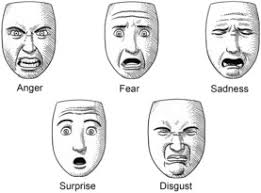
Don’t Let Fear Overwhelm You

Our actions can be motivated by many factors both internal and external.  Our environment and other people can exert a strong influence
Fear driven behavior might not be the most appropriate, in these cases, it is best to take time to think through your options although this is often easier said than done given the presence of a sense of urgency.

Think

Some of our reactions to danger are an innate action and can be hard to control, in some cases controlling these is not the best option.

However, in many circumstances, taking the time to contemplate our fears will produce much better outcomes.  We cannot always control our external influences but how we respond is within our ability to manage, just not always easily done.

Allowing our fear or anxiety to take control of us and dictate our behavior might achieve acceptable results but in those cases, it is purely by accident.  Retaining control of your destiny at all times is a much smarter approach.

Choose

While sometimes external factors are out of your control, you can always choose how to react.  Overriding instinctive action is difficult and occasionally not appropriate but generally more satisfying.

Without a doubt, our choices are influenced by circumstances.  Picking the best alternative for any given situation, sometimes at the moment, is often overlooked due to expediency or just because the effort appears too great.

In reality, taking time to get it right is always a high-value proposition and worth the effort.  Avoid being stampeded by your fear, you won’t regret it.
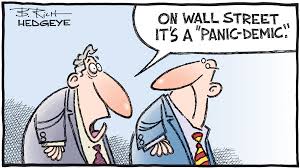
 

Panic Demic

In a time of a pandemic, the new norm becomes social distancing.  That is keeping at least one meter away from others.  Perhaps elbow bumps are okay but handshakes and hugs are out.

Given the covid -19 virus can live on surfaces for up to a week or more I am not sure social distancing has great value.  Airborne transmission is considered not to be the main vector, although not much is really known.

Over Reacting

This is a serious disease that is propagating rapidly, often passed by carriers with no symptoms.  The illness can be fatal.  Putting protective and preventative measures in place is only common sense.

In this situation not reacting makes no sense but overreacting/panicking is probably not a good choice.   Things like hoarding or pure isolation could be more harmful.

In Canada, the authorities’ reactions have been somewhat measured but the general populous is acting in full-on panic mode in some cases.

Economic Reality

World wide commercial activity is clearly going to be reduced during this pandemic.  This loss of productivity will worm through each countries economy over time.  This is obvious.

What I find hard to understand is the running for the exits before the fire has really started.  Stock markets around the world have crashed, but the economy soldiers on.

Must be anticipation.  Herd mentality. All-consuming panic.   Basically just a sudden uncontrollable fear or anxiety leading to wildly unthinking behavior.

For all the good it does.  Not!


The Secret Cave

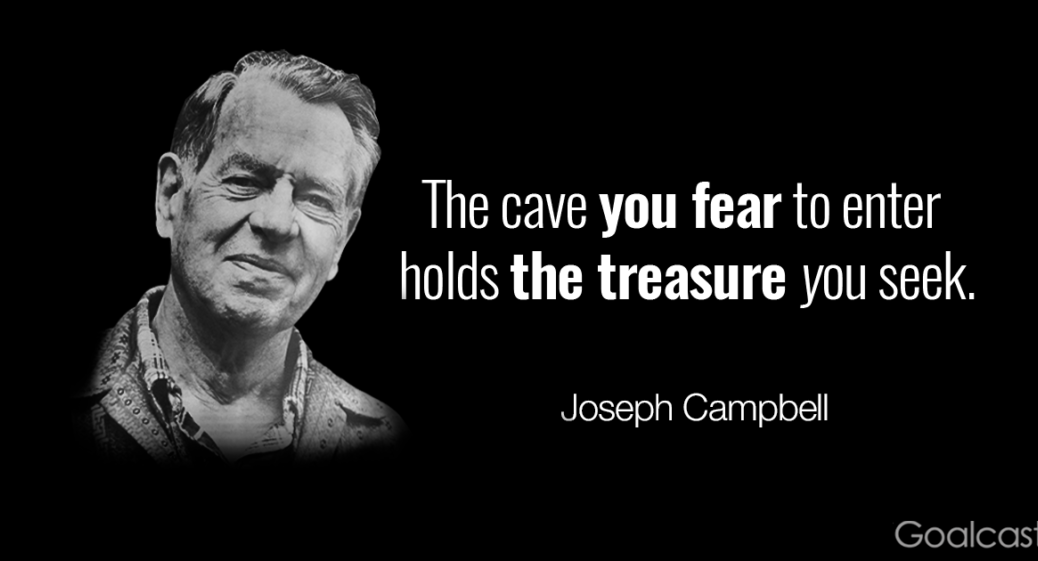
Building on yesterday’s post which focused on a metaphor today’s musing is about an analogy.  Do not be afraid to enter the secret cave to find the answers you seek.

The secret cave is analogous to the hidden knowledge we don’t have.

The cave is ominous and a little scary.  Should we enter it to find out the things we don’t know.  There is an appropriate quote by the character Yoda from the Star Wars movie, Return of the Jedi.

During a scene where Luke Skywalker is hesitant to enter the cave lest he finds out things he does not want to know, Yoda prompts him  “Find the answers you seek, enter you must”.

Fear of the Unknown

Caves are dark.  We cannot see what awaits us inside.  It could be dangerous, even life-threatening.   Overcoming this fear is necessary if we want to unlock the knowledge within.

Of course, this does lead to the very pertinent question, is there knowledge within?  Otherwise, why would I waste my time and take the risk of proceeding into a potentially dangerous situation?

Motivation to overcome the fear of the unknown is sometimes hard to achieve because you are not sure if the reward will be there.  Is it worth the risk, is it worth the effort?

Enlightenment

Unfortunately, sticking with the analogy, you need to enter the cave if you want to achieve enlightenment.  To paraphrase the earlier quote in order to find the answers you seek you must enter the cave.

It is the only way.

Why Worry?

Don’t worry you can figure it out.  This can work really well as a personal philosophy provided you don’t make it too all-encompassing.

Figuring stuff out is virtually always possible.  However, sometimes it is not expedient or efficient and quality often is diminished.  Completing a task or objective at the moment might work but might not be the best solution.

Risk Prevention

Identifying things that could go wrong and proactively working out an approach to mitigate them when they do can be more effective than figuring out how to deal with the issue when (and if) it occurs.

In both cases though, whether you plan in advance how to resolve problems or deal with them at the moment, there is nothing to worry about.

Fear and worry arise because we intuitively recognize working things out on the fly can be challenging and might not produce top quality results but we should not worry about failure, somehow we always figure it out.

Avoid Rushing

Working out how to deal with a problem or unexpected event can be a rush; both from the surge of adrenaline and the need for speed perspectives.

Being aware of things that could go wrong and preparing in advance (i.e., figuring it out) is probably the best approach to dealing with problems but is not always practical.

Worry about things in advance though does not make sense. Either plan how to address it before it occurs (in case it occurs) or be ready to deal with it at the moment.  However you choose to figure things out, in advance, in the moment or a combination of both approaches, remember, there is no need to worry.

Panic

It is probably not a desirable event but on occasion, most if not all of us will experience sudden uncontrollable fear or anxiety, often causing wildly unthinking behavior.

Panic probably has a purpose although I am not sure how valuable it is given the often associated illogical or irrational behavior which is driven by the shock/stress associated with the fearful event.

Keep Calm, Carry On

During the second world war, the British Government prepared a campaign to use in the event of an invasion by Germany.  The tag line was “keep calm and carry on”.

The premise was, panic is not a useful behavior in a crisis.   England was not invaded and the campaign was never run although leftover posters were found a decade ago and the motto has become a popular phrase for modern posters, coffee mugs, etc.

Why Panic

Panic is driven by strong emotions.  Most typically is fear of undesirable consequences.  The greater the impact of the bad things we visualize potentially the greater the magnitude of our panic.

For me avoiding panic starts with a logical consideration of why it occurred in the first place.   Panic is an innate natural behavior for prioritization.

Prioritization is critical to determining when to react, how quickly and how forcefully.  In this context, panic makes sense in that it could help us prioritize the need for immediate action.

Avoiding Panic

The downside arises from emotional underpinning.   Our prioritization might not be logical and the reaction might not be the most appropriate.

That is urgency drives us to “GO” even when a little forethought might be more appropriate to arrive at the best resolution.

Simple to avoid, stop, ask why you are panicking, consider options, pick the best one and move on.


The politics of fear

Today the US mid-term elections are underway.  These cover seat in the senate, house of congress, state governors and a number of other things like plebiscites and other miscellaneous elected positions like district attorneys. 

There is a belief based on polling to date that the Trump factor will be a key driver of the election results and the country may swing from a Republican party focus to Democrats (or reinforce Trump staying strongly Republican.)

The Caravan

As many as 6000 Central American and Mexican refugees have formed multiple caravans that are winding their way to the United States. 

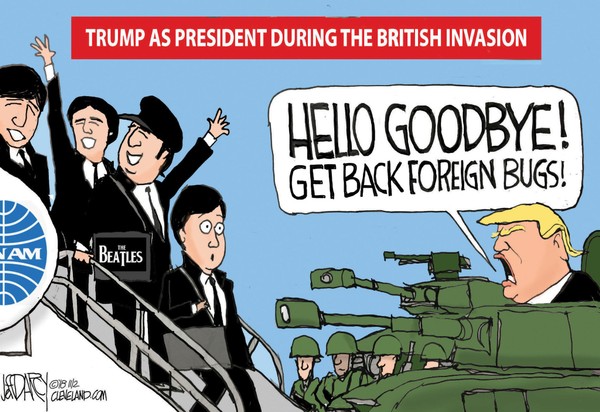
President Trump is treating this as a danger to the United States and is moving up to 15,000 troops to the Mexican border in a defensive posture to stop illegal entry into the country. 

This series of events is well publicized and personally I wonder if the timing was orchestrated to purposely gather some support for Trump and the republicans on the eve of the mid-term elections (admittedly a conspiracy theory).

The Fear Factor

Fear of invasion by maybe 6000 immigrants, albeit probably an irrational fear, is fabulous propaganda tool.  Fear is well known as an excellent way to manipulate the masses.

Groupthink is rarely logical and strong emotions like fear can be strong behavioral motivators.   Throughout his two years in office Trump has shown his preference to motivate through fear, on many occassions. 

My conspiracy theory is possibly far fetched, whether true or not, I really do hope the Republican party looses the majority in both houses today.  

Logic or Emotions

I received some terrific feedbck about yesterdays post.  In summary of my post, I postulated a world based solely on logic would be peaceful.  That is to say, the things that break the peace have an emotional driver.

This idea was explored in the original 1960’s version of the sci-fi TV show Star Trek.  Vulcan characters could not feel, express or act on emotions.

Feedback Recieved

What would live be like without emotion.  Emotions motivate, create pleasure (not logical but nice to feel) and pain or sadness (again not logical but certainly motivating)

Also the question arises whether a fully logic based race would in fact be peaceful.  Could violence not be logically justified under certain conditions?

The answer to whether violence can be a logical outcome of any situation is probably an interesting discussion for debate.  I think strong arguments exist for both sides.

Motivation

The lack of feeling, pleasure or pain, does on the surface seem very detrimental.  Interestingly this topic was explored in a number of the Star Trek episodes.

Having watched these episodes with pleasure, I believe the ideas expressed promoted both lack of emotion as best and on the oppisite side,  the need for emotion as critical.  In short, it was inconclusive.

Of course A fictional drama cannot provide definitive conclusions; however, it can certainly be thought provoking.  As I hope is this blog post.

Personally the discussion I had about yesterdays blog, that is emotionless world might not be the peaceful paridise I postulated, certainly has strong suporting arguments.

That being said I do truly wonder if this emotional world we live in, with it’s mass murders, war, personal attacks, bullies and so on,  is really worth having the pleasure of emotions.

Right or Wrong?

In the context of taking an action, that is making a decision or choice and acting on it, how can you determine if it was right (a good choice) or wrong ( a bad choice).

Feedback recieved during the decision making process can help.  Of course, results from  multiple sources can lead to a variety of input both postive and negative. Confusion reigns.

The goal should be to focus on objective feedback based on tangible metrics, things you can definitively measure.  This requires a clear statement of outcomes.

Strategic or Tactical Time Frames

Analysis can be complicated by point in time outcomes.  Is it about short, medium or long term.  Or even all three or a combination thereof.

Further complicating determination of right or wrong can be underlying moral or value based considerations associated with the decisions results.

For Example

In 1948 the Russians decided to block the Western allies tranportation access to west Berlin, thus starving and otherwise inconveniencing the western allies (and the general population) such that they would decamp and leave Berlin under complete Russian control.

For the Russians this was a moral and just decision.  Not so much for the Western allies.  Was the decision right or wrong?   At the time the answer to this question depended somewhat on where you lived, your politics and values.

Should the US restrict visitors and immigrants from selected predominantly muslim countries? is it right or wrong, can it be justified?

My own opinion is this action is both wrong and unsupportable.  However, there are those with a contrary powerful argument.   Perhaps the best way is respectful dialogue.  Maybe we can figure it out.

Or maybe, as occured in the case of the Berlin blockade, one side figures out how to overcome the other.  Guess who stayed in Berlin without starving.

Fear

I read a great definition of fear the other day.  It was described as an unpleasant emotion caused by the belief that someone or something is dangerous, likely to cause pain, or a threat.

On the surface fear is a valuable emotion.  It can help you to craft appropriate response to danger.  This could save you from suffering unpleasant consequences.

Unfortunately fear is also a tool that can be used by the unscrupulous to gain advantage.  There are multiple examples through the ages where power seekers have used fear to gain and sustain power.

For Example

Last century the German dictator Hitler leveraged attacks on Jewish people (and  other groups like the Communists or what he called inferior races, for example Slavic) to achieve and maintain absolute power over the German populous.

As far back at ancient Greece humankind has recognized the power of using enemies (real or imagined) to achieve personal gain.  Like a magician, this use of misdirection can hide the dictators true nature.

And now Donald Trump

Last Friday the President of the United States (Donald Trump) signed an executive order to stop vistors from seven largely Muslim countries.

He is leveraging fear of terroism to advance his own agenda.  Obviously the majority from the targeted countires are normal contentious, caring humans.  Like anywhere there are a few deviants    and this can in no way be ascribed to where you live or your religion.

Having a visible enemy to direct enmity toward for his own gain is President Trumps purpose.  It is sad the American populous appears unable to stop him.

Fear and Hope

The reaction to the results of the recent U.S. fascinate me.  I include mu own emotions in this analysis.  As Spock, the unemotional Vulcan from the fictional TV series Star Trek, would say -Fascinating.

Start withFear

In the run up to the election I was fearful that Trump would win.  Of course I was not alone in this with many news stories supported this.  And of course talk about flight to Canada as a safe haven.

Followed by Hope

The day after the election I found myself strongly feeling hopeful.  President elect Trumps post victory actions seemed positive.  My self talk focused on the thought “It’s going to be alright”

In fact it might even be better than that other candidate, what was her name again (Hilary something)?  These trade agreement changes and tax cuts could be a good idea.

These blatent optimism is not mine alone with many of my collegues espousing this approach.  This is all about living in the moment.

The electoral contest was up in the aircreating an unknown void filled by worry and fear.  (Actually a very common circumstances)

Remove the unknown and voila, hope and optimism abound.  The underlying facts become less important in the face of certainty.  Worry no more, the die is cast.

One Caution

“Don’t worry it’ll be fine” is a great sentiment.  Optimism and hope certainly are more likely to lead to good outcomes that fear and worry.

That being said, there is a risk of too much optimism allowing the bad to get worse.  Remember, optimistic or not, be on guard.