Tag Archives: self control

Enjoy the Moment

Relative to the age of the universe, as best we can guess it, our earthly human lives are but a brief moment in time.  We can speculate what happens after this life but it is not definitively known.

During our short lives, we have the opportunity to experience joy and pleasure.   Of course, we can also experience pain and unhappiness and every range of emotion in-between.

Control

What we experience is not totally in our control.  Events, the activities and interventions of others and perhaps extra-sensory factors are not always fully in our control.

How we react to the things going on around us, what we feel can be controlled by us consciously albeit sometimes requiring quite a bit of effort.

Our sub-conscious can take over sometimes without us even realizing it.  Hence negative emotions and feelings can arise within us before we are able to take control and quench them.

Blind Happiness and Joy

I firmly believe how I feel at any point in time is up to me and fully my choice however reality does intrude and I do find this is not always the case.

Or perhaps it is and I choose (even to a largely sub-conscious extent) to worry, be fearful, sad and unhappy on occassion.   Given the negative context of these feelings though, I wonder why I would ever choose this route (but maybe that is part of life).

I wonder if joy, pleasure, and happiness can be continual and uninterrupted if I choose to make it so.  My experience seems to lead to the conclusion this is not the case.

That being said, taking control of how I feel and channeling my thoughts and behavior to the positive is always worth the effort although sometimes it is not always doable.

Free Will

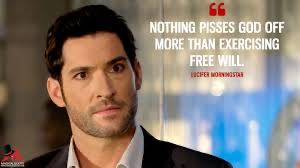
When you come to a fork in the road, choose free will. Free will represents the exercise of power to act without the constraint of necessity or fate; the ability to act at one’s own discretion.

It may seem at times the choice is not yours to make due to arbitrary constraints, external pressures, forced needs or just happenstance.  Ultimately though, choosing free will is always the best choice.

Use the Power Within

Each of us has the ability to create and use earned power.  We all have the ability to select, influence and change an outcome (i.e., the exercise of free will) even when we are not specifically granted that authority.

This is not the default state though and the exercise of free will requires skill and effort.  When you are presented with options and need to decide your personal approach, the exercise of free will can be the most satisfying but also may be the most difficult approach.

For me, the mantra is “I choose free will”.

It is Satisfying

The most powerful argument for the exercise of free will is the associated pleasure it gives you.  It feels good to take charge of our destiny and while not usually the easiest path it is certainly the most personally fulfilling.

Of course, as will all things balance is key.  Taking charge and blatantly exercising your free will can harm relationships with others and the overall result could be catastrophic.

So do take care, but don’t dodge undertaking the use of your free will because it is too hard.  Ultimately it is worth it.


Empowerment

The term empowerment can be used to refer to the process of becoming stronger and more confident, especially in controlling one’s life and claiming one’s rights.

Or in the corporate world, it is more commonly viewed as a component of the culture set by leadership.  In this case it is more about granted power, that is the limits of authority or power given to someone to do something.

Contradictory but Related

In one context empowerment is granted and in the other, it is just taken.  In reality, your personal empowerment is a balanced mix between these two approaches.

How much authority you earn or take on to make yourself stronger and more confident contains some risks.  You may end up suffering consequences from overstepping your granted authority (for example termination) or you may receive a great reward (for example promotion).

Own It

Seeking to become stronger and more confident by taking control of your destiny is not in direct opposition to working within granted authority limits but rather must be used with care to avoid backfiring with unpleasant results.

Ultimately though, your success and aassociated happiness is linked to taking ownership and accountability.  Push the bar, not to far but enough to enable achievement of real personal growth, without consequences.

As you move through life’s experiences seeking and executing that balance is is critical to growing your self satisfaction.  Take control learn from it and  become better for it.

Finding the optimal balance of self empowerment can  bring you great joy.


Express Yourself

Our feelings can often drive how we express ourselves.  We want to show our feelings in a way other people can understand, not be offended and respond appropriately.

Or sometimes we want to hide our feelings as expressing them may do more damage than help.  A key component of managing your feelings is expressing them positively, containing them when appropriate.

Control

Communicating in a respectful way how you feel is not only more likely to achieve results, it’s also a way to reduce your own levels of stress.

Being proactive in dealing with potentially difficult situations arising from your feelings can be a very beneficial outlet.  Storing your angst and frustration is much more stressfull than addressing it.

The challenge is to communicate in a way that does not escalate your feelings but rather puts them to bed.  This requires both careful thought and the exercise of control.

You are in Charge

The key to managing your responses to strong feelings is ensuring your associated behaviours are targeted toward outcomes.  Think through what results you desire, emotions aside, than plan actions likely to lead to the desired effect.

Consciously take charge of your actions, don’t let your feelings overwhelm you.  This will allow you to avoid reacting like a volcano.  If you do explode be sure it is a planned and measured one.

Expressing yourself is an individual activity.  It is about you.  Others cannot do it for you nor should their actions overtly influence you to expressions you may regret.

Take charge of your feelings and the results will be gratifying.

Happiness

The formula for a happy life is not a secret. Tal Ben-Shahar is a self proclaimed happiness researcher. He has a doctorate in organizational behaviour.

Mr. Ben-Shahar famously advised Michelle Obama at their first meeting, when asked what he did, that he was a happiness researcher. Her classic reply, “Oh, is that a thing?”

Ideas

Tal travels the world consulting and lecturing on happiness related behaviours and concepts. One of his several books on the subject, Learn the Secrets to Daily Joy and Lasting Fulfillment, led me to todays topic.

Happiness is of our own making, yet, as implied by the self help books title there is some secret to attaining it. Personally, there is no secret. I know what makes me happy, actually I would suggest most people do.

Choosing to be Happy

For me the hallmark of the work of Tal Ben-Shahar is not researching happiness itself but rather how to practice happiness focused behaviours.

Ultimately it is about choice. The first key step in the secret formula to happiness (which is not really a secret at all) is choosing to do so. Of course the cavet is, “Not at the expense of others”.

Knowing what mkes you happy and choosing to behave in ways that create personal happinessis in fact the simple bu effective secret formula.

The key to this is resisting the urge to let external factors, those out of your control impinge on your happiness. You can contro your own reaction to everything so whatever happens, perceive it correctly and you can be happy.


Confidence

Self confidence is the belief you can rely on yourself.  The level of your own self trust is reflected by your behaviour. 

Intrinsically, we all have firm trust in ourselves but it can be eroded over time through the influence of environmental circumstances.

Believe

It is very important to take accountability for your self trust.  Personal confidence is yours to own and manage and yours alone. 

This does not mean you should be unaware or heedful of feedback and signals from others either verbally or through actions. 

The key point is to remember is this is your life and while your actions should not be taken with an unwavering conviction that you are right, neither should you bow to others unless the rationale is strong. 

Be Firm, Not Stubborn

Personal confidence is not about charging head first like a bull, challenging all around you and portraying a high level of firm self trust. 

It does empower you to be firm in your beliefs not to the extent of stubbornness but rather to the level of fair judgement.

Be aware of your surroundings but trust in your ability to judge fairly the best path to follow.  Firmness is articulated through reasoned analysis not forceful action.  

Rely on Yourself

The most important message associated with self confidence is the belief that everyone is important, that includes you. 

Managing your Self Image

Not surprisingly how you perceive yourself is a foundational aspect of how others perceive you.  As with most things, it is the extreme aspects of how you see yourself that are most impactful, balanced behaviour is often overlooked. 

The mental picture you have of yourself is intricately in-twined with your values and personality.  It’s also impacted by the way you believe others view you. 

Self Worth

Your interpretation of the intent of other peoples actions can drive your behavioural responses to them.   You believe their actions represent what they think of you, coupled with how you wish to be viewed (your self image) if their is a gap, a strong emotional response can occur.

To a large extent the your mental image of what you are and how you should be perceived is unconscious and the associated emotion laden response might not be well thought out. 

In fact, without consciously realizing you may believe the others are making an attack on your self worth.  They think less of you than they should.  The reality could be quite different and their behaviour was just innocuous (to you it was ferocious). 

Think about it!

Pride, in the negative sense, can lead to an irrationally corrupt sense of your personal value.   In this case, your pride can be the driver of inappropriate behavior and in a vicious cycle of truth, this leads the others to develop a negative perspective of you, when in fact none existed before, you only thought it did.   

Disappointment

Sometimes we feel thwarted because our hopes, desires or expectations are not achieved.  The outcomes fall short of where you wanted them to be. 

Disappointment is all about personal perspective.  The situations that disappoint are as much about you perceiving poor results as the poor results themselves.

Optimism

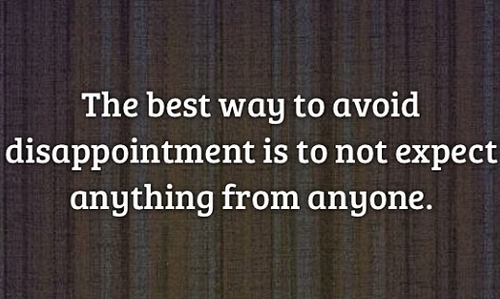
Expecting the best outcome can be optimistic and not always realistic, accepting the outcome as the best might not be realistic but it will avoid disappointment.

Reaching for prefered outcomes, believing they are possible is a form of optimism; however don’t let your optimism become a driver of disappointment. 

Moving On

Disappointment can lead to disengaement and reduce your motivation to make things better.  Disappointment is real but should not be allowed to interfer with moving on.

Acknowledging disappointment even sharing it with others can be theraputic but it should focus on acceptance or planning how to resolve things to meet your expectations.

Of course lowering your expectations to match the outcomes is one way of resolving disappointment, that is not what I am suggesting.

Letting your disappointment fester like a wound is much worse, so acceptance is more about getting to a place you can live with the outcomes. 

Manage your Expectations

The core action for avoiding disappointment is to manage your expectations.  That is not to say you shouldn’t set the bar high, rather recognize how realistic your desires are and temper your expectations accordingly.

This does not mean you will never be disappointed, but instead your reaction will be positive, healthy and lead to something better.

Anticipation

When you expect with a high probability that an event will occur, you are experiencing anticipation.  This can be something pleasant or not so pleasant and the anticipation reflects that prediction.

Positive anticipation is associated with excitement, in fact it seeds it.  Anticipation can be also be worrisome particularly if there is uncertainty about the outcomes.  This can be stressful. 

Anticipate – Manage

Recognizing circumstances which are underpinned by your anticipation of the ultimate results is a worthwhile skill.  Conscious identification of an anticipatory situation enables you to control your behavior. 

Often associated with the unknown is worry.  Consider the case where you have left your car with a repair shop.  You expect the result will be a resolution to your car trouble (a good thing) but worry it might take longer than you anticipated and/ or cost more. 

To a large extent worrying about this has little impact on the end result, it will be what it will be.  The danger is in the effect it has on your behavior.  You may have trouble concentrating or be vague or curt in your interactions with others as you worry about what is going to happen. 

Common Sense

Applying common sense, anticipating bad results probably will not change anything but can negatively affect your reactions/ behaviors.   So concentrate on the positive, anticipate good outcomes, be happy, after all, why not?

Let your anticipation be exciting (a positive emotion).  Or more forcefully put, anticipate the positive, be excited, act accordingly. 

Don’t worry about unexpected results, according to Murphy’s Law they can and will occur.  

Are you feelin Alright!

How you feel is part of a thought process.  This process is centric to YOUR brain.   The brain is not autonomous for most things (exceptions are basic things like normal  breathing).  In fact, the behaviours and feelings derived from  the data you receive from your brain are yours to control and yours alone.

The brain does not action, it provides data which you use to decide and implement action.  Therefore, logically, you will never feel bad.  Why would anyone decide to feel bad.

The operative descriptor here is “bad”.  By definition the things described as bad are negative.  Negative is typically not a desired state of being.

People do feel bad

The simpliest explanation for choosing negative feelings and the associated depressed and sad behavior is based on the analysis of the data.

You parsed the data provided by your brain and decided the most appropriate internal response was to feel bad.

Personally I wonder what the value equation is.  The data could be a death of a close friend or relative, loss of something you hold dear and a thousand other things as simple as dark cold days.

My own approach is to feel good, regardless.  Why not?  In truth, up to the point of my own death, anything but feeling good, upbeat and happy seems pointless.

I choose how to feel, act and behave and logic dictates sad unhappy feelings make little sense.  Maybe I am part Vulcan.