Tag Archives: patience

Recovery is Possible with Patience

Back in April, one of my QNAP network access storage (NAS) devices was subject to a ransomeware attack.  The cause was identified as a vulnerability in the built in media streaming application.

The company (QNAP) acknowledged the issue and very quickly fixed the flaw and issued a firmware update including enhanced malware detection and removal.

Nice try

They also disabled the old media ware software on all devices using their cloud (myqnapcloud.) in an attempt to deter the virus from infecting machines it had not got to yet.

For me the good news /bad news was one of my devices was not protected in time but the other largely was with only one file impacted (which I had a copy of elsewhere).

For the other device however basically all the user files were encrypted.  I did not purchase the encryption key (about $500 in bit coin) but rather decided to wait and see if a recovery approach would be devised by someone.

QNAP comes through

I recently contacted QNAP support because I found on the web they had developed a recovery process which they would run for you remotely if desired.

Unfortunately after several tries we could not get a stable remote access to my device so I just decided to follow the instructions and attempt recovery myself.

I was able to recover about 70% of the files and many others I had copies of on other drives.  Bottom line I was able to recover the majority of my lost data as well as taking the opportunity to clean-up  my data storage overall.

Moral to the story, the evil hackers can be defeated although I understand it is estimated they made almost half a million of the attack from those that did pay.
Have Patience my Friend

All of us has some capacity to accept or tolerate delay, trouble, or suffering without getting angry or upset.  How much capacity varies both by each individuals personality (go to behaviours) and perceived circumstances.

If your expectations were set through a hard commitment you may have little patience with delays however even in these cases you may be able to accept poor performance.   A lot depends on the personal impacts, i.e., is it painful or just annoying?

A Virtue?

Some associate patient behaviour with high moral standards and thus patience is often classified as virtuous.  Basically your tolerance and ability to accept the failings of others is a positive value.

For me this is not an absolute value but rather, as with so many things, patience needs to be a balanced behaviour.  There are times to act on your frustration, but with appropriate thought.

In other cases the results will turn out better and most likely be sustainable if you wait.  Exercising patience is best managed through a self assessment.

Eating Away at you.

When something does not occur in accordance with your expectations you may well be feeling of upset or annoyed, especially when you are not readily able to change something or achieve your goal.

Caution is recommended to avoid acting in a ways which  moves you further from your goal.  Granted the delay be upsetting but your first approach should also ways be to pause and reflect.  Waiting a little longer is probably not going to be a disaster.

Responding too quickly could well make things worse.  This is not to say patience will lead to resolution.  Balance your frustration with an appropriately timed plan of action.


Maturity is not about age

Behavioural maturity is benchmarked against characteristic behaviour of a well balanced human adult.  While subjective to a degree mature individuals are able to practice interpersonal skills in ways that lead to consistently positive results.

Maturity is learned through observation and strongly environmentally influenced however the basic behaviours are mainly logical and intuitive.

Acting with Maturity

Although education and experience are cornerstones of mature behaviour this doesn’t necessarily mean older people will behave in a mature manner and younger people are not yet able too.

Selecting the most appropriate way to interact with others or respond to any specific set of circumstances is improved by background knowledge and understanding of what is acceptable  or not but common sense and intuition are also key skills.

Choosing the best ways to react requires a basic understanding of human nature and associated best practices but also relies  on the ability to be patient, empathetic and prudent.

Interactive versus Reactive

A basic tenant of mature behaviour is recognition all interpersonal reactions contain a social component to some extent.  Although the extent of socialization is dependent on the nature of the interaction it is always present to some degree.

Acting in a way that clearly recognizes and respects the needs of others (i.e., social requirements)  is a key sign of mature behaviour.  Recognizing normal behaviour requires consistent and complete repect of both yourself and others (the core of maturity).

Mature behaviour also needs to be intrinsic to the way you think and act and otherwise will be easily recognized by others as superficial.

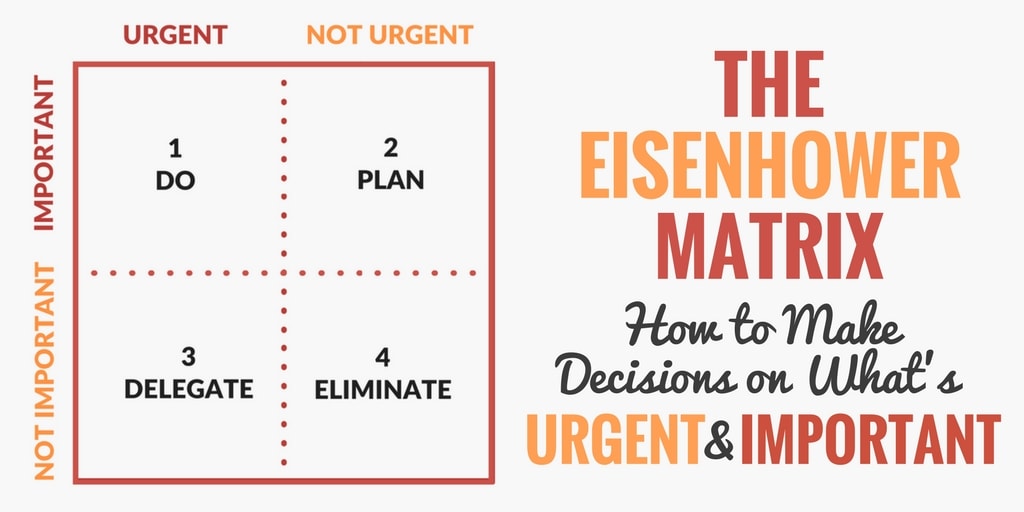
Eisenhower Decision Matrix

Yesterdays post about patience got me thinking  a littlebit more about when it is appropriate for the urgency/ impatience balance to favour urgency.

This reminded me of the Eisenhower matrix which classifies activity based on it’s urgency and importance.  The simple question to ask is, how important is what I am going to do  (i.e.,  task, activity, strategy, behavior and so on)?

The combination of urgency/importance can help guide the best mix of patience or perhaps impatiece, that is need to get it done right now.

Importance speaks to value, spending lots of time on less important activities is obviously less value than spending little time on important actions.

Definitions

Important tasks are things that clearly contribute to our strategy and objectives.  We know they add value because they specifically solve a specific defined objective.

Urgent refers to any activity or task that seems to require require immediate attention. These are the things that we percieve to be  shouting “Now!”.

The Matrix

Eisenhower’s matrix classifies things we want to do based on a Y axis of low to high urgency.  The x axis is low to high importance.  This results in four main quadrents:

  • Low importance/low urgency – spend a lot a patience on these, in fact why even do them at all.
  • High Importance/High Urgency – based on the classification obviously worth doing quickly, don’t waste patience on these.  It is not appropriate and maybe detrimental.
  • Low Importance/ High Urgency – You kind of wonder whats the urgency if it is not important.  This is a category to be carefull with and a modicum of patience does not hurt.
  • Low Urgency/ High Importance – there is good value here, they are important but be patient as you complete the work.  Focus on getting the best value, patience is an asset.


Patience

A valuable but often overlooked personal skill is the ability to accept or tolerate delay, trouble, or suffering without getting angry or upset.

Some demonstrate little patience and even proclaim “I don’t have the patience for this”.  This is not necessarily considered a negative trait  (i.e., lack of patience), but maybe to some degree, it should be.

Balanced Approach

Like so many things, the extreme approach is seldom most effective.  Which is better, being direct, forward and focused on quick results versus the analytic, patient approach?  This question has no definitive answer and the best way is often contextually driven (i.e., what is the overall situation).

A complete lack of patience can lead to presumptuous actions while too much patience is not only frustrating but can be the result can be dissappointing as well. Carefully considering the options of each approach and employing the best mix is likely to lead to better results.

Waiting Patiently

Waiting patiently is an interesting approach.  Initially, it can appear indecisive, just waiting for the default to occur.  On the other hand, it can be a calculated method to gather enough data to inform proactive behavior, before actually acting.

Patience, by and large, results in either acceptance or a deliberate alternate action with a full understanding as to why.  As time progresses you have the ability to consider and ultimately decide to live with the way things are going or take an alternate.


Patience

Patience is the ability to tolerate delay, trouble or suffering without getting angry or upset.  ” Patience is a virtue” is a fifth century proverb as applicable now as it was then.

In effect controlling negative emotions like anger or anxiety usually creates the opportunity to respond to a particular situation more effectively than if your actions are clouded by feelings.

It is, what am I going to do

Years ago I attended a seminar where the leader suggested taking the approach “It is what it is” when presented with a frustrating situation you had little to no control over.

Since then I have used this techique often and found it leads to patience.  Most importantly though acceptance of things outside your control reduces the likelihood of behaving inappropriately.

Frustration is a leading cause of actions you regret later, yet it really is a weak excuse for misbehaving.

Act when you can, Patience when you can’t

A wise consultant (yes they do exist) once advised me not to worry about things out of my control because there is nothing to be done anyway (i.e., exercise patience) .

He also noted I should not worry about the things within my control, because I can, and should, act to resolve them (patience is not needed in this case).   Following this advice leads to a worry free life.


Seeking Patience

My younger brother is the administrator for my mothers estate.  Getting probate, gathering, disposing and distributing the assets takes time.

My other brothers and sister are possibly feeling like I do, that in this case, the time it is taking is a bit too long.  My younger brother explains, “I’m on it”

Sounds okay until you realize thats what he said after buying new hardwood flooring material for his kitchen.  “We asked when it would be installed , I’m on it he said”

Ten years later he returned the hardwood floor in the original packaging and Home depot gave a refund. I guess ” I am on it ” does not necessarily mean it will get done.

Last week my younger brother asked me for one thing.  “Can you just give me one thing bro”. “Sure I said innocently, what do you need?”  “Just patience” he replied

And there it is, a request for me to accept or tolerate delay, trouble, or suffering without getting angry or upset.  It got me thinking, why not.  Probably a very reasonable request and ultimately the anxiety and frustration that usually go hand in hand with lack of patience would dissipate.

The value of Patience

On pondering this  simple request I quickly realized lack of patience was not a pleasurable state to be in.  And for what.  Certainly everything unfolds in the fullness of time (love that phrase) .

So why suffer the anxiety,  when it is unlikely to change anything anyway.  Maturity has taught me, if I can’t change or control it, why sweat it.

And so, in the fullness of time my mothers estate will be resolved, and I’m okay with it.

Practicing Patience

I struggle with waiting.  To be good at waiting for something requires patience.  Behaving patiently is a skill worth mastering.  Precipitous actions have a medium to high risk of unwanted results.

Often when waiting I allow myself to contemplate all the disaster scenarios.  For example, there will be no tickets left when I get to the front of the line.

You have time while you are waiting so filling it with thoughts that make you uncomfortable, nervous or afraid is easy to do.  This is not the best use of wait ime and can lead to unfortunate reactions – anger, frustration and so on.

Achieviing a state of happy patience

Given being patient gets better results and lowers the risk of negative feelings being able to practice this behaviour clearly has some value. The real question is how to do this.

Like any skill, it can be learned.  The first step is to create a realistic understanding of what patient behaviors are.  If you can’t visualize what it looks like it is impossible to imitate.

Patience is individual to a certain extent so you need to understand what it means to you.  Secondly, it is important to buy in to the value equation.  That is accepting the arguments here as to why being patient is beneficial to you.

Pay Attention

Be aware of how you are reacting, that is how you feel and what you are doing.  If you are waiting think about why you are waiting and what is the prize at the end.  simply put focus on the positive.  Don’t let your idle thoughts drag you into the abyss.

Give it a try next time you cannot get instaneous gratification.  Relax, you’ll figure it out.