Tag Archives: risk

Manage Risk Don’t Worry

There is almost always the potential for danger, harm or loss with everything we undertake, that is a risk.   This can lead to anxiety or unease as we allow ourselves to dwell on upcoming difficulties or troubles, that is worry.

Often when we are exposed to danger, harm, or loss our emotions kick in, and rather react in a logic-planned way we panic and get anxious.

Substitute Risk Management

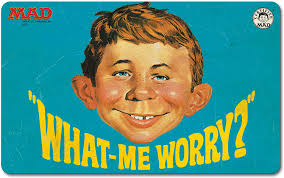
Some of you will remember the popular Mad magazine character from the sixties or seventies – Alfre E Neuman.  His tag line was “What?  Me worry”.  (Not sure what his motivation was.)

Personally, I emulate that motto but my rationale is based on constant and effective risk management.   Things we worry about stem from the risk of something untoward occurring and if we plan to prevent it or how we will manage if it occurs then, why worry?

Think Ahead

Basically when you undertake a goal or plan an activity think about possible outcomes.  Don’t overthink it, that in itself can be worrisome, but consider reasonable possibilities.

Some of the things that might occur might be less than pleasant, bothersome, or even totally undesirable.  Mitigating these risks, that is planning what to do if they occur to lessen the damage or even prevent occurrence are things you can do.

By preparing for risk and being ready to take action as needed you to remove the unknown, fear, anxiety, and uncertainty is tamed, and voila worry is gone.

Hard to believe but it is that simple.  What? Me worry.  Why would I engage in a needless and unsettling emotional activity?  I can see no rational reason to do so.
No Regrets

We make decisions every day.  In some cases, our decisions can have positive results and in other situations,  negative consequences.  Warnings can influence our decisions but are not necessarily the deciding factor.

Taking heed of a dire warning could cost you time, effort or financially but the risk of not doing so needs to be carefully weighed.  If the worst happens can you live with it?

For Example

This is a simple scenario but illustrative of the principle.  I needed a gas fill-up yesterday.  On the way to the station, I noticed my window washing fluid seemed to be coming out low and slow.

Around this time of year in the northerly clime, I live in when the weather warms up a bit the roads become messy and spit a lot of dirt on the windshield.

Without adequate windshield fluid, your view can become so clouded that you actually need to stop driving, get out and manually clean it.

The Decision

Since I was stopped for gas anyway, I asked myself should I acquire some more windshield clean fluid to be ready to add when it actually runs out?  It seems like too much time and effort, a mild warning was there but not cataclysmic so ignored.

Less than 1km from the gas station my cars visual and very annoying audio warning about low fluid happened.  Yikes I made a bad decision.

But No Regrets

Now I had to go somewhere and get fluid or I would really regret it.  So if you are going to ignore the first warning signs be sure you are okay with what happens next.  No regrets.

What makes a company great

  1. I participated in an interesting discussion today about one of the most strongly held perceptions about businesses, that is big companies are “too big too fail”.

Does size of revenue, as an indicator of overall company size, provide an indication of stability, maturity and capability?  That is, large cap companies have more mature operations.

The theory is large companies have developed mature processes and practices that enabled them to grow large and maintain their size.

These so called blue chip companies are unlikely to suffer severve drops in value or even collapse.  And if they did someone would be around to pick up the pieces and keep them going.

Intuitively Speaking

A small or medium enterprise might fail more often than a large cap company.  Common sense would dicatate the large company  is less likey to make mistakes or engage in unnecessary or risky practices.

The reality is making silly mistakes, having unmanageble bureaucracies or disregarding stakeholder needs are actually more likely behaviours within a large company environment.

With size, control practices and leadership practices  should be more mature enough to deal with the challenges that come with size (more employees, more regulations, and reputational constraints).

Just because it should be, does not necessarily mean it is.  Due diligence of large company management, infrastructure and financial framework is just as needed for a large entity as it is for a small to determine the risk and benefits offered by the corporations environment.

Judging

When you form an opinion or reach a conclusion about a set of data you are judging.  The process may include both active or passive fact gathering as well as consultation with others.

Danger, Will Robinson, Danger

In the late 1960’s, “Lost in Space” was  a popular TV series modeled after the childrens novel “A Swiss Family Robinson” . The TV show was about a family lost in space (in the book they were lost at sea).

The TV family had a robot cleverly called Robbie (Robbie the robot).  The young adolescent member of the family (Will Robinson) often made decisions based on questionable judgements at best.

The flawed judgements were regularly identified by Robbie (the young masters protector)  who would ejaculate the catch phrase “Danger, Will Robinson, Danger”

This became a very popular catch phrase of the time, as sound bites from popular television shows often do.   Of course the audience recognized this as a clue Will was about to suffer the consequences of a bad judgement.

Judging

The act of judging represents a mixing of the objective (facts) and the subjective (assumptions and conclusions).  While we cannot live without making judgements, caution is advised.

Like Will, the  fictional intrepid space traveller, we all run the risk of adverse consequences resulting from our behavioural decisions, which are based on our judgements.

Unlike Will we do not have Robbie the robot around to warn us.  My advise is to think through the potential impacts associated with your judgements.

Consider the worst potential result and be ready to accept it before acting.  If it is unacceptable, reconsider the judgement and your approach.  This could save you some grief.