Tag Archives: anxiety

Be Calm

The time you spend with your thoughts can be refreshing and invigorating.  Thinking is a foundation of creativity.  However, anxiety and overthinking also begin with thought.

Our thoughts can take over and be in control.  Typically when negative feelings are generated during moments of focused thinking it is not because we desire to be become anxious, depressed, fearful or something similarly negative.

Be in Control

Putting science fiction aside, today outside of extreme cases (e.g. brainwashing, torture, hypnotism) we are solely in control of our minds.

The subjects we focus our thinking on may arise from our sub-conscious but always we have the ability to take control and decide where these conversations with ourselves will lead.

Why Worry?

Giving way to anxiety or unease by allowing one’s mind to dwell on difficulty or troubles is a choice.  What do we achieve by making the decision to worry about something?

Worry leads to feeling troubled or concerned and typically creates stress together with the associated physical reactions (e.g., high blood pressure, reduced ability to focus, tiredness).

There is little positive value resulting from being worried about things.  We our in control of our own thoughts so choosing to be calm enables us to avoid the negative results of being worried.

It is a Choice!

For each of us there are different ways to manage our thoughts, take ownership and be in control.  By taking control of our minds we determine what the outcomes of our thinking will be, that is choosing to be calm whatever the scenario.

The key point is not which technique you select to avoid worry and become anxious but rather recognizing it is your choice to do so and choosing wisely.

Manage Risk Don’t Worry

There is almost always the potential for danger, harm or loss with everything we undertake, that is a risk.   This can lead to anxiety or unease as we allow ourselves to dwell on upcoming difficulties or troubles, that is worry.

Often when we are exposed to danger, harm, or loss our emotions kick in, and rather react in a logic-planned way we panic and get anxious.

Substitute Risk Management

Some of you will remember the popular Mad magazine character from the sixties or seventies – Alfre E Neuman.  His tag line was “What?  Me worry”.  (Not sure what his motivation was.)

Personally, I emulate that motto but my rationale is based on constant and effective risk management.   Things we worry about stem from the risk of something untoward occurring and if we plan to prevent it or how we will manage if it occurs then, why worry?

Think Ahead

Basically when you undertake a goal or plan an activity think about possible outcomes.  Don’t overthink it, that in itself can be worrisome, but consider reasonable possibilities.

Some of the things that might occur might be less than pleasant, bothersome, or even totally undesirable.  Mitigating these risks, that is planning what to do if they occur to lessen the damage or even prevent occurrence are things you can do.

By preparing for risk and being ready to take action as needed you to remove the unknown, fear, anxiety, and uncertainty is tamed, and voila worry is gone.

Hard to believe but it is that simple.  What? Me worry.  Why would I engage in a needless and unsettling emotional activity?  I can see no rational reason to do so.

Peace of Mind

Living in a state of anxiety and uncertainty over actual or potential problems is a personal choice.  We can choose to give way to anxiety or unease and allow ourselves to dwell on difficulty or troubles.

Or not.

I do not intend to advocate the ostrich approach, that is choosing to hide your head in the sand (avoid reality) and a staying away from worry, however, allowing yourself to be anxious or worried when there is nothing you can do about it seems to me to be just a way to propagate unpleasant feelings unnecessarily.

Why Worry

Emotions that typically do not raise your level of pleasure (for most of us) exist for a purpose.  Things like fear, anxiety, and worry do have value but we often allow ourselves to experience these emotions when it really serves no purpose.

This raises the question, should I worry about something and if not then why am I?  Fair question.  I think the answer lies in the level of control and level of impact.

Consider – Why do I care?

The value worry brings is the resulting actions it prompts you to take.  Worrying continuously without addressing the root cause is both painful and relatively useless practice.

Most importantly don’t ignore your worry, do something about it, this might just be acceptance.  The key factor here is determining if you can do something about it, if not, accept and move on.

For example, recent budget cuts by the provincial government where I live are resulting in job losses.  Can I stop it, probably not?  Can I prepare for the eventuality, of course, there are many things I can do.

So I don’t worry, I just act.

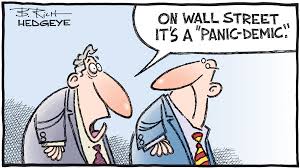
Panic Demic

In a time of a pandemic, the new norm becomes social distancing.  That is keeping at least one meter away from others.  Perhaps elbow bumps are okay but handshakes and hugs are out.

Given the covid -19 virus can live on surfaces for up to a week or more I am not sure social distancing has great value.  Airborne transmission is considered not to be the main vector, although not much is really known.

Over Reacting

This is a serious disease that is propagating rapidly, often passed by carriers with no symptoms.  The illness can be fatal.  Putting protective and preventative measures in place is only common sense.

In this situation not reacting makes no sense but overreacting/panicking is probably not a good choice.   Things like hoarding or pure isolation could be more harmful.

In Canada, the authorities’ reactions have been somewhat measured but the general populous is acting in full-on panic mode in some cases.

Economic Reality

World wide commercial activity is clearly going to be reduced during this pandemic.  This loss of productivity will worm through each countries economy over time.  This is obvious.

What I find hard to understand is the running for the exits before the fire has really started.  Stock markets around the world have crashed, but the economy soldiers on.

Must be anticipation.  Herd mentality. All-consuming panic.   Basically just a sudden uncontrollable fear or anxiety leading to wildly unthinking behavior.

For all the good it does.  Not!


Why Worry?

Don’t worry you can figure it out.  This can work really well as a personal philosophy provided you don’t make it too all-encompassing.

Figuring stuff out is virtually always possible.  However, sometimes it is not expedient or efficient and quality often is diminished.  Completing a task or objective at the moment might work but might not be the best solution.

Risk Prevention

Identifying things that could go wrong and proactively working out an approach to mitigate them when they do can be more effective than figuring out how to deal with the issue when (and if) it occurs.

In both cases though, whether you plan in advance how to resolve problems or deal with them at the moment, there is nothing to worry about.

Fear and worry arise because we intuitively recognize working things out on the fly can be challenging and might not produce top quality results but we should not worry about failure, somehow we always figure it out.

Avoid Rushing

Working out how to deal with a problem or unexpected event can be a rush; both from the surge of adrenaline and the need for speed perspectives.

Being aware of things that could go wrong and preparing in advance (i.e., figuring it out) is probably the best approach to dealing with problems but is not always practical.

Worry about things in advance though does not make sense. Either plan how to address it before it occurs (in case it occurs) or be ready to deal with it at the moment.  However you choose to figure things out, in advance, in the moment or a combination of both approaches, remember, there is no need to worry.

Challenge/Stress/Anxiety

Anxiety is a natural response to stress or lack there off. Most associate anxiety with the presence of stress, however, the absence of purposeful goals (with their associated stress) can also be worrisome.

While anxiety is typically a feeling of fear or apprehension about what’s to come a lack of naturally occurring challenges or potentially stressful scenarios drives us to find things to worry about.

Making it up

In the absence of things that create stress we will often imagine potential worrisome scenarios. Interestingly, having nothing to do can be as stress as the more commonly recognized scenario of having too much to do.

Our minds are always active with conscious and unconscious thought. Thinking is a constant activity, we cannot avoid brain activity. If your environment is not stimulating you, often you will imagine issues – a car running out of gas, slipping on ice and hurting yourself.

Stress drives behaviour and sometimes is harmful, however no stress can cause us to make up stressful scenarios because we need some stress.

It’s a Balance

Too much stress can affect your help, lead you to unsocial or even unacceptable behaviour while too little stress can actually have the same results.

The key is finding the careful balance between too much and too little stress. In essence this equates to manageable or unmanageable stress.

Anxiety arising from manageable stress can be resolved and in and of itself the resolution activities are healthy. Unmanageable stressful situations should be avoided, both circumstantial but more particularly those of your own design.

What’s Holding you Back?

Your power to achieve is only limited by your fear of success.  Often this phrase is stated “…..as fear of failure” but surprisingly unconciously we are often cautious about achievement.

The thought process includes things like:
– Do I really want this change, it seems better, but?
– What will others think of me if I am successful?
– What happens next after this accomplishment?
– If I succeed, things will be different, do I really want that?

Change is Constant

A lot of the reticence to moving forward is related to change itself.  Change represents the unknown and although your objectives are things you desire (by definition) there is always the ever-present anxiety around making a change.  

As I have noted before, in numerous posts, change is inevitable.  Controlling the changes and managing your destiny might be a better approach but often the default to accept and move on is easier. 

Change is going to occur with or without you, would you not rather it be with you?  

Unconcious Anxiety

If your goal is to have a better entertainment experience you may consider replacing your current home entertainment centre.  Success will mean the existing electronics and technology will need to change. 

New skills will be needed to use the new equipment.  How you access and view entertainment will likely improve (that’s the goal) but the current state will be gone.

Do you really want to succeed with this goal?  Is not the current state comfortable, acceptable and easier?  Why make the effort?  There is a fear that success will tear you out of your comfort zone (in this case, relative to home entertainment).

Go For It

Ultimately, moving forward, making the effort and experiencing the results of your success might not always be as expected and could lead for some nostalgia for the pre-success state of things.  However, in the long run  do you really want to stagnate in the past?


Patience

Patience is the ability to tolerate delay, trouble or suffering without getting angry or upset.  ” Patience is a virtue” is a fifth century proverb as applicable now as it was then.

In effect controlling negative emotions like anger or anxiety usually creates the opportunity to respond to a particular situation more effectively than if your actions are clouded by feelings.

It is, what am I going to do

Years ago I attended a seminar where the leader suggested taking the approach “It is what it is” when presented with a frustrating situation you had little to no control over.

Since then I have used this techique often and found it leads to patience.  Most importantly though acceptance of things outside your control reduces the likelihood of behaving inappropriately.

Frustration is a leading cause of actions you regret later, yet it really is a weak excuse for misbehaving.

Act when you can, Patience when you can’t

A wise consultant (yes they do exist) once advised me not to worry about things out of my control because there is nothing to be done anyway (i.e., exercise patience) .

He also noted I should not worry about the things within my control, because I can, and should, act to resolve them (patience is not needed in this case).   Following this advice leads to a worry free life.