
Tag Archives: leadership

Not Knowing

We do not know everything.  Is it a failure to not know?  Absolutely not.  Acting without knowing everything is normal.  Allowing the fear of the unknown to limit your actions reduces your capabilities.

Acting in your best interests is a balance between what you know and the risks associated with the things you are not aware of or misunderstood.

Balanced Behaviour

Most importantly, to be effective we must overcome our fear of failure but not at the expense of proceeding without full confidence.

Blasting ahead like a bull is probably not the most effective approach but neither will hiding your head in the sand like an ostrich.

Outside Influences

Everyone serves somebody (Bob Dylan song title) even it is only none but God.   Our leaders can play a significant role in how we behave.

Micro-managing others often reinforce their natural inclination to caution.  That is taking a chance and trying something where you might fail is unlikely.

If your boss, leader, colleague, etc is unsupportive and likely to be derisive if you make a mistake or do something incorrectly possibly because you just didn’t know, it’s most probable you won’t try.

Effective leaders need to encourage us to be empowered and take action.

Taking a Chance

Making an attempt at anything, taking the initiative and giving it a try is a positive behavior as long is it is tempered with logic and reason.

I advocate taking chances but not high-risk ones.  In leadership situations, the best results arise when your followers understand the fact that you support them and won’t fault them (within reasonable limits.).
Foundation of Leadership

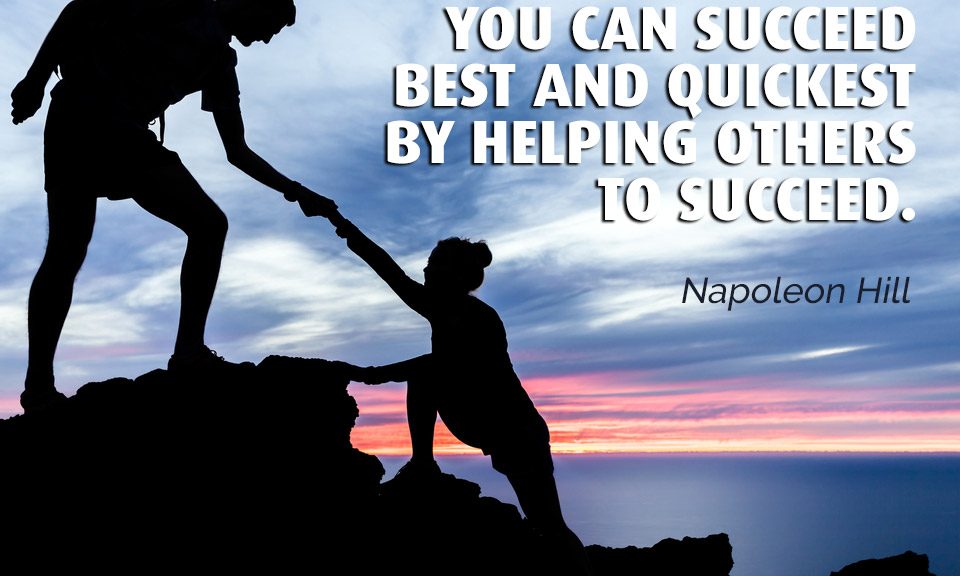
Great personal satisfaction can be obtained through the action of helping others fulfill their potential.  This applies to both the helper and the helpee.

Leaders do many things.  Whether you are a designated leader with a granted power base or you lead from behind larger using earned power helping others is the cornerstone behavioral attribute  (or of course some combination of earned and granted power).

Excellence in Leadership

Many behavioral practices come into play to influence the quality of leadership.  These do not need to be present in equal quantities and in some cases perhaps a particular aspect of emotional intelligence is low or not present at all (e.g., empathy). That is okay.

However, without the ability to facilitate growth in others, you are not a leader ( whether practiced actively or passively).  This is a baseline required behavior of all leaders.

Simply put leadership is not about you, it is solely about others.  The things you impart to others helping raise the potential bar continuously can be self-applied but must at a minimum focus on others first and foremost.

Emotional and Intellectual Intelligence (IQ&EQ)

The quality and effectiveness of a leader can be predicted by the levels of IQ and EQ they demonstrate.  The higher the score in both these categories, the better the overall performance.

Of course, IQ and EQ must be balanced and if individually each does not meet the minimum level (even if one area excels) probably the leader will not be exceptional.

These attributes aside if the aspiring leader does not focus on growing other capabilities they will never achieve greatness in the role of leader.

Your Problem

When your leaders approach is to tell you to bring them solutions, not problems, I question their value.  Should we not expect our leaders to support us.

When someone assumes I am bringing them a problem or issue that I could solve myself it makes me wonder what I did wrong.  My personal philosophy is don’t waste time bringing your problems to others, resolve them and carry on.

When reality intrudes, and I cannot solve it myself then I go for help.  At this point when those I seek assistance from are telling me to show up with a solution, I get a bit frustrated.

Awareness

It makes sense to encourage others to be accountable.  As a leader, mentor or just a friend encouraging responsibility in others is a noble pursuit.

However, blindly assuming those you collaborate with have not thought it through can be more harmful then good.  If you are seeking to change behaviour there must be a good foundation to do so or you are likely to fail.

Taking a blanket position to encourage others to think and act for themselves, that is empower them requires more thought and effort than simply demanding they come to you with a solution.

Understanding

Before saddling someone with a problem make sure that is an appropriate step.  Get the background.  It may well turn out they have thought it through  completely and the decision to seek help is a good one.

Before discounting an approach for help check it out, maybe your assistance is really needed.

Taking Charge

Within the social context of life, all of us have the opportunity to assume control or responsibility for events and actions both internal and external to us.

We can take charge of a group, an event or activity or simply accept full personal control of our own actions.  Taking control removes the ability to blame other people or things.  Nothing made you act beyond your own volition.

Guiding the Result

In a group situation, in the interests of efficiency, it is often helpful if one person acts as a facilitator.  The guidance provided by the recognized authority enables all to act consistently and effectively.

Consider a security guard or first responder providing direction to others in an emergency situation.  Without them, panic could reign and chaos would result.

Sometimes the appointed leader or person in charge is not always obvious.  These cases represent an opportunity for us to step up and exercise leadership, even though we have not been granted the privilege.

For the Greater Good

Being granted authority to take charge (or not) shouldn’t be a limiting factor relative to your decision to step forward and help.  Think of the greater good.

When there is a leadership vacuum the groups’ ability to perform is greatly diminished.  This is not to denigrate the value of collaborative functioning as a whole, that is the hallmark of a high performing team.

However, there are times when group action requires a queue.   Often people are wondering, should I act, what will others think, who is going first, should it be me?

These are great opportunities for you to take charge.  You can influence the result for the betterment of everyone.

I am important, Not!

One of the a leaders greatest failures is a lack of humility.  Often the trappings of leadership, things like large offices, special assistants and inaccessibility, send the message “I am special”

A key to building a strong follower-ship through collaboration is to behave in a way that clearly proves you believe everyone is important, equally so.

  Check with my Assistant

I find nothing more demeaning than being asked to check with an assistant for time to talk to someone who is so much more important than you are they require assistance to control their access.

Great leaders encourage interactions with everyone.  They do not hold their positional importance in high esteem but rather value their followers more.

After all without followers you cannot be a leader.  You can definitely lead effectively without large offices, special perks and  an army of personal assistants, although admittedly these things are nice to have.

Humility Wins

The key is to be consistently humble in everything you do and not lord your greatness over others through boastful behaviour. You must both believe and act like your time is not more important than that of someone else.

The historic trappings of leadership, think emperors and other monarchs, do seem to have benefit from the leaders perspective, not at all from the followers.

When you are charged with facilitating everyone to become great recognizing and drawing out their personal greatness requires you to remain on their level.  They must feel and return your empathy to receive the gift of greatness it is yours to grant them.


Avoiding Mistakes

Mistakes are the product of ill-conceived actions that are typically fraught with peril.  Based on this description of the root cause of mistakes, they are totally avoidable.

Simply put aside high risk approaches conceived in haste and the likelihood you will make a mistake is very low if non-existent.  This is a strong argument for consistently practicing careful analysis and thought.

Reality Bites

In practice taking the time and effort to apply careful analysis and planning to everything we do is impractical.   While careful forethought is a wise approach the situational context is a key factor affecting the feasibility of behaving this way.

Undertaking expediency often leads to mistakes because the urgency can drive us to rushed decision making that is not fully thought out and high risk.

The reality is mistakes can be avoided, however, it is often not a simple thing to do.  As the first step in any decision-making process, it’s most helpful to ask yourself “What can go wrong and if it does how sorry will I be?”

Considering the negative impacts, even if only at a high level focusing on the obvious, allows you to make a choice to stop and take time, even in the face of percieved urgency.

Mistakes can be Painful

While taking too much care to avoid mistakes can lead to missed opportunities taking too little can be painful.  Spending a little effort to help achieve the right balance is always worthwhile.

Avoid the pain, maximize the gain, think a little before you act.


Let it Go

There are times when tenacity, that is the ability to firmly grip something and not let it go, is admirable.  Also, there are times when letting go is the better option.

The balance between determinedly following a course of action (e.g. a personal career path) and changing direction (taking a new career path) is not always an easy one to follow.

Just Move On

Holding on relentlessly can cause internal anxiety for you but can also color other peoples perspectives of you in a negative way.  Being perceived as the stubborn or intractable is a negative spin, it is better to be seen as firm or tenacious.

Managing how others view you is an important life skill.  Recognizing when to drop something is a key part of this.  That does not necessarily mean acquiescence, but rather closing a topic in a way acceptable to everyone that is involved.

Often, to do this, you need to be able to recognize when it makes sense to just let it go.  When arguing or ongoing discussion is clearly just fostering continued disagreement it is likely time to shut it down.

Not Giving Up

It is important to distinguish between letting go and giving up.  These are very different approaches, albeit they can appear to have the same outcome.

Giving up will lead to personal baggage and potentially you will feel bad about yourself.  Letting go is about recognizing that hanging on is painful to you and getting nowhere.

Releasing the pent up emotion which is eating away at you for something that is unlikely to change can be resolved simply by accepting the way it is and moving on.

HelpIng Others

When you are accountable  (others may be executing the tasks required to meet the objective) the consequences associated with the outcomes fall to you. 

There is a delicate balance between directly assisting (hands-on), providing explicit instructions (micro-managing), gentle guidance (mentoring) and full empowerment (hands-off).

Choosing Wisely

Accountability often entails getting things done through others.  How you assist them is a choice and is very dependent on the situtation.  

The option you choose (from hands-on to hands-off and everything in between) will be a significant contributing factor toward success or failure of the activity. 

The key is not to let anxiety about your accountability override the focus on enabling others to excel.  That is, getting things done through others is not about you, it is about them. 

Helping Unostentatiously

Providing help to others achieve the defined objective (your accountability), regardless of which approach you select (hands-on/hands-off), should be characterized by a lack of vulgar or pretentious behaviour which is designed to impress or attract notice.

The most effective assistance, (that is the actions and results are improved), is seamless, not even noticeable.   Helping others without them knowing is always the best approach.  

Everyone is Important

Sometimes the top level accountability is translated into importance.  Importance is associated with the role and location in an organizational or social heirarchy. 

Others performance,  that is the action of carrying out or accomplishing an action, task, or function, is dependent on the importance you place on it.  

Helping someone accomplish their task should not displace the importance they should feel with your own importance (organizational, structural or otherwise) 

Leadership Pyramid

Human organizations typically have a single accountable role that leads them.  This applies whether the group focus is political, corporate, social, charitable and so on. 

The concept of having one leader accountable, that is the place where the buck stops, is an endemic design that repeats itself through the ages. 

Co-Leaders

A simple definition of leader is the person who leads or commands a group, organization, or country.  Significantly by definition we consider the term leader to be singular.  

This is a simple way of defining accountability and limiting our own responsibility.  When something bad happens we can point to the leader saying “They are in charge, they are responsible for the consequences.”

The use of a single leader gives us the ability to defer accountability with clarity and having multiple leaders would make this confusing and potentially obfusticate the issue.

This likely is a key contributing factor as to why we have not seen many instances of co-leadership (there are some) or even multiple leaders. 

Efficiency and Effectiveness

Surprisingly, although teamwork is often recognized as more efficient than individual effort and ultimately producing higher quality results, we stick to our old standard of a single leader at the top. 

For many of us, it is easier to follow than to lead, taking direction requires less effort than participating in developing of the strategy and than supporting the execution (i.e., leading).

And so, albeit a model that logically is not optimal – that of a single leader overall – is the model we stick with.  Interesting, a simple and obvious innovation yet few organizations can make it happen.  

Seeking Direction?

Life encompasses growth, ongoing activity, and continual change preceding death.  From birth to death each of us is on a conceptual journey where our experiences lead to new understandings. 

Our journey can be passive (go with the flow), active (control the outcomes) or a combination of approaches.

 Whether  you choose to control or influence your outcomes, or let someone else do it,  a key factor is what direction are you headed.

Finding Your Way

Your direction is dependant on where you are headed, that is what is the objective or goal?  Sometimes you my have an idea but need some help.

In these cases we often look to our leaders to provide some ideas or indications, even suggestions of our destination.  Ultimately we choose but our leaders can help us make that choice.

Of course in some cases the leaders directions are firm and prescriptive and we just need to go along for the ride.  The more motivating approach occurs when leaders encourge and advise but leave the choice to us.

Passive/Aggressive

When the leaders pronounced direction is not to your liking you may choose to appear to accept the direction (passive reaction) but through your actions do everything to acually go a different direction (aggressive).

Ultimately the path you travel and the destination you reach  are most pleasant when it’s where you want to go.  

This applies regardless of whether you devised your own direction or it was provided by a leader or even just through circumstance.