
Tag Archives: responsibility

No, No, It Wasn’t me.

I heard the classic rock song  “It wasn’t me” by Chuck Berry which appeared on his 1965 studio album ” Fresh Berrys”  on the radio this morning.  This was his 9th studio album.

The title and chorus line appealed to me as a potentially great blog topic.  And so here we are.  In this case, the author is me, but for everything else you want to blame me for, well, it wasn’t me.

On the Defence

It is natural to defend ourselves.  Our unconscious can play a big role in this leading us to explain why it was not us even before we have thought it through.

Self defence can begin even before conscious logic kicks in.  Not surprisingly, this is not always the best approach.  We revere honesty in others and so owning up to mistakes and taking the blame right out of the box can put us in good stead with others.

However, that takes more than a little effort, in main because we will both naturally and unconsciously immediately defend ourselves.  Not sure what the accusation is but “No, No wasn’t me” is often our first reaction.

Own Up

It has been my experience accepting blame, without excuse or explanation (and thats a real important part) focusing on resolution works wonders.

This is not to suggest we should accept responsibility for ever accusation, in particular those for which we really are not to blame.

That said falling on our sword, while not  a natural inclination can very often be the best approach and a way to turn failure into success.

Give it some thought next time the opportunity to avoid blame comes up, maybe you should be singing “ Yes, Yes, it was me”.

 

Taking Charge

Within the social context of life, all of us have the opportunity to assume control or responsibility for events and actions both internal and external to us.

We can take charge of a group, an event or activity or simply accept full personal control of our own actions.  Taking control removes the ability to blame other people or things.  Nothing made you act beyond your own volition.

Guiding the Result

In a group situation, in the interests of efficiency, it is often helpful if one person acts as a facilitator.  The guidance provided by the recognized authority enables all to act consistently and effectively.

Consider a security guard or first responder providing direction to others in an emergency situation.  Without them, panic could reign and chaos would result.

Sometimes the appointed leader or person in charge is not always obvious.  These cases represent an opportunity for us to step up and exercise leadership, even though we have not been granted the privilege.

For the Greater Good

Being granted authority to take charge (or not) shouldn’t be a limiting factor relative to your decision to step forward and help.  Think of the greater good.

When there is a leadership vacuum the groups’ ability to perform is greatly diminished.  This is not to denigrate the value of collaborative functioning as a whole, that is the hallmark of a high performing team.

However, there are times when group action requires a queue.   Often people are wondering, should I act, what will others think, who is going first, should it be me?

These are great opportunities for you to take charge.  You can influence the result for the betterment of everyone.

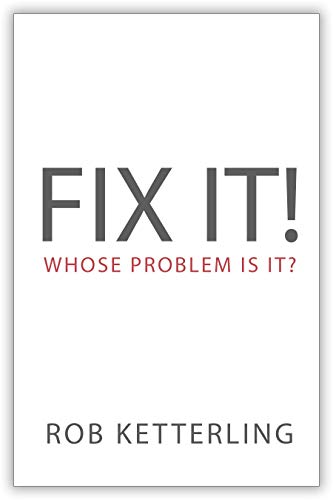
Whose Problem Is It?

At various points in time, everyone encounters a matter or situation regarded as unwelcome or harmful and needing to be dealt with and overcome.

Ignoring the problem, hoping either other people will address it or even that circumstances will change and the problem will just disappear can be options.

Typically though, while these approaches can work,  both are risky with a high potential for failure and the associated negative consequences.

Taking Accountability

One attribute of high performing teams is that everyone accepts accountability.  For important topics, debates or discussions (i.e., issues) the team practices a culture of inclusion.

In high performing groups everyone accepts the need to participate and become part of the overall value add an equation.  Ultimately this means minimal effort is expended to achieve maximum issue/problem resolution.

Building a culture of inclusion and accountability is an activity that everyone needs to participate in.  Achieving a state where group responsibility overrides individual is not a simple task but well worth the reward.

It’s Our Problem

Collaborative efforts, when coordinated and conducted intuitively typically achieve the best results.  Diversity of thinking and approach are powerful tools.

Working together, spreading the effort across multiple resources (rather than relying on a single point of failure) has many advantages over reliance on an individual.

In the case of problem-solving, this requires everyone to take ownership.   They don’t blame or accuse each other, rather like the three musketeers, one for all and all for one.

Worry and Acting Responsibly

Mad magazine first published as a comic in 1952 becoming a satirical magazine in 1955.  The mag’s famous mascot is Alfred E. Neuman.  Alfred’s motto is “What me worry”.

Mad is still published today albeit with a much reduced circulation from their peak year of 1974 (two million).  Maybe they should try pictures of nude women (see yesterday’s post).

I grew up reading Mad (although I have not read an issue in years) and I always admired the “What me worry” slogan.

Managing your Worries

Years ago at a seminar I attended; the key note speaker spoke about using  a shrug and mantra ” it is what it is”  or ” it just is” to resolve things that would worry you and allow you to move on.

Strangely I have found this technique to be very effective for me and practice it regularly.  Logically worrying about, or being bothered by, things you cannot change does not make sense.

What about acting responsibly?

A recent experience got me thinking about some of the potential negative impacts on others  when you follow the “What me worry?” principles.

Let’s say you are regularly late for appointments.   Comments like “traffic was terrible”,  “my wife was late and held me up” can work really well from a personal perspective.  That is to say “it is what it is, what could I do”?   Of course this could work for those waiting for you as well – “It is what it is, you are always late, no worries”.

I do have a bit of emotional reaction to this scenario however.

It make me realize that while the ability to relax and enjoy a moment, not to worry about things that don’t deserve to worried about is a great practice to have in your behavior arsenal, but like all things a balance is needed.

Everybody is important and a promise is a promise are key values that need to factor into this equation.  Sometimes worrying about how you negatively impact others is appropriate.