Tag Archives: understanding

Short and Sweet

When communicating with others there is a lot of good things to be said about being brief but still complete, accurate and to the point. 

Over many years of practicing both written and verbal communication to small, medium and large audiences, I learned from feedback, short and sweet was best. 

Retention

If your intent is to for the audience to absorb the messages short and sweet is the way to go.  I have often heard other describe how a long monologue or book length explanation is needed. 

My response, as cynical as it may sound, is always, “Why to bother, most of your content will be wasted effort.”  Experience has made it clear to me, length rarely, probably never, adds clarity. 

Motivation

Length also is a great motivator to incent the reader to procrastinate.  How often have you followed up on a message you left and been told: “Saw it but didn’t have a chance to read or listen yet.”

Basically,  the message to you (which is short and sweet) translates to: “Your massive input is a bit overwhelming, I know I have to get to it but hopefully later rather than sooner.”  

Call to Action

 Every communication should have a purpose.  Broadly you can think of this as a call to action.  That is, what do you want the recipients to do.  This could range from do nothing beyond increasing knowledge and awareness, to a very specific measurable activity (e.g., buy the car).

Whether the call to action is physical and measurable or just an increased awareness understanding your intent and how you will confirm it was achieved are all part and parcel of the short and sweet communication strategy. 

Ultimately, over time, it is likely you will find much more success achieving your call to action when practicing short and sweet, than otherwise. 
 

Perspective

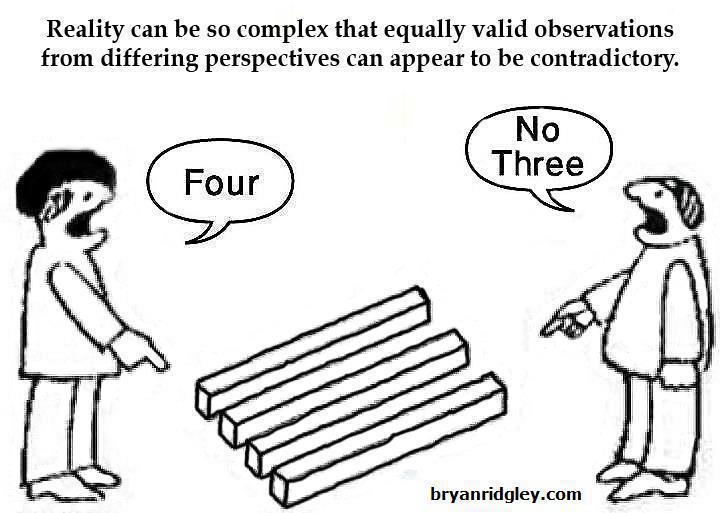
Your personal particular attitude toward something (i.e., a point of view) could be unique to you or it could be shared by many others.  This perspective defines how you interpret information about the object of your attention. 

When the perspective is largely the same among a group, the attitude becomes a truth – i.e., lots of people see it that way so it must be correct. 

Of course, this is not necessarily the case and perceptions can be both illusory and bias based.

It’s an Illusion

For example, an optical illusion can be interpreted by most in the same way but by its very definition, it is not real.  In this case, the majority perspective would not match reality.  

It does raise the question though, if the majority perceive a thing to be so, does it become fact?  Facts are provable and examination of the illusion would prove it not to be true, therefore the majority perspective might be indicative but it should not be accepted as fact.

The world is flat

A classic example of this is a common belief that the world was flat and if you traveled to the horizon you would fall off.  At a time this was believed to be true by the majority (and still a few even today – e.g., the flat earth society) but it was not true. 

Understanding perspective is important to both interpret what others are communicating to you as well as avoiding the trap of believing in a false truth. 

How do you see yourself; How do others see you?

From birth to death everything we do is a form of behavior. The way you act is your behavior.  It defines you. Your behavior is not in isolation and most often the context for behaviour interpretation is how you conduct yourself toward others.

Categorizing your behaviour

Would there be value in interpreting your behaviors in terms of the impacts they have?  Do your thinking style and associated actions support personal effectiveness and satisfaction.

That is, what are the behaviors that define your lifestyle and what is their impact?   Of course, this question depends on perspective.  Your answer might differ from that of others.

Simply stated how you view yourself could be different from the way others perceive you.  To get real value from a behaviour analysis you need to get both what you believe and what others think.

Human Synergisitics

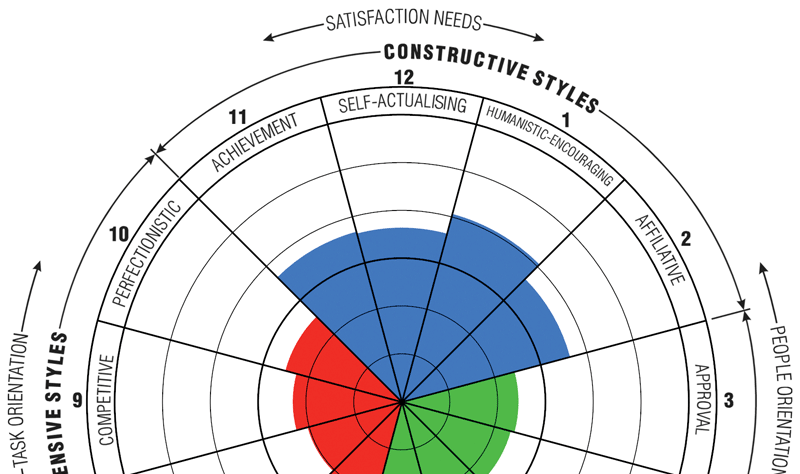
The best way to get information about your behaviour styles, both from you and others is through an anonymous web questionarire crafted by researchers who have developed questions that can be translated  to behavioural styles.

While no one can be 100% certain the results are accurate, if the consultants that administer the survey are supported by years of study and supporting data it is likely to have a high degree of alignment to reality.

I had the good fortune to have an assessment performed on me by Human Synergistics  and I found the results very useful to determine behaviour changes I wanted to make and ideas on how to execute the changes.  They do both lifestyle and leadership assessments.

Disclaimer – This post is not an endorsement of HumanSynergistics  ( they are just an example I used out of familiarity) Rather the post is intended to get you thinking about the value of having your behaviours assessed.

That is, to help you understand what others think of you and adjust your styles if you want to.


What do people think about you

Your reputation is basically what others think about you.  Over the last couple of posts my key postulate has been about the value of  managing your reputation (in marketing terms, your brand).

The basic framework for personal reputation management is to first understand what you want your reputation to be, then what it is and finally craft a plan to either maintain it or change it.

Maintaining,changing or a combination, is both audience and current state dependent.  The key here is to not submit and hope but to be proactive.

So, what is my reputation?

Asking others this question directly usually does not work.  Most people are conscious of thier own reputation and treat the question more as an opportunity to advance their own agenda.

The best way is anonymous surveys overseen by an independent party that does not know you and has research based experience to craft and interpret insightful questions.

The internet offers a variety of options for this kind of service from free to costly and of course their are many consulting agencies you can pay to do this for you ( of varying quality).

Observation

Independent feedback is not always practical or feasible.  Do not give up, personal observation is a tool that can be just as effective.

This entails activities like:

  • watching  how people behave around you or in context of activities you are involved in.  Peoples body language and they things they do and say in the normal course can be very telling.
  • indirect probing about things that appear to be about something else. ( e.g., How are you enjoying this project?) As a project participant you can leverage the reponses as indicative of your own reputation.
  • gently guide various people you interract with to share what they hear others saying about you, albeit indirectly.

In short observe how people behave relative to things you have involment in and course directly toward you.  Don’t be superficial in your self assessment.  Think deeply.

Passive Clarity

Everyone benefits from clarity.  When the crafter of a message and the receiver both interpret the content identically, it is intuitive to assume the result is more positive than otherwise.

The message can be delivered directly (forceful clarity) or indirectly (passive clarity).  Whichever technique is used the most critcial attribute is clarity.

Clarity

Clarity in communication occurs when the message is logical, consistent and easily understood or comprehended in a consistent way.

Crafting a clear message is a skill that takes effort, patience and most importantly practice.  To learn this skill you must use it repeatedly and use ongoing coaching to attain high levels of performance.

Forceful Clarity

In this case the message is directive.  It is typically one sided (your view) and mainly intended to illicit a partcular response/behaviour.  The key to forceful clarity is delivering the content in a way that is readily understood and brooks no misinterpretation.

Passive Clarity

This communication style is collaborative and indirect.  It is the most difficult to practice but also can be most rewarding.   I equate passive clarity to leading from behind.

In this case the message is understood and reinforced without actually directly providing the content.  In these cases the others figure out the message, the approach and how to achieve the goals without being told directly.

This is a very self motivation focused approach.

Balance

Forceful and passive clarity are best used in balanced conjunction with each other.  As a leadership skill, the use of self awareness enables the leader to achieve the most effective balance between how clarity is imparted.

Oh behave!

One of my favorite movie scenes is from Austin Powers International Man of Mystery.  It is  Austins response to the movies femme fatales offer to slip into something more comfortable.

“Oh behave, baby!”

Defined by our Behaviour

How do each of us assess others?  Basically, you start with the apparent, appearance, grooming and so on, moving on to speech, actions and non verbal communications.

All these things, from grooming to non verbal communication queues are derived from a persons behaviour.  So it is not a stretch to conclude how well you control your behaviour is key to achieving your goals.

Self Awarenes

Self awareness is the practice of being intimately aware of both your and others behaviours at any point in time, constantly analyzing the impacts and outcomes of your own behaviour (within context of those around you) and molding your actions to achieve the desired results.

To lead others, whether via the traditional “in front” practice or more innovatively from virtual or pheripheral places where physical positioning is irrelevant, the ability to behave in a self aware way is foundational for success.

In the simplest terms everything you do from how you dress, walk or talk to your written communications, facial expressions, emotional vibrations (what people sense about you) must be conciously managed.

Everything is carefully orchestrated to realize planned outcomes.  You know what you want to achieve and through awareness of your own and others strengths and weaknesses (expressed behaviourally) you get what you want.

The practice of strong and effective self awarness behaviours alone might not make you a great leader but it undoubtedly frames you for success.


Intelligence and Knowledge

Intelligence quotient is a number representing a person’s reasoning ability (measured using problem-solving tests) as compared to the statistical norm or average for their age, taken as 100.

Although IQ is considered to be somewhat age related, in general it is believed to  remain relatively stable across your lifespan.  That is, the reasoning ability is set in your early years and does not change much.

Knowledge is acquired through a combination of learning and the application of your reasoning ability.  Theoretically, your ability to acquire, develop and utilize knowledge is limited by your reasoning ability (i.e., I.Q.)

Application

Often we subjectively assess other peoples intelligence based on outcomes.  We associate this with ability to create and disseminate knowledge – in essence the ability to learn.

For example theories and law’s developed by Alberta Einstein are almost universally considered to be the result of high intelligence (a high IQ).

Many believe their own IQ’s, that is their  innate reasoning ability, would not enable them to reason out such complex concepts as the theory of relativity.

I wonder if this is true.

Nature or Nurture

The very concept of IQ leads to the conclusion that you are born with (nature) a fixed ability to reason and this limits your ability to learn (nurture).

Since, as a general rule IQ is not believed to change significantly through your life (although there are age based variations) this concept leads to the conclusion you are born with a certain ability to gather and create knowledge.

Although this innate ability does not endow you with knowledge (work is required to do that) your basic capability to gain knowledge is genetically based.

For me, this logic is just one of the issues with IQ measurement.  The ability to measure it in the first place being another.

The Quest Continues

Research on intelligence, both what it is and how it is acquired (nature vs nurture) continues and I look forward to the continued streams of unfolding conclusions on this topic as more data is gathered.

All in all, it makes for a fascinating discussion.

A touch of Philosophy

Reality is of our own making.  Facts are real based on our perception of them.  You might argue human society is an integrated whole, for me, ultimately it’s all about me.

Only you can control your thoughts and behaviours. External influences, albeit real, do not make changes in and of themselves. Only you can act.

Everything can come to pass in the fullness of time .  With a little patience and some saliva  ants can devour an elephant.

Sound like nonsense?

Given the nature of thought,  there are truly no absolutes.  If I think it,  then it is real.  Probably not, surely some balances exists between facts commonly accepted as “true” and our own perspectives, perceptions and interpretations of these facts.

The cynical me argues a rational argument exists for any reality.  For example I could state the sky is orange , not blue.  Since I believe it, is it true?

By common agreement the sky is blue, therefore I am at fault with the facts.  How so, just because the there is a plurality of belief of among other humans as to the color label am I  wrong?

This of course is where standards and agreements come into play.  Total anarchy around facts would lead to disintegration of culture.  Without some common acknowledgements inter-operation of individuals becomes virtually impossible.

A common Reality must Exist and be recognized as such

” I think, therefore I am” is a broad and universal statement of existence.  If it is false, I do not exist.  If I do not exist, then you do not exist as your existence ( at least validation of it) depends on my existence.

Ah, the joy of the circular argument.

Today’s post while largely a bit of whimsy and a bit of fun does stem from real conversations I have had with my colleagues and some others over the last week.  An interesting week to say the least.