
Tag Archives: meaning

Lockdown Lingo

Language is constantly evolving.  New words and phrases developed from emerging cultural norms and environmental shifts are really common.

I recently encountered a new term, seemingly quite popular on Facebook, which is the term coronacoasster.  Just a quick way to describe the emotional rollercoaster we are on due to all of the news each day about the Corona virus.

Excitement Every Day

From high numbers of new cases every to, to a drop off in new cases, back to high numbers, the rollercoaster analogy is quite apt.  Although rollercoaster give us a quick thrill I am not sure the corona virus ride will be all that quick or even thrilling.

The daily dose of corona virus news streaming on social media or from emergency press conferences is exciting in a way but not really positive or anticipatory, beyond hope for improvement.

Catch Phrases

Like headlines are to newspapers,  in these days of mutiple social media channels, catch phrases get a special nod from communicators.  It is an easy way  to send a message.

Clarity is not always the intent for these channels, grabbing interest and getting views is often the goal.  For example, Want to hear about my coronacoasting?

You might not be sure what the word means, nor is the author, but it sounds cool.  Here is a phrase that slips off the tongue, people listen because it’s snappy and with it.

Flavor  of the day,  coronacoasting comes and hopefully leaves.  With luck this new phrase won’t hang around for long.
Fewer words

Communication is a key to personal success. Understanding the information you receive and having information you provide interpreted as intended is not easy.

When listening or observing we interpret we filter the input and the result is not always as intended. Similarly when we communicate verbally we regularly say more than is needed.

Filtering

It’s virtually impossible to communicate, whether incoming or outgoing without some level of filtering affecting the result. When sending a communication you can reduce the risk of filtering through brevity.

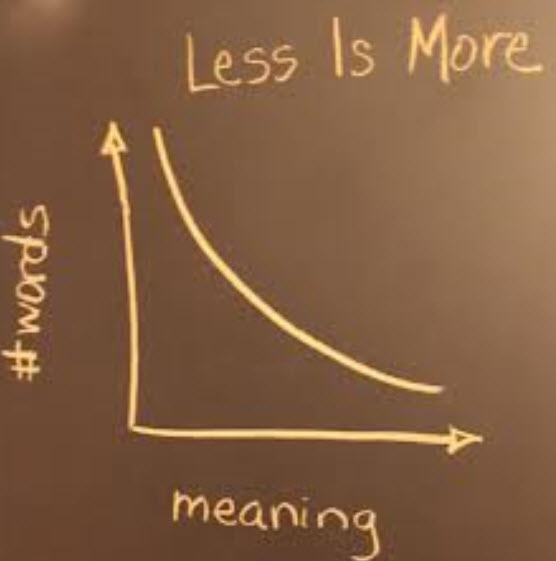
Many mistakenly believe detail will support clarity. In reality, the more information provided, the more filtering occurs on the recieving end and thus a greater likelyhood of misunderstanding.

Few words, carefully selected and crafted into short uderstandable groupings are far more likely to be interpreted as intended.

In fact, more information, longer explanations including many supporting details frequently just get filtered out. The multitude of words are simply are not heard.

Although there may appear to be receptivity on the the part of the listener, the filtering going on in their brain is invisible to you, but it is definately present.

Wait

Start with a few words and wait for a response. This is doing the listener a favour, they have less filtering to do (fewer words on your part) and more time to digest, absorb, analyze and understand.

Your pause should prompt a response which will give an idea of the level of understanding. These allows you to craft your next set of few words (if needed) in way targeted to enhance understanding.

Improve your communication, use fewer words and longer pauses inbetween. You’ll beamazed how quickly it works.

The Endless Search

During my high school days I had a personal goal to determine the meaning of life.  Not the Monty Phython  variety which was more tongue in check, but a logical rational explanation.

God Explains All

During my early childhood there was an attempt to indoctrinate me into a belief that God explained all.  Simplistically man was created in gods image, mankinds purpose (the meaning of life) was to serve god.

My own observations led me to the conclusion that god was an artifact invented by other humans  to both satisfy their own need for meaning as well, for those with  less scruples to leverage as a power base.

The Search Continues

So far, my own experience is that the search for meaning is endless.  The purpose of my own life has ultimately become; “to search for meaning”.

That is to say the action of searching is both the purpose and meaning of my life.  The search itself has no result beyond more searching.

The actions associated with the search give me pleasure and realization my purpose lies in more searching, that is what I do and I enjoy it.

The End

This personal solution to the meaning of life is gratifying but it does not explain the ending; i.e., death.  If death is linked to the meaning of life, searching endlessly stops at death.

What then is the purpose of death?  To stop the cycle of endless searching?  If that is the case, as with all questions around meaning – why?

So while the meaning of life being an endless search for answers is satisfying me at the moment, I wonder if this will change with time.

Let me Help

In his novel “1984, author George Orwell struck new ground and invented some words that have become part of the English lexicon (i.e, the vocabulary of the lanuage.

Orwell used the term doublespeak in reference to deliberately euphemistic, ambiguous, or obscure language.  The novel, published in 1949, was prognostic of the future, that is the year 1984.

Although visioning changes in culture, politics and human behaviour some 55 years in the future, some of the novel was surprisingly accurate.

Fortunately though many scenarios he described , although possibly still on the horizon, have not yet arrived to the extreme  level of the examples in the novel.

Doublespeak Lives

Double speak though,  thrives in our cuurent cultures.  Well, at least in English although I would not be surprised if has permeated most languages.

Examples are things like:

  • passed on instead of dead
  • downsizing instead of firing
  • experienced instead of old
  • ethnic cleansing instead of genocide
  • curvy instead of fat.

For me the concept of softening a harsh reality has always been humerous.   I mean dead is dead however you say it, passed on is still dead.

Amazon Quote

I recently came across an argument suggesting retail and service organizations should adopt the Amazon philosophy to sales.  In 1996  Jeff Bezos, CEO of Amazon said , “We don’t sell products.  We help people make purchase decisions.

What a great example of double speak.  I m not selling you anything, actually, I am helping you.  Excuse me while I choke on the sentiment. Yuck.

I am sure there is a fine subtly here (which I don’t get).  Perhaps since I decided to buy the product Amazon (or their agent) did not sell it to me.

However, they were motivated by profit for me to buy something using their website. So this was not an altruistic act, as you might ascribe to it by the double speak.

My advice to sales folks out there, offer to help – sure but don’t be dishonest about your motivation to sell.  I don’t think most people are naive enough to fall for that anyway.

A touch of Philosophy

Reality is of our own making.  Facts are real based on our perception of them.  You might argue human society is an integrated whole, for me, ultimately it’s all about me.

Only you can control your thoughts and behaviours. External influences, albeit real, do not make changes in and of themselves. Only you can act.

Everything can come to pass in the fullness of time .  With a little patience and some saliva  ants can devour an elephant.

Sound like nonsense?

Given the nature of thought,  there are truly no absolutes.  If I think it,  then it is real.  Probably not, surely some balances exists between facts commonly accepted as “true” and our own perspectives, perceptions and interpretations of these facts.

The cynical me argues a rational argument exists for any reality.  For example I could state the sky is orange , not blue.  Since I believe it, is it true?

By common agreement the sky is blue, therefore I am at fault with the facts.  How so, just because the there is a plurality of belief of among other humans as to the color label am I  wrong?

This of course is where standards and agreements come into play.  Total anarchy around facts would lead to disintegration of culture.  Without some common acknowledgements inter-operation of individuals becomes virtually impossible.

A common Reality must Exist and be recognized as such

” I think, therefore I am” is a broad and universal statement of existence.  If it is false, I do not exist.  If I do not exist, then you do not exist as your existence ( at least validation of it) depends on my existence.

Ah, the joy of the circular argument.

Today’s post while largely a bit of whimsy and a bit of fun does stem from real conversations I have had with my colleagues and some others over the last week.  An interesting week to say the least.

Politically correct speak

In 1949 a fictional novel by George Orwell was published.  It was called “1984”.   The story presented the world as George perceived it might be in the year nineteen eighty-four based on his observations of the current state of things.

His vision of a world populated by totalitarian states which were presented to the populous as utopia’s was frequently used during the decade’s of the fifties, sixties and seventies as a warning of what was to come.

While the totalitarian states predicted in the novel did to not come to pass the use of language as propaganda throughout the tale always fascinated me.   That is not necessarily what you meant but how you said it.  This is a practice that continues today, that is how we label things somehow changes the meaning and  makes them more acceptable.

What’s in a label?

Recently I called a para-medic an ambulance driver and quickly learned how inaccurate this was.  The lady in question told a tale of how she had been called to an accident where one of the police officer’s on the scene was holding a witness for her care before questioning them.   The officer introduced her “The ambulance driver will check you out now”.   She followed that with “And when I am finished the police car driver will have some questions for you”.

For me this is a humorous  tale with a purpose.  The reality is para-medic does describe the role far more accurately than ambulance driver which was the traditional title as I was growing up.  The work performed by these first responders (an alternate and as I understand it, acceptable title) has changed drastically since my youth, both their capabilities, skills and success ratio’s.

Semantics Matter!

I have always been fascinated by importance of meaning behind the words and how the meanings morph over time.  For example the term “gay” to describe homosexuals has gathered negative connotations to the extent I have recently seen commercials on television deriding it’s use.   Originally intended to describe a particular sexual orientation, a negativism was associated with the word because the practice was viewed as deviant.  Being a homosexual is now largely an accepted practice by society.  Today, to describe that sexual behavior in politically correct terms using homosexual is much safer although in fact the two words do generally refer to the same things (albeit one does have a negative spin).

Should semantics matter?

Language is how we communicate.  The need to assign nuances to our words is paramount, so short answer – Yes semantics matter and in my opinion this needs to be the way it is, so societies can continue to mature  communication practices and grow clarity when exchanging information.