Tag Archives: clarity

Understand me, please

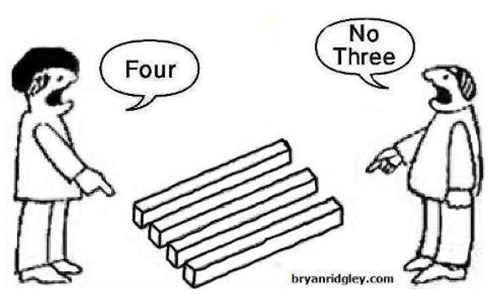
The act of imparting or exchanging information, providing direction, or passing on the news is more of an art than it is a science.  Clarity is founded on an individual perspective and to some extent, it is unique to each of us.

Strangely, because of the subjective quality implicit in any message the being coherent and intelligible with what we perceive to be full transparency can still result in misunderstanding.

Assumptions

In almost every communication both the sender and the receiver include things they accept as true or certain without the need for elucidation (i.e., assumptions)

Without assumptions being explicitly identified and defined it is easy for parties to believe the information being exchanged has a unique and clear meaning.  Sigh, sadly this is often not the case.  Depending on the assumptions the message could be very different.

Avoiding Miscommunication

One way communication is most likely to be misinterpreted.  Without the opportunity to test the message (i.e., two-way exchange), combined with a message that appears complete and clear it is easy for the recipient to assume they understood.

This situation applies to the information provider as well.  Without receiving feedback they can only assume the everyone understood the point and all is well.

In these situations, surprises occur frequently and the result is often by choruses of “that is not what I meant” and “well that is what you said”.    The intent of the message is not achieved.

Keeping the content simple is obviously one way to achieve clarity but most important is testing/validating the communication on multiple sources, getting feedback, and modifying accordingly.

This of course is really critical when providing directions or instructions on how to do something.  Misunderstandings can lead to costly mistakes.


I comprehend

The difference between comprehension and understanding is a very fine line with the basic meaning of each term broadly overlapping.  However there is some subtlety to be applied when using these terms.

I would highlight this by noting, true comprehension requires much more than just  understanding.   Comprehension is generally broader and more holistic.

While understanding is at it’s core, comprehension includes the ability to conceptualize the broader context.  Fitting the various pieces together to form a broader and greater understanding, comprehension is really the next level.

Subjective

Understanding contains a subjective component.  I understand is all about you.  Your understanding might not match that of others but if not confusion can certainly arise.

Comprehension implies the broader context of taking others views into account, i.e., the bigger picture and translating this to a universal meaning that is not self centric.

Piecing together all the information rather than focus on a single point of understanding is the only way to be in a position to truly comprehend the situation.

Avoid Misconception

Understanding based on your own personal conception is common.  It is the baseline and how the majority of us develop conclusions.  Taking the time to fully comprehend can lead to avoidance of misunderstanding.

This is not a silver bullet.  Believing you have full comprehension in a particular circumstance does not mean that is so, validation is still needed.  Take the time to build a fact based objective foundation.

Working to fully comprehend both implies and requires looking more broadly and the situation and combining individual understanding into a cohesive whole.

The Root of Confusion

I will hazard a guess that we have all been bewildered or unclear in our minds about something, at some point in our lives if not on many occasions.

Confusion largely results from inadequate communication and unclear objectives and is particularly prominent when the circumstances are complex.

Too Many Cooks

A very common aspect of confusing situations is a multitude of stakeholders, each of whom purports to have a full understanding of the situation.

Feeding the confusion is these multiple explanations offered to add clarity are often perceived to be different or even in some cases are actually different.

Keep it Simple

Avoiding confusion always begins with simplicity.  Clearing away the misunderstood begins by reducing the situation to the fewest components.

To ensue clarity and focus explanations need to be single threaded, that is provided by a single designated knowledge expert.  Using a single point of reference without exception is key to avoiding honest misunderstandings.

Start with the End

When explaining a process or providing how-to instructions the comprehension of others begins with understanding the end result.  It seems to make sense to describe the journey and reveal the outcome at the end.

Perhaps strangely so, this is not the case.  My psychology studies have demonstrated humans achieve understanding much more quickly when they know what the goal is upfront.

Eliminating confusion is a combination of limiting the number of stakeholders involved with explanations coupled with providing clarity of outcome, what does done look like, right from the beginning.


Confusion

When those around you are in a state of being bewilderment or unclear about something the key question is what can be done to resolve the confusion.

The answer begins with the source or root cause.  Most frequently this is related to poor communication often stemming from assumptions and personal bias.

Assumptions

Unconsciously we use things we know to be true as underpinnings of  information we want to share with others.  Unfortunately, just because something that is accepted as well known and true by us, this assumption might not be universal.

This can confuse others because they are not at the same baseline as you.  You may be frustrated at the apparent misunderstanding and not realize it is simple a result of different baselines.

Your unconscious assumptions are often not shared directly, because you don’t believe it needs to be.  This gap is the most common cause of confusion.

A Simple Solution

On the surface it appears confusion could be avoided by sharing everything and confirming everyone is starting from the same information baseline.

The reality is a balance must be struck between sharing for retention and comprehension.  A dump of everything you know has the same effect as holding back, it creates confusion, if not boredom too.

Confusion Free

The key skill associated with reducing or eliminating confusion relates toward regular interval testing.  Provide the background and information objective but test for comprehension every step of the way.

Comprehension test does not mean asking “Did you understand?” but rather questioning on a subject related point that requires understanding to be answered correctly.

Avoid confusion it will make communicating moreenjoyable for everyone.


Ponderous and Pretenious

Sometimes written and verbal communications can include two unsettling properties.  They could appear to be ponderous or pretentious.

Unfortunately, the ultimate objective of the communication might be of value but the subjective perspective of the listener/reader that it is solemn, dull and laborious quickly leads to an attention deficit and most likely the message is lost.

Fake packaging

Another way to ensure your message is blocked occurs when you attempt to impress by affecting greater importance, talent, culture, etc., than you actually possess.

When you are perceived as ponderous or pretentious, or even both, the ability to impact and influence others is greatly diminished.  You might believe you are lively and believable but if others don’t, it is game over.

Keeping it Real and Sharp

Others judgements are very impactful on your ability to achieve.  Your personal enjoyment and pleasure cannot always be derived  solo, the ability to positively interacting with others is needed to complete your pleasure dome.

This requires you to pay attention and use other peoples verbal and non- verbal queues to determine how they are perceiving your input.

It is usually not that hard to determine if your message is being lost.  Consider the cause, your behaviour, and make a change.  Check through probing questions why you are being perceived negatively.

Ponderous behaviours are typically repetitive, slow and boring.  Pretentiousness is usually all about attitude.  Loose the better than you intonation and body language.

Being viewed as ponderous, pretentious or both does you no favours.  Make the change..


Clear thought

Clear thought is the bedrock of logical outcomes.  Today’s environment has a multitude of complexities that have developed over-time and can lead to sensory overload. 

As our society has advanced,  so have the associated cultural complexities.  Obvious examples of this are the behaviour changes associated with automation, communication advances and the omnipresent social media options.

Focus

Intuitively, the first step to a clear mind is to focus on nothing.  This is the basic principle of meditation.  This technique causes your brain becomes cleared of all thoughts except what you are focusing on.

As you are focusing on nothing,  beyond involuntary thoughts, which you cannot control, the brain becomes thought free.

Meditation is often thought of a a relaxation technique, this is simply because the elimination of every day sensory overload, which we are all subject to, is nothing if not relaxing.

Clarity without Meditation

Meditation is used only a an example of a mind clearing technique.  It is not always practical to meditate and is best done in a quiet isolated place where you will not be bothered.

The principle of clearing the clutter that burdens your thinking is the same.  It requires focus.  When you are seeking to employ logic, and are not able to find a quite place or time to enter a meditation state, simply focus on the objective.

That is, place all your attention toward the data set you want to understand, parse and resolve.  This singular focus will enable you to follow a logic path to the best outcome.

Passive Clarity

Everyone benefits from clarity.  When the crafter of a message and the receiver both interpret the content identically, it is intuitive to assume the result is more positive than otherwise.

The message can be delivered directly (forceful clarity) or indirectly (passive clarity).  Whichever technique is used the most critcial attribute is clarity.

Clarity

Clarity in communication occurs when the message is logical, consistent and easily understood or comprehended in a consistent way.

Crafting a clear message is a skill that takes effort, patience and most importantly practice.  To learn this skill you must use it repeatedly and use ongoing coaching to attain high levels of performance.

Forceful Clarity

In this case the message is directive.  It is typically one sided (your view) and mainly intended to illicit a partcular response/behaviour.  The key to forceful clarity is delivering the content in a way that is readily understood and brooks no misinterpretation.

Passive Clarity

This communication style is collaborative and indirect.  It is the most difficult to practice but also can be most rewarding.   I equate passive clarity to leading from behind.

In this case the message is understood and reinforced without actually directly providing the content.  In these cases the others figure out the message, the approach and how to achieve the goals without being told directly.

This is a very self motivation focused approach.

Balance

Forceful and passive clarity are best used in balanced conjunction with each other.  As a leadership skill, the use of self awareness enables the leader to achieve the most effective balance between how clarity is imparted.

Leading through Ambiguity

Sometimes things are not clear and can be open to more than one interpretation.  These situations are ambiguous and the resulting confusion can be challenging to work through.

I often comment about leaders as facilitators and being a catalyst to group success rather than directive; however, ambiguity is a circumstance where effective leadership can make a real difference (and lack thereof a real detriment).

Leading from the bottom of the pyramid

I strongly believe, as a broad practice, leaders should not be in front most of the time.  I subscribe to  the inverted pyramid, where the tip of the pyramid, representing the heads of a organization, is at the bottom .

This concept focuses on releasing the power and capabilities of everyone in an organization (represented by the pyramid) rather than focusing on the few so called leaders.

Leading from front

That being said there are times when  leaders should live up to their title and lead, that is get out in front (i.e., flip the pyramid).  When an ambiguous situation needs to be addressed, typically confusion reigns.

By definition ambiguity includes  multiple views and perspectives largely leading to analysis paralysis.  If no one takes charge, successfully achieving the intended goal will probably only result by accident.

Leading directly, providing clarification and defining the course of action is sometimes the best approach.  This behaviour should be used sparingly, the power of the group should be leveraged most of the time, but when the group is in dissarry, the leader must guide.


How or What?

We all do things every day. These things range from waking up, eating to a multitude of other activities.  For example  working for monetary compensation or for non monetary motivations.

Two basic attributes can be applied to everything we do.  What are we doing and how are we doing it?  Obviously where, when and why can be important to some degree but what and how must also be known and always come into play.

Concious versus Unconcious

Often what we are doing and how we make it happen occur withput much thought.  We wake up after sleeping (the what) and it could be a concious action with an assist from an alarm clock or it could just be our unconcious internal clock causing us to awake.

Taking control of what you do and how it is accomplished is a critical aspect of personal success.  Deciding what to do based on a well considered motivational understanding is more likey to result in the outcome you desire.

While happy accidents do occur, taking charge of your destiny means there is no need to rely on the roll of the dice.  Whether the out ome was  good or bad, you thought it through.

Doing the Right Things

The message of this post is simple.  If you know waht you are trying to do (the goal or objective) you can plan for success.  If you plan for success and excute the plan effectively the risk of failure is greatly mitigated (although not removed, failure is always an option).


It’s Obvious

The other day I overheard a colleague saying ” philosophy is often the art of expressing  the obvious”.   Given that obvious things are easily perceived and understood, this sounded like a shot.

On deeper thought it occured to me, the obvious is sometimes hidden by it ordinariness.  Obvious things don’t stand out and thus get ignored.

Leveraging the Obvious

Acting or behaving according to some obvious principles requires a concious understanding and recognition of the concept.  It may be easily understood, but also easily ignored.

Of course, what appears obvious might not be and could benefit from some some analysis and clarification.  Hence the interest of philosophers.

For Example

Check the distance before you jump.  This appears to be a pretty simple, easily understood statement.  Makes sense.  Wait,  is this just about broad jumping or leaping from one roof top to another?

Could this be more of a metaphoric phrase about a possible approach to life.  Checking the distance is about considering the potential  risk and benefit.

Is taking the action, which in the metaphoric sense may be more than jumping (e.g., asking for a raise, investing in a stock, getting married) worth it.

And so, the obvious might not be so obvious, thus enters the philosopher.

Pay Attention

Ignoring or accepting the obvious without thought could be at your detriment.  Is there a deeper meaning?  Can it help craft your behaviour to be more successful?

These are not easy questions nor is the answer obvious (he,he).  Think conciously for a moment the next time you encounter the obvious.  It might be enlightening.