Tag Archives: strategy

Submit and Hope

Relying on hope as your strategy will produce outcomes, good or bad, that are basically due to chance.  Without a plan of action or policy designed to achieve your goals, the results are in essence derived from happenstance.

While feelings of expectation and desire for certain things to occur is a valid emotion it is never the best approach to taking action and working to achieve your dreams.

Greater Uncertainty

For example, if your goal is to increase your fiscal wealth, purchasing a lottery ticket, submitting the numbers, and hoping for a windfall of cash is an option and sometimes it can pay off.

Basically, though this approach is based on chance.  How you choose your numbers, or how many you submit might affect the chances but overall this strategy is simply put – submit and hope.

Improve your chances

It has been well said, “Nothing is certain” but having a solid strategy increases the likelihood you will be able to achieve your desires.  Uncertainty still exists but can be diminished through planning.

Working out a set of actions to achieve your goals (e.g. increase your personal wealth) will not guarantee results but if formulated based on research, logical, and analysis the opportunity for success is increased.

Not to abandon hope

This is not to say that hope does not have value.  Hope underlies optimism and without it, life can be very depressing.  However, relying on hope alone is not a valid strategy if you truly seek to achieve success.

Do not abandon hope but also do not underpin your plans solely with hope.
Vision, Goals, Strategy, Tactics

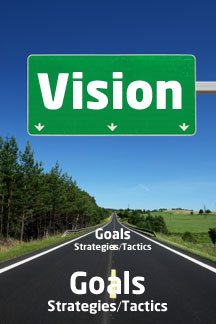
Our ability to think about or plan the future with imagination or wisdom is often referred to as vision. This can be a great starting point to define your goals and objectives.

Using what you visualize your future to be as a foundation, goals are the specific aims or desired results that make up the steps to enable you to achieve what you seek.

What Next

Once you have determined your goal/objective, that is the achievement aimed at or sought, the next steps are to determine how this will be done.

This is where strategy comes in.  Basically a plan of action or policy designed to achieve a major or overall aim – i.e., your ultimate goal or objective.

Strategies clarify what is to be achieved, by when and how.  This may be a multi-step process and the strategic plan does not need to be detailed but is rather more indicative in nature.

Make it Happen

After you have defined your vision, developed the goals to support is and combined everything into an overarching strategy, it is time for execution.

Use your strategy to develop tactics and associated tactical plans.  These are a series of carefully thought out actions that form the recipe for success.

The tactical plan defines activities that are focused on achievement of a specific end – the specific milestone needed to support the strategy which is just an encapsulation of the goals and objectives required to achieve the vision.

Using vision, goals setting, strategy development and tactical planning enables you to perform efficiently with a high chance of actually achieving your vision.

Getting it Done

What do you want to achieve, how and why are all key considerations relative to getting things done.  When managing or leading others ( or even just yourself) the priority you assign to the objective versus how and why can vary.

Often those with a reputation for getting things done focus on the actual deliverable.  The reasons for doing the work are not considered important and the approach is not standard, that is, just something that works.

Sustainability

The direct approach focusing on outcomes can be very effective relative to achieving results.  The downside is sustainability.  In cases where the outcomes are not just one time, lack of sustainability can be an issue.

Many studies have shown consistent implementation processes coupled with a strong understanding of why things are being done result in more durable results.

Strategy vs. Tactics

How and why are the basic building blocks of a strategy.  Of course the goals are paramount but without supporting rational and underlying approach to achieve the objectives, it is not a strategy.

Tactically clearly defining what to do without reference to why, how or specific goals can work very efficiently.  It is a bit tricky to intergrate with other work and measuring is largely based on doing what you said you would do.

For sustainable results starting with a strategy to guide your execution may take a little more effort up front but in the long run it will pay off

Vision, Mission, Goals, Objectives, Strategies, Tactics

The goal of a non-drug induced vision is to inform the development of strategies that can underpin a series of objectives,  achieved through tactical practices, ultimately resulting in the completion of your mission (should you choose to accept it).

What a meaningful statement I just wrote, I must really know what I am talking about.

Bureaucratic Double Speak

On a stand-alone basis, the organization buzzwords employed in the first paragraph do have some relevance.  Strung together, I am not so sure they do much more than provide self-gratification.

I wrote the leading paragraph because I can, it sounds good and makes it appear that I know what I talking about.  In reality, though, I would propose it is a pretty empty statement.

Know Where you are going and the road to get there

Taken on their own merit these words do have more value than combined.  Each plays an important role in answering what you want to achieve and how you are going to do it.   (although goal/objective and strategy/tactics are virtually interchangeable terms)

Using them in a jargon form diminishes the effectiveness.  Most people recognize condescension versus meritous information. Why fool around with catch phrases.  Let us be clear, just say this is what we are shooting for and this is how we are going to do it.

  • Goal  – the sought after aim or desired result
  • Vision – elucidating the dream state, what is sought but not attained
  • Strategies – The plan to achieve your aim
  • Objectives – the plan to realize your sought after aims or desired results
  • Tactics –  the plan to realize your sought after aims or desired results
  • Mission – the assignment that will enable achievement of your your political or commercial purposes


Bully for you

When someone uses their strength or influence to force you to do what they want, you may have been bullied.  This is a broad definition and there are sub forms of bullying that display the same characteristics but are specific in context ( e,g sexual harrassement)

I often encounter people who have been bullied and don’t recognize it as such.  (I was either in the audience or told the story afterward).  Most associate  bullying with youth.  It is defined as something that happens in high schools or perhaps universities.

Bullying behaviour is not restricted by age or location.

The Reality

Behaving like a bully is second nature to some.  It is in fact, very human.  Simply put, it is the practice of achieving your goals forcefully without regard to the damage you may do to others.

In fact, doing damage is often part of the technique.  Fortunately our Canadian society believes bullying to be an unacceptable behaviour, and actively discourages bullies.

Don’t Take It

Bullies typically threaten or leverage their authority but have little intention to follow through and normally will back down  when confronted.

Unfortunately many don’t take a stand, they accept the course of least resistance and the bullying rarely stops.  In organizations this largely takes a pyschological form and can be more harmful over time than the physical.

Often the frustration and anxiety the person being bullied feels continues to grow inside until like the volcano there is a sudden release and it’s usually not pretty.

Next time someone works to make you feel bad for their gain, don’t take it.  Speak-up, resist and don’t hesitate to seek help, believe me most don’t appreciate bullying behaviour and will support you.

Oh behave!

One of my favorite movie scenes is from Austin Powers International Man of Mystery.  It is  Austins response to the movies femme fatales offer to slip into something more comfortable.

“Oh behave, baby!”

Defined by our Behaviour

How do each of us assess others?  Basically, you start with the apparent, appearance, grooming and so on, moving on to speech, actions and non verbal communications.

All these things, from grooming to non verbal communication queues are derived from a persons behaviour.  So it is not a stretch to conclude how well you control your behaviour is key to achieving your goals.

Self Awarenes

Self awareness is the practice of being intimately aware of both your and others behaviours at any point in time, constantly analyzing the impacts and outcomes of your own behaviour (within context of those around you) and molding your actions to achieve the desired results.

To lead others, whether via the traditional “in front” practice or more innovatively from virtual or pheripheral places where physical positioning is irrelevant, the ability to behave in a self aware way is foundational for success.

In the simplest terms everything you do from how you dress, walk or talk to your written communications, facial expressions, emotional vibrations (what people sense about you) must be conciously managed.

Everything is carefully orchestrated to realize planned outcomes.  You know what you want to achieve and through awareness of your own and others strengths and weaknesses (expressed behaviourally) you get what you want.

The practice of strong and effective self awarness behaviours alone might not make you a great leader but it undoubtedly frames you for success.


Incremental Strategy

Projects can be executed in a variety of defined approaches.  Waterfall being an sequential approach and agile being iterative, or variations of each of these are the most common practices.

Similar approaches can be applied to both creation and execution of an organizations strategy.   Strategies are just plans to achieve defined objectives.

Defining Objectives

The first step in any strategy is to define the goals and objectives.  Simply put what is the strategy intended to achieve.  These can be can cover one or many topics for example; financial, repetitional, risk aversion, resource focused and so on.

In a waterfall approach to strategy the objectives are determined first and then the plans to achieve them.  An iterative approach could be better defined as an incremental strategy.

We will figure it out

Incremental approaches to strategy appear at first to be contradictory to the definition.  Strategies are plans and incremental plans seem almost not to be plans but rather just acting in the moment.

It’s a Framework!

While strategies clearly identify what success is, that is when you reach the strategic objective you are successful.  If success is identified in an iterative way, are you not just making it up as you go along.

Of course yes that is the intent of both a project executed iteratively and and strategy approached this way.  The benefit is the ability to mold the ongoing goals according to what make sense at the time.

Rather than committing to a 3 to 5 year strategic plan the committment is to a framework which is reviewed, balanced and corrected iteratively as it makes sense to do so.

Don’t just laugh out loud at iterative strategies, there is some method to the madness.


Strategic Alignment

Today I had a discussion with my colleagues about strategic alignment.  Typically in organizations there is some heirarchical structure.  Strategy must bridge this structure.

Overriding strategies start at the institutional level and cascade down.  The overall strategy is by its very nature more indicative or directional than specific.

For example, the three year strategy institutional strategy could be to reduce costs while maintaining a constant revenue.  Although this can be simply stated, of course, the execution plan is more complex.

Reaching All Levels

A litmus test for organizational alignment lies with results.  Strong alignment throughout the organization is far more likely to contribute to the overall strategic objective.

Defining strategies within any section of the organization that will contribute to the overall organization goals can be difficult because there is some subjectivity inolved.

For example, cutting staff in one department might appear to support a cost reduction strategy, and is easily measured at that level ( staff were reduced or they were not).

The rub is, the staff reductions could seriuosly impact revenue, which maintaining flat was the other part of the strategy.  Simply put, aligning the strategies of parts to the whole is not easy.

Thinking Strategically

A potential assist to the pitfalls of strategic alignment is to expect everyone to think strategically with the institutional high level goals in mind.

Years ago I attended a seminar where the speaker highlighted what this kind of thinking looks like.  He was doing an organizational assessment at Boeing, probing employees about their work.

He asked a janitor he interviewed what his job was.  The janitor replied, “I build planes”.  Hard to argue that employee was not thinking about the companies strategy and didn’t get at.

At there very core in every aspect of the company, in fact, as simply put by the janitor, ultimately the employees build planes.

Developing Strategy

Strategy is an oft misinterpreted term.  It can be used to justify actions or inaction.  It can be seen as far seeking and visionary (not necessarily always the case).

Strategy involves creation of  a plan of action or policies designed to achieve a major or overall aim.  The key attribute is that the strategy reflect “major” goals.  Strategies typically don’t extend to routine or low impact actions.  These are typically defined as tactics.

A series of tactical actions often underpin the strategic plan.  An example of this is:

  • the strategy is to grow sales revenue every year by 10%
    • planned actions include improved customer service, broader product line, more advertising
    • tactics underlying the strategic plan include specific actions to improve customer service including measures, new product development and so on

Developing the Strategy

Developing the strategic plan can be a difficult exercise.  The more collaborators the harder it is, although more participant could also lead to better plan with more buy in.

It is important to start with the major or top level goals.  The strategic activities and the tactical plans all stem from these.  The time frames associated with achievement of these goals is critical  to define as well.

Another tip during strategic planning is to focus on measurable actions and outcomes.  Intangible things are quite subjective and much harder to obtain consensus on.

Additionally, keep the focus on high level overridding plans and time frames first before moving to the tactical level.

And finally , use strategies wherever they fit.  The whole organization or just personal goals.  The value is clarity in what you are striving for and definition of the optiminal way to achieve it.