Tag Archives: motivation

Finding your Talent

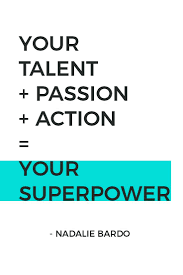
Each of us is born with a natural aptitude or skill.   Our challenge is to identify what it is and then leverage that ability to the maximum.   In many cases the latent talent is overlooked and sadly unused during a persons lifetime.

Talent is a special gift granted us through nature but which needs to be grown through nurture to reach it’s full potential.  Unfortunately there are many talent suppressors in our environment and it is rare for to see them blossom.

Perseverance

Human life can benefit from a wide range of skills and abilities ranging from mental to physical.  One person may demonstrate an aptitude for soccer while another excels in performing kerrculations (calculations).

These natural abilities are inherent within of genetic makeup but do require effort to become both apparent and to excel at them (i.e., training and practice).

When exercising our latent talent we must practice both patience and perseverance.  While the opportunity exists for us to demonstrate amazing capabilities by exercising our special talent it is not easy, natural but hard.

Motivation

One of the leading reasons our hidden talents often stay hidden is lack of motivation.  Just being able to excel does not equate to excellence.

We must both have the innate talent and the desire to practice and persevere in order to leverage and excel at our talent.  Surprisingly, given the presence of our gift is natural and unassuming we often do not seize upon it and the lost opportunity leads to waste.

Some of us our fortunate to encounter coaches and mentors to help  unleash our hidden talents while others do not even recognize what they are capable of and so it goes to waste.  It is your choice, do you really want to miss out on your chance?
Activating Inspiration

The ability to be inspired lies dormant within each of us, we only need to activate it.  Becoming mentally stimulated to do or feel something, especially to do something creative, is a personal choice.

The opportunity to do so is neither unique nor limited by intelligence, everyone has the capability.   The defining factor is desire.

Passion

Caring or being passionate about something is a great way to ignite inspiration.  Inventors often describe how their passion for a particular topic was a key motivator to create.

The trick is to let your interest flower into a passion, explode as inspiration, and voila a brilliant creative outcome will blossom.  It is just a personal choice.

Something Special

The ability to be inspired is not something special that exists in a select few.    The level of innate intelligence and talent granted to each of us unquestionably has a genetic component.

However, everyone is capable of personal inspiration.  The results of our inspired behaviors are subject to the extent of our capabilities but inspiration will drive results in every case.

Everyone has the ability to choose to stretch themselves, to examine, explore, and be excited by the possibilities around them.  We can use this excitement to drive both actions and ultimately achievement.

Wasted Opportunity

Every missed chance to become inspired by something is a missed opportunity.  When your curiosity is aroused let your interest be peaked, go with the flow and forge onwards.

Take heart in the fact that you can, and only you can, choose to be inspired.  No-one can block you, the only roadblock is yourself.

Pushing Until you Succeed

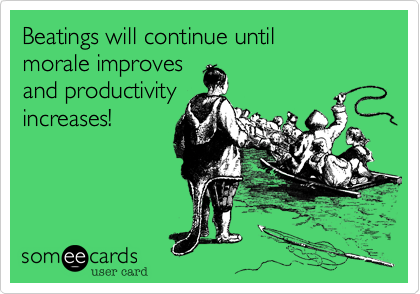
The beatings will stop when morale improves.  This somewhat humorous statement highlights a conundrum of changing group or individual behavior.

Care needs to be taken to ensure the approach to make changes and successfully achieve the desired goals does not contradict the overall objective.

Using Pressure to Attain Calm

Pushing for a quality result, or a wholesale change in culture or perspective needs to be accomplished in a way consistent with the expected outcomes.

A pressure cooker environment might drive results but if the intention is to do so in a way the participants are relaxed, calm and enjoying themselves, obviously the two goals diverge.

Pushing Yourselves or Others

Motivation is required to succeed.  At a high level, motivation is either a push, pull or combination of the two.

Pushing is by it’s nature, demanding and does rely on pressure and anxiety somewhat to drive results.  This approach can backfire if the stress level gets too high.  Many of us just shutdown when that happens.

The pull approach is often more difficult to set-up and must be enticing enough to the target audience to get results.  A pul could be overlooked or even ignored.

The Middle Ground

As with most things balance is a great approach.  In this case combining push and pull techniques can have the advantage of  attention getting without the negative aspect of consequences.

Most people prefer to make their own choice, or at least believe they chose freely.  Influencing people in a way that initiates self motivation is usually far more effective than flogging.


Life Long Learning

I had a friendly lunch with a former colleague today who is planning to embark on an executive MBA program.  Nothing unusual in that except he is in his very early fifties.

It got me contemplating the value of formal education later in life.  Although I am a fair bit older than my lunch companions today  I have been thinking of taking some courses toward an advanced degree.

Motivation

I admire my friends resolve and am a bit jealous.  The issue with entering some educational program boils down to motivation.  Is the cost and effort worth it (i.e.  are the outcomes justified.

To be motivated to take the significant step of applying for a course of study there are of course a variety of drivers but ultimately three things are key to your level of motivation.

How much work you need to put into it,the cost and what you will get out of it are foundational parameters that must be acceptable, regardless of the other considerations.

Effort and Cost

At later stages of life it is likely you have accumulated the resources to fund a program like an MBA (they are not cheap).  Probably though cost won’t be your limiting factor (subject somewhat to the appeal of the outcomes.)

Effort on the other hand is a bit of harder to reconcile, after all it is work for sure, perhaps a lot of work and as you approach or pass retirement age, do you really want to commit to working, albeit to your personal benefit.

Achievement

The core of a decision to proceed or not most likely lies with your perception of benefit to you.  What will you get out of it.  Retirement aside maybe for you this is the way to keep your brain active, stay connected with other people, even enhance your life achievement.

Personally I am still stuck on the motivation equation, maybe todays lunch conversation will push me off the fence.  Thanks friends.


Bureaucratic Boredom

Many of us are involved with large organizations, whether for profit or not, we provide our time and effort to support the institution’s goals, voluntarily or otherwise.

Typically large organizations have some administrative bureaucracy built into their operations.  This can range from internal governance to regulatory or external requirements.  Bureaucratic behavior is probably be embedded in the organizational culture.

Putting in Time

Large organizations with heavy bureaucracies often end up with a  percentage of people that are going through the motions.  For a lot of them boredom has set in, but their daily activity is something to do ( fiscal compensation if not a volunteer role is also a motivating factor to put up with the boredom)

Leaders of large organizations particularly those with administrative operations that lean toward the bureaucratic can and should address contributor boredom proactively. For both organizational and the team members benefit.

Motivational Practices

  • Ongoing communication of why everyone’s contribution is important and successes achieved.  This is recognition needs to reach to everyone and does not work as a motivator if just focused on the organizational level.
  • Team building through regular fun activities.  Involve everyone in games and celebrations outside of the organizational context.  Let people release tensions and recharge.  Demonstrate organizational contribution is more than just day-to-day drudgery
  • Encourage innovation and creative thinking.  That creates a culture of empowerment that does not set boundaries and force everyone into a boring and mundane box.
  • Change (for the better) should be constant.  Change always includes some challenge and challenge is motivating.

You are not alone

Leaders are most effective when they leverage others to the maximum extent possible.  As a leader, typically you take accountability for results, this is separate from taking responsibility. 

Leaders can rely on authority/granted power to get others to take on responsibility, (while they retain accountability).   However, it is important to note the use of earned power does not require the use of authority and the outcomes are often of a higher quality.  

Delegation

Delegation is the process of both motivating and empowering others to take on the responsibility to carry out specific activities.  While there is some discretion associated with the delegation the accountability remains with the delegator.

Typically delegation is based on a social or organizational hierarchy, however, skilled leaders can facilitate actions by others through the practice of influence. 

Influence

When you affect change in the actions, behaviors or options of others it is most likely through the exertion of influence.  You are able to motivate others to produce a result because they want to, not because they have to. 

Activities that arise through an act of influence will probably be of a higher quality.  This is because responsibility for the effort is not mandated but rather based on personal motivation.  

Intuitively, things other people want to do are more likely to succeed than things they have little choice about. 

Don’t Go it alone

As a leader, you are more likely to succeed both your and other expectations, that is meet your accountabilities and more, through effectively motivating and supporting those around you.  

Skill or Capability

If you have expertise or experience you should be able to complete a task in an acceptable way.  The better your skill or experience the greater the efficiency or quality.

For example if you have both training and practical experience you can probably perform a plumbing repair more quickly and with less risk than I could, I am not greatly experienced in plumbing.

This is not to say I can’t do plumbing work (in fact I have on a number of occassions) but it has seldom been fast and when problems were encountered I have needed help.

Capability

In the plumbing example, while I do not have extensive skills and experience with plumbing I am capable of doing the job. The extent to which I have the power and willingness to complete a task is my capability.

Selecting Leaders, Group/Team or team members

If you are interesting in a winning combination, when building a team   (sports or otherwise) a business or other organization the mix of skill and ability is critical.

Unfortunately there is no absolutely correct mix of skill and capability.   The best balance varies widely depending on numerous factors.

These include the nature of the role, the overall complexity of the activities, envionmental factors and well, just about everything else.

The key is recognizing that the balance between skill and ability needed in any given situation varies and should be analyzed and determined before selecting someone to tale on the assignment.

This is not an easy task but a very worthwhile one which increases your chance of selecting the best resource for any given role.

Reputation Part 2

Yesterdays post explored the concept of personal reputation.  In summary, it is of great value to you to understand your own reputation (as varied by audience).

Leveraging your reputation is an invaluable tool in supporting achievement of your goals.  Managing your behaviour (how you act and what you do) will manage your reputation.

Group Think

Groups of people achieve gang mentality  by sharing their perceptions about others with each other.  The communication methods can include social media, public media, in person, water cooler gossip and a variety of other ways.

The group is not logical and underlying bias can influence the perceptions.  That is for example a group may have a conservative or liberal bias.

The reputation you have within the group is mostly not openly shared with you so you need to figure it out through observation.  This can include conversational ploys to determine what others think of you.

Behaviour and Reputation

Reputational behaviour is not only what you say and do but ranges from the clothes you wear to the cut of your the cut of your hair.  How loud you speak or the effectiveness of your deodorant all inluence reputation.

Since a lot of your reputation can be derived from gossip and peoples bias the trick is to figure out what those bias are (through logic and intuition) and use them to craft the reputation you seek.

Your reputational goal could be respect, isolation (just leave me alone) , a trusted advisor or any of a plethoria of things.  Whatever it is, you can craft your behaviour to formulate the matching perceptions.

Passive Clarity

Everyone benefits from clarity.  When the crafter of a message and the receiver both interpret the content identically, it is intuitive to assume the result is more positive than otherwise.

The message can be delivered directly (forceful clarity) or indirectly (passive clarity).  Whichever technique is used the most critcial attribute is clarity.

Clarity

Clarity in communication occurs when the message is logical, consistent and easily understood or comprehended in a consistent way.

Crafting a clear message is a skill that takes effort, patience and most importantly practice.  To learn this skill you must use it repeatedly and use ongoing coaching to attain high levels of performance.

Forceful Clarity

In this case the message is directive.  It is typically one sided (your view) and mainly intended to illicit a partcular response/behaviour.  The key to forceful clarity is delivering the content in a way that is readily understood and brooks no misinterpretation.

Passive Clarity

This communication style is collaborative and indirect.  It is the most difficult to practice but also can be most rewarding.   I equate passive clarity to leading from behind.

In this case the message is understood and reinforced without actually directly providing the content.  In these cases the others figure out the message, the approach and how to achieve the goals without being told directly.

This is a very self motivation focused approach.

Balance

Forceful and passive clarity are best used in balanced conjunction with each other.  As a leadership skill, the use of self awareness enables the leader to achieve the most effective balance between how clarity is imparted.

Destructive Criticism

I was chatting to a colleague today about some constructive criticism they had recently received.  I provided my thanks for the opportunity to rant, and then did so.

There is no such thing as constructive criticism.  I am not sure who came up with the term but lets start our analysis with the definition of criticism.

Basically any expression of disapproval of someone or something based on perceived faults or mistakes, a critical review.  Based on this definition there is little about criticism that appeals to me (particularly when it’s about me).

Constructive criticism is apparently a helpful and good thing for you to embrace because it’s an opportunity for improvement.  It focuses on a particular issue for you to fix.

What a load of crap?

My personal observation is the outcome of so-called constructive criticism is almost always negative.  Hence my own clear and accurate description, destructive criticism.

At least with with criticism you can characterize it as an unhelpful attack by a small minded individual preening their self importance through the use of a subjective personal opinion.

Constructive criticism, because it is couched in the lie that it is intended to be helpful, is simply the knife covered by a cloth so you don’t see it coming right away and so have more trouble defending against it.

Negative, really?

You may question my bold statement that constructive criticism most often fails to achieve the change it is intended for.  I support that assertion with a simple question for you.

Has criticism directed at you, constructive or otherwise, ever resulted in feelings other than anger, fear, dissapointment, agression, defensiveness and the list goes on.

These are uniformally bad feelings which make you feel bad.  Good results come from good feelings not bad ones.  I will end with an exaggeration.

How effective do you think the boxing coach is during a bout when he provides his fighter with constructive criticism.  “You are terrible, this is the worst fight I have ever seen and you deserve to loose.  Iam just telling you this for your own good.”.

Oh yeah, that will motive the fighter to do better, NOT.