Tag Archives: reality

That’s Correct

A position that is free from error which aligns with the facts is defined as being correct.  Truth is based on facts that can be proved as accurate and valid.

Therein lies the rub, facts reality and accuracy is subject to interpretation.  This means all facts can be challenged so that which is true in theory must be proven by logic to become a law. Unfortunately logic can be questioned.

The World is Round

Grass is green, the earth is a spherical shape, vaccines are beneficial; these are all examples of statements for which arguments relative to their accuracy exist and proponents and opponents exist for both the statements and their  opposites.

Regardless of the fact the majority believe these declarations to be true and proven facts the flat earth society, colour blind people and anti-vaccination groups exist and argue their fallacy, even though the logical enumeration of the facts is overwhelmingly supportive.

Consequences

Sadly, the different interpretation of the facts can be impactful.  I might choose to not circumnavigate the earth if I believe it is flat, limiting my travel options and associated potential joy.

Or I might decide not to reduce my chances of getting ill from a serious disease perhaps even leading to my death or perhaps infecting others, leading to their death.

The subjectiveness of arriving at the truth is an underpinning of human beings ability to think freely and is of great value but not necessarily without consequence.

Embrace the Whole

Differences of factual interpretation are real and should be encouraged.  It is not necessary to agree on the positions each of us may take but rather focus on the outcomes and finding ways to collaborate on positive consequences.

That is don’t argue the facts but rather work together to make the resulting outcomes better whatever you believe to be true.


Dreams, an alternate reality

Thinking about past life events lately I have been very surprised to have powerful visualizations of occurrences  that seem very real past experiences, but on further  contemplation I am pretty sure they are not.

With focused conscious thinking I can nether place them in the reality of my past experiences nor confirm they really occurred during a waking state.  I have concluded they are memories derived from my sub- conscious based on repeated dream sequences.

Alternate Reality

I wonder if dreams are as real as my conscious experiences occurring in alternate reality.  Perhaps  the parallel fictional universe I construct while sleeping becomes part of my altered consciousness   and so in some context is real.

The question this raises for me is what does it all mean? These fleeting memories, some of which are quite strong seem to have an association with things that I believe did occur but with a twist or different perception of the events.

What is Real?

At the risk of becoming a bit of an existentialist, It makes me wonder what is reality, beyond that which we define it as being.  That is to say perhaps french philosopher Sarte is not correct in his proclamation “I think therefore I am”

Maybe the common definition of realty,  “the world or the state of things as they actually exist” is dependent somewhat on the definition of existence.

Dream Reality

Dreams do exist so assuming the world or state they define is real this raises the question,  is my conscious  life more real or are dreams in fact the reality and consciousness the alternate.

As I continue to explore these long past glimpses of strongly themed dreams I can to some extent perceive their reality.  Perhaps sleep is where the good stuff really happens.

Travelling Muddy Waters

Clarity begins with the fullest possible understanding of all the pieces.  When things are unclear the first task is to clean the glass.  That is, put things into a condition from which understanding can be derived.
Clarity requires viewing of all aspects of a particular set of circumstances in a way that is consistent with the practical world around you and specifically the state of things as they actually exist, as opposed to an idealistic or notional idea of them.

Interpreting Meaning

Once you have a clear picture of all the various components you can begin to discard the irrelevant factors and focus on those things that are truly impactful.
This analysis should focus on determining, what is reality?  To be able to parse the information, and thereby determine what it means, it is critical to a clear understanding which is not encumbered by things that don’t really matter.
The things that cloud your view (the dirt on the window pane) need to be removed if you are to achieve a valid and accurate perception of what is real.

Eliminate Distraction

Clarity requires focus.  Anything that prevents you from giving your full attention to determining the core information can result in misunderstandings, mistakes and misinterpretation.

Following the wrong path or undertaking wasted or potentially inadequate actions because you missed the point can be costly and perhaps even painful.

Avoiding being overwhelmed by a myriad of information begins by clearing away the unnecessary.   Those things that ultimately are not important in the overall scheme of things must be ignored.

Seeking clarity in all you do and you will lead to greater satisfaction.

What is it?

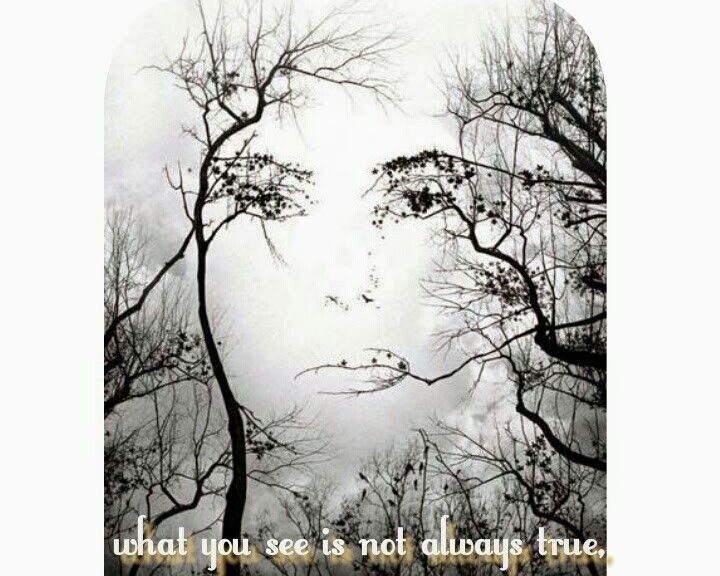
It’s not what you see that matters, you are impacted more by what you think you see.  One of your brain’s key functions in interpreting the data received via your eyes.

Vision is the ability to perceive things with your eyes (i.e., sight).  What you see is based on perception, not the truth.  However, from a personal perspective what you perceive is the reality of the moment so perhaps it is the truth.

Avoiding Confusion

We co-habit the world with a multitude of other people.  If everything we see is subject to personal interpretation rampant confusion will reign.

From birth we learn from our parents and others how to recognize and provide common labels.  For example we don’t see the colour green and label it as such.  It is learned.

The basic parameters for interpreting things, from labels to the definition of what it is, (e.g., thats an animal) is all part of the learning experience.

Perception/Perspective

Although we learn common names and meanings for the things we see obviously the learned items form just a baseline.  It is not possible for every single thing you in your lifetime to be identified and taught.

This need to figure out and define what we are seeing (i.e., not seen or experienced before) applies to everyone.  Hence there are times when we use our baseline knowledge to decide what we are seeing.

Our perception will have commonalities but each of us could see the same data input and arrive and dramatically different conclusions as to what we see.

When viewing and describing things to others keep in mind there is always room for interpretation and open discussion to clarify can help avoid confusion.


Knowing Yourself

Before you can understand others you must understand yourself.  In basic terms, self-understanding is your own awareness of and ability to understand the rationale for your taking of an action and reasons behind your reaction to actions taken by others.

This is not to imply that others will only act within the realm of your value system and personal motivations.  Being aware of your self provides a framework to map another person’s behaviors against, for understanding, not for judging.

Not Judging

Of course, we all judge ourselves, sometimes to our determent and often this extends to judging others.  Understanding is not about judging, rather it is knowledge.

Knowing the facts, information, and skills applicable to the situation, derived through experience or education, enables us to gain either a theoretical or practical understanding of others.

Your own experience and education are the foundation from which you can assess others behaviors and most importantly respond accordingly.

By not judging, rather, using an informed and therefore highly accurate knowledge-based assessment to understand why others do what they do your response can be measured, reasonable and most likely well received.

More than Seeing Yourself

Self-understanding goes beyond just viewing yourself in a mirror.  The view you see in a  mirror show what you look like only superficially and real understanding is much deeper than that.

How you think and behave is really what matters for ongoing interactions with others.  Understanding yourself at a deep inner level is key to being able to manage your responses to another’s behavior in the most effective way.

That is, to react in a way that will create a positive experience for everyone involved you need to understand why that would be the case.


Is it Fair

We generally expect behavior from both ourselves and others that is in accordance with defined rules and standards (i.e., fair). Of course, this falls down a bit when the rules or standards are unclear.

Some behavior standards are unwritten just embedded in the culture.  Others are embedded in our personal value systems and might not synchronize completely with other people, although typically there is a fair amount of integration with our fellow humans.

Subjectivity

One of the greatest challenges in assessing the fairness of something, even when clear rules or laws exist, lies with the different possible interpretation of associated standards.

This leads to frequent situations where things one person thinks are justified and fair might not be perceived that way by others.   Resolving this problem in a reasonable and fair way is one of the main reasons for civil courts.

A Festering Wound

One of the greatest dangers about perceived unfairness is how it can grip you mercilessly, not letting go until you explode in agony. And, still, nothing is resolved.

Given others might not be sympathetic to your perceived slight, letting it continue unresolved leading to unsocial behavior only does you harm.

While the resolution, through discussion, open communication and understanding will not always lead to the result you desire, ergo the unfairness is not eliminated, at least your inner turmoil will be shut down.

If you believe yourself unfairly treated do not ignore it, nor lash out in anger but rather do yourself a favor and find a place where you can live with the situation, release any built-up angst and basically, move on.


What is Reality?

A common definition of reality is the world or the state of things as they actually exist, as opposed to an idealistic or notional idea of them.

It seems simple enough but determining the existence of something, and what that entails, has a subjective component and therefore defining what is real can become different depending on individual perspective (although this flies in the face of the definition.)

Existentialism

Soren Kierkegaard was a philosopher who proposed that each individual—not society or religion—is solely responsible for giving meaning to life and living it passionately and sincerely, or “authentically”

In essence, this could be broadly interpreted as meaning we create our own reality.  How we give real meaning to our lives is founded on our self-creation.

We create ourselves and live within our self-creation.  This becomes our reality and the essence of our existence.  This does not mean we can ignore things as they actually exist, however; we can perceive them in the context of our self-actualization.

So Is Anything Real?

If there is broad acceptance by everyone that a thing actually exists than it does.   What that existence means and the impacts of it can be open to analysis and interpretation.

A single reality only exists for the individual but out of convenience and for practical purposes general consensus of reality across a population is needed.

Your own reality is constrained by outside forces.  For example, if you believe you have the ability to survive underwater with breathing assistance, the constraints of reality will intrude in a very real and deadly way.

Reality, Who cares

I have noticed that leaders often say what they believe their folloers or constituents want to hear.  This is not just politicians but successful Corporate and other group leaders (e.g. religous, charitable, etc.)

Human nature, the basic framework for average thinking processes is architected to allow for us to pull the wool over our eyes and believe it.

Desirable or Possible

My own believe is we should set our objectives based on the possible.  That is the high level goal should be analyzed for feasibility together with how long and how much effort is needed. (part of the feasibility).

Most often the accountable leader constructs the doability of an objective around the perception it creates.  That is, they say they will do something not because they know it can be done but rather because they beleve it makes them look good.

Conflict of Interest

The people responsible to execute the leaders vision and objectives are often frustrated because of the lack of buy-in.  Both theirs and the leaders, one thinks it can be done and the other not.

This dichotomy can lead to confusion and is a underlying cause of why goals often take longer to achieve than original publicized.  Both because of lack of buy in/support and because the leaders pronouncement have no foot in reality.

Instant Gratification

Our culture, particularly corporte and political environments, are founded on the concept of immediacy.  For many, long term strategies have no merit.  

I want it now is the primary thoughtprocess and therein lies the problem.  Changing cultural beliefs, so all understand the value of being real even if it sounds like it is going to take longer.

We can try to change the thinking but most often we just struggle with the unrealistic.

Enlightenment

An enlightened state is probably more a concept than a reality.  That is, to achieve freedom from all ignorance and misinformation, enabling full accurate comprehension of everything, is more something to seek than to actually find.

The search for enlightenment requires acceptance of reality.  Philosophically we can question reality as a concept, does it really exist and if so what is it?

For me, reality is neither derivative nor dependent but exists and is tangible.  True enlightenment must be based on reality, ergo, to be enlightened you must accept that reality exists.

An Alien Experiment

It has been postulated humanity is simply an experiment devised by a super intelligent alien race.  Of a pre-programmed series of events generated by a computer where the players are just computer simulations. 

The potential for alternate theories of existence is obviously broad, perhaps infinite and can be fun to contemplate and explore, however, at some point reality intrudes. 

Pragmatically, be guided by what’s real

If we focus on the tangible, what we know and can prove, the reality we construct can guide our comprehension of everything, leading us to an enlightened state.

The underlying principle is we must accept reality, that is to say, although possibilities exist beyond the tangible, it is the tangible that has the real impact on what we do, how we behave, how we feel.

We ignore reality at our peril and our chances of success in our continuing quest for enlightenment (a stretch goal probably never to be achieved) is diminished.  

Trade War

Canada has announced retalliation against the steel and aluminum tarrifs the U.S. has decided to enforce against Canada.  Laughably the U.S. rational for the tariffs is national security.

I refer to this as  laughable simply because the tight political and geographic alignment between Canada and the United States makes the consideration we pose a security threat simply ridiculous.

Nobody Wins

Free trade should be a prized practice and lack thereof disdained.  For me this is very much like the basic philosophical misalignment between communist economies and capitalist.

Human motivation is a very real factor in these two models.  At a very high level, conceptually, the reward incentive is reduced in a communist economy because everyone shares.

When effort is not tied to gain there is less incentive to work hard and therefore output suffers.  In the capitalist model effort is linked to results.  If you work harder, your gain is greater.

Free trade works like capitalism, what you put into it affects what you get out, without having to worry about artificial constraints.  If the government is influencing your ability to profit, through trade restrictions, this may have a short term positive effect but in the long term,  like most purely communist economies, all will crumble.

Why Fight

Ultimately everyone looses in a war, whether physical or a trade war of wits.  War is bad for the human condition and those who believe it is a way to achieve what is right are in fact very wrong.

Free trade or restricted trade, it is what it is (albeit free trade is obviously better).  However war is very bad no matter how you look at it.