Tag Archives: decision making

Over-thinking

Spending too much thought about something can make simple things appear to be complex.  The ultimate result is often delayed action.

Sometimes not deciding how to proceed because of analysis paralysis (i.e., over-thinking) can have significant negative impacts.  Acting too late often is like not acting at all.

Balance

Making a snap decision can have the same impacts as over-thinking.  The amount of analysis should be enough to make a good decision.  This requires a careful balance to prevents spiraling down a rat-hole in search of every answer, perhaps ultimately achieving nothing.

Decisiveness is the ability to make decisions quickly and effectively.  Too often we focus on the quickly part while the critical key to being decisive in a positive way and achieving the best results is making good decisions rather than quick ones.

The circumstances vary when we are thinking through an issue.  The impact of our decision should be the influencing factor relative to the balance between a quick or carefully measured and thought out choice.

Self Awareness

Overthinking is something we need to manage ourselves.  Thinking is a very personal action.  How much or how little thought you put to something is completely a personal choice.

Granted external factors can influence, even pressure us, to make a faster decision.  It is our best interests to avoid undue pressure for a quick decision.

Being aware of and using all options available to enable a reasonable amount of time to consider the best approach is a key practice of getting the right balance between and time and analysis.
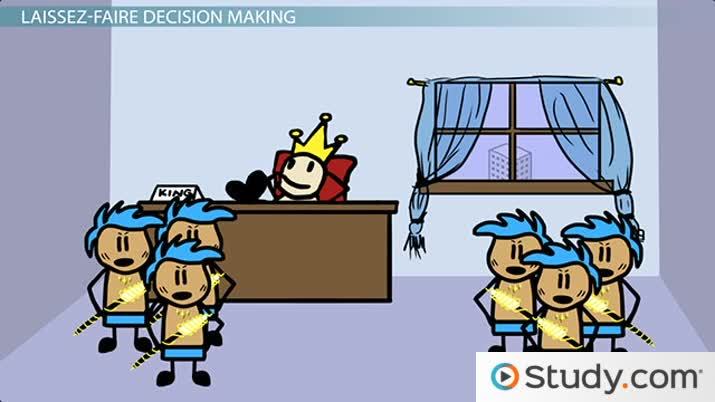
Leadership Approaches

Which approach to leadership gets the best results, leadership from the top or collaborative leadership?  Trick question, the answer is both.

Balance is the key here.  When to be directive and when to collaborative depends on a multitude of factors.  Not only when to employ a particular style is important but also the sequence, collaborate before direction from the top.

Lead from the Top

Top down leadership refers to a heirarchical structure with the fewest resources and the greatest power at the pinnacle.  Simplistically there are two classes of people in the organization, leaders and followers.

This approach can be very effective, basically the leader telling the followers what to do leveraging their power to get it done, granted by dint of their location in the heirarchy.

Collaborative Leadership

In this case there is no hierarchy.  Some roles may have more authority or power but getting things down is participatory and involves everyone.

Those with greater skills and earned power (e.g.,trust and respect) may catalyze the team, that is get things going without direct participation, but no-one is unilaterally directing.

Collaborative approaches tend to have superior outcomes. The effort to achieve the results is more efficient and of a higher quality.  This results from stronger buy in (driven by personal accountability) and the leverage of a diverse set of skills and capabilities.

Both Approaches?

Sounds like collaborative leadership is so much better why is there a need for leadership from the top.  Because, the direct approach is sometimes needed.

For example when collaborators flounder and a single direction can not be arrived at strong direction from the top may be the onlyway to move forward.

On the whole though the best balance between percent use of collaborative and directive leadership is probably in the 90/10 range.


Using Data

Computers have been collecting data since the 1940’s.  In the last 20 years digital storage technology and processing capacity far exceed utilization.

Corporations, organizations and individuals have probably massed more data about individuals than the individual would be able to review about themselves in a lifetime.

It is probably just physically impossible, there is so much.  There is no metric on this I am aware of but even if not completely true it is intended to be illustrative of the volume of digital data.

We used to have warehouses full of stored documents, whole buildings rented to keep records stored.  This physical storage capacity limited how many and how long records could be kept.

That limitation is no longer an issue.

Mining the Data

Having large amounts of data available is not, in and of itself, necessarily of great value.  Without the ability to collate and analyze the data within reasonable durations, it is not usefull.

This also is a problem computing power has solved.  We can now develop software programs to sort, group, interpret and finally summarize the answers to our questions about the data, in relatively short order.

The computing software and hardware are great tools for enabling us to use the data effectively but human intelligence is still needed to know what questions to ask  (at least for now) and to action the results.

Our decisions, things like whether to buy, spend, create new products, services (and so on) are greatly improved by our incredible  data storage and processing capabilities.


The Stacey Matrix

In 2011, Professor Ralph Stacey published the Stacey diagram also known as  the Stacey Matrix.  His objective was to describe management techniques as they relate to the degree of agreement and certainty within the organizational environment.

Ultimately the concepts comtemplated within the matrix can be leveraged as a tool to assist with choosing between management or leadership approaches for a specific issue or decision.

Close to Certainty/Close to Agreement

In this zone the decision making is described as rational.  Using data from the past we predict the future and plan and monitor our actions accordingly.  Basically there is agreement to both the approach to making decisions and what the result will be.

Close to Agreement/Medium Level of Uncertainty

Decision making leans toward the judgemental.  We agree on the issues but are not sure of the outcomes.  Best judment is employed.

Close to Uncertainty/Medium Level of Agreement

In this case decison making is political and resolves around a certainty of available and achievable outcomes but there is a lack of agreemet as to which outcomes to persue.  So we manipulate.

High Uncertainty/Far from  Agreement

This is a zone of chaos where traditional methods of planning and visioning break down.  This is considered a zone of chaos. Typically the organizational culture becomes one of avoidance.  If this kind of decision making is continued over longer periods the results are usually disastrous.

Medium Uncertainty /Medium Agreement

This is where complex decision making occurs, most often the results are innovative.  In this zone traditional approaches like rational, judgemental and political do not work.  The decisions are in and of themselves arrived at with innovative and different approaches.  Operating in this zone requires leaders and mangers to be highly creative.