
Tag Archives: the unknown

Planning for the Unknown

It is hard to deal with things you do not know enough about or perhaps they are unfamiliar.  Risk management is a good example of developing plans to address or avoid the unknown, basically preparing actions just in case.

In general, planning for the unknown can have many applications in our daily lives and is not limited to mitigating potential or anticipated risk.  Sometimes our personal objectives relate to an unclear future.

Being that as it may be, we need to forge ahead as best we can.  Plans based on the unknown or as much as we do know with assumptions and guesses about the rest are needed if we are to be effective as we move on.

Objective Focused

Planning for the future, which is full of potential surprises starts best with a clear idea of what you want to achieve, that is the direction in which you are headed.

Building from these objectives, and using sound judgment founded on the consideration of optimistic, most likely, and pessimistic futures, you can craft an approach to reach your goals.

As time goes on things both become clearer and also change relative to your initial estimations of the possible.  To address these factors requires flexibility and the original plan you form will not work well if you intended it to be carved in stone.

Focus on the probable and the possible

When creating your plan of actions to achieve your goals and objectives, even if many relatively unknown factors exist, remember to always apply the litmus test, “could this happen and is it likely to do so?” (i.e., both probable and possible).
Following the river

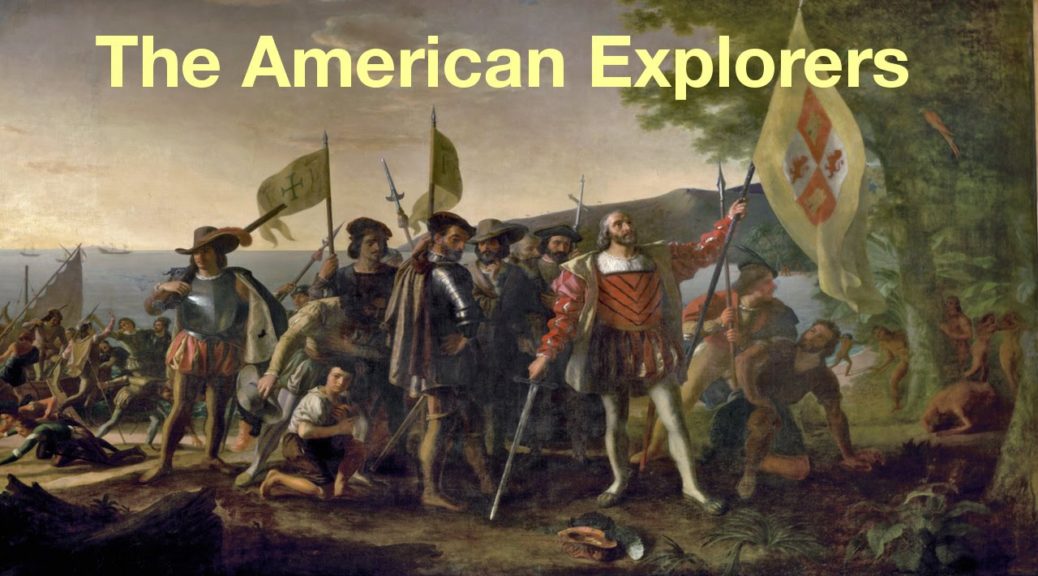
When European explores began their overland journeys to the western parts of North America in the 16th and 17th century travel by water was a common practice.

Of course this limited the explorers and settlers that followed somewhat, to places the rivers went or the lakes were.  The philosophy was, follow the river, it will take you somewhere.

Making Maps

Using rivers and lakes allowed greater distances to be covered faster and supported the development of maps.  Of course the destinations were not planned, beyond going where the river went.

Eventually portages between bodies of water and ultimately land bound trails increased the scope of exploration and maps covered the entire continent.

The initial approach, basically follow the river into the unknown, fascinates me.   I am a firm believer in planning which starts from the premies of knowing where you are going (the destination).

The first European explorers and the settlers that followed them basically figured it out as they went along.  Looking back in history this proved to be a viable approach, that is it worked.

Careful Plan versus Sketchy Concept

The successful exploration of North America, albeit a high risk high reward situation, does demonstrate that working toward a conceptual goal ( with a multitude of unknowns) can lead to sucess.

This leads me to balance careful planning wth a less structured course.   That is just following the river into the unknown, going where it goes and figuring out how to overcome obstacles as they arise.

While this does not resonate with me at a basic level, intuitively it makes sense to balance planning with chaos for the best overall results.

Planning

Not a new or novel thought, but if you don’t know what you are looking to accomplish, how will you know when it has been achieved?

This is one of the main reasons for planning.  In order to create a plan of actions to complete a goal, you need to know what the goal is.   In essence, a plan is simply a recipe for what by when.

Planning for the Not Yet Known

The question arises, how can I plan if the goal is not fully defined?  Our current knowledge of the goal is at a high level.  We have the concept but not the details.

Planning is feasible even if the target is only conceptual.  In these cases, the plans include analysis or investigatory steps to cover the unknown items.   The timelines might be guesses or just placeholders but will provide a valuable guide against how you are doing.

For Example

Consider a suspicious death investigation.  The goal is to find the cause of death and if applicable who did it.  At the beginning of the investigation, there are lots of unknowns.

A successful investigation follows a plan building on known activities and common sense.  There are a standard set of investigation steps that would be included, however, each death has different clues or variables so the plan needs to be updated as more information is uncovered.

Never the less, a plan is imperative for success, and even then sometimes the cause and murderer (if applicable) are still not uncovered.

The underlying success of a plan is always having an idea, whether high level or detailed, of what you are trying to accomplish.  Without knowing that, how can you plan?


Answers

The response to a questions is the answer.  By simple logic, if you seek answers all you need to do is ask questions.  Typically you would ask about things you don’t know.

Of course, therein lies the dilema.  If you don’t have knowledge about something, ( i.e., it is an unknown) how can you know what to ask.  Without the question, there is no answer and the unknown remains a mystery.

Question Types

Closed questions will get yes or no responses or limited information.      This type of question can be useful when you have a good sense of what it is you don’t know.

For example if you go to a store looking for hammers, asking “do you carry hammers?” or “where are the hammers located?” would be a good use of close ended questions.

On the other hand if you had a piece of work to do but were not sure  how to do it you are more interested in an informational focused answer.  The response can fill in unknown gaps for you, without limiting the scope.

This type of question is called open ended and is most useful when you are trying to find out some information  but you are not really sure what.

The key to getting answers is not really about just asking the question, but rather asking the right question in the right way.  How you phrase the question is very much a determining factor relative to kind of response you will receive.