
Tag Archives: management

Behaviour Governance

You have the authority over your personal deportment, that is your behaviour or manners.  Self governance does not mean you can act any way you wish.

It simply means you chose (under your personal authority) which boundaries apply to you.  This decision must be undertaken with consideration paid to the influence of social and cultural norms ( both legally defined, and common sense ).

Impact and Influence

Your personal choices which guide your daily deportment define how others perceive you.  Taking control of these choices and being sure to practice good governance is a simple way  ensure others view you in a positive context.

Acting in the moment or solely according to your personality (i.e., your go to behaviours) without applying some level of constraint can result in others discounting your value to some extent.

Conforming to both your needs and others

Individuals perceived by others to provide  high levels of value typically are under control.  That is their behaviours satisfies everyone (including themselves).

They  have developed an inner code of personal behavioural governance which allows them to tailor their action most appropriately both to the situation and to other peoples needs.

Not a Bad Word

Often I run into people that describe governance as a necessary evil.  Something to avoid if possible.  While this is usually focused on corporate governance it does apply to the concept of governance holistically.

I respectfully disagree, the practice of good governance will almost always, if practiced judiciously, lead to positive outcomes.  Personal governance underpins personal greatness.
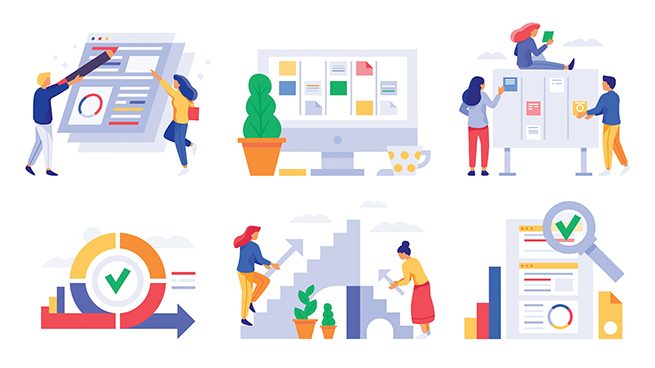


Agile or Waterfall

Getting things done in a specific order of completion, commonly referred to as the waterfall approach is relatively simple.  Basically the instructions are, do this then do that.

Sometimes things are done in parallel or a staggered sequence but typically the tasks have a relationship to each other.  Working this way is simple to do, just organize and monitor.

Waterfall Approach

Following the sequential approach, often called waterfall, the focus is on milestone objectives each a building block to the overall goal.

One  common challenge with this approach  is it may take some time to achieve worthwhile results.  Milestones achievements along the way may be significant but on their own meaningless.

People often say we done a lot, “what are the results”.   Being patient and waiting is not an behaviour many of us are comfortable with. Show me now.

Adding Complexity

More complex strategies involve an iterative approach to planning and guiding the work.  The process becomes a series of interrelated questions and analysis,  like if I do this, then that occurs, otherwise this.

The flow is not step by step.  As a result outcomes are actually practical and useable from completion of the first iteration. This method of getting things done is known as the agile method.

Over time each iteration improves on the previous, ultimately the same finished overall goal as in waterfall approach will be achieved.  You just get to use parts or iterations earlier on.

Of course, both methods for sequencing of work have some value but typically the agile approach requires more skill to manage effectively.