Tag Archives: validation

Understand me, please

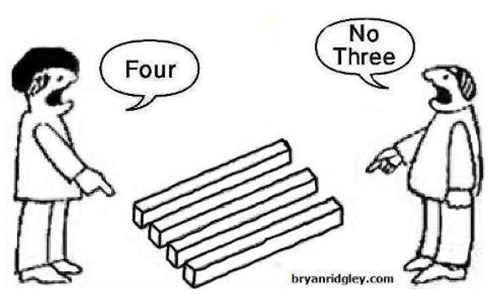
The act of imparting or exchanging information, providing direction, or passing on the news is more of an art than it is a science.  Clarity is founded on an individual perspective and to some extent, it is unique to each of us.

Strangely, because of the subjective quality implicit in any message the being coherent and intelligible with what we perceive to be full transparency can still result in misunderstanding.

Assumptions

In almost every communication both the sender and the receiver include things they accept as true or certain without the need for elucidation (i.e., assumptions)

Without assumptions being explicitly identified and defined it is easy for parties to believe the information being exchanged has a unique and clear meaning.  Sigh, sadly this is often not the case.  Depending on the assumptions the message could be very different.

Avoiding Miscommunication

One way communication is most likely to be misinterpreted.  Without the opportunity to test the message (i.e., two-way exchange), combined with a message that appears complete and clear it is easy for the recipient to assume they understood.

This situation applies to the information provider as well.  Without receiving feedback they can only assume the everyone understood the point and all is well.

In these situations, surprises occur frequently and the result is often by choruses of “that is not what I meant” and “well that is what you said”.    The intent of the message is not achieved.

Keeping the content simple is obviously one way to achieve clarity but most important is testing/validating the communication on multiple sources, getting feedback, and modifying accordingly.

This of course is really critical when providing directions or instructions on how to do something.  Misunderstandings can lead to costly mistakes.


Common Sense

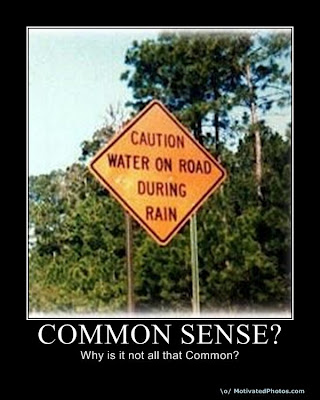
Yesterdays post about empowerment contained the suggestion to practice common sense.  I received some excellent feedback questioning the validity of my recommendation.

After all common sense can be a very subjective term with a multitude of interpretations.   As a decision support tool, does it really have value or is it just an easy motherhood type recommendation.

In Principle

My intent was to consider the practice of common sense more as a principle and strategy than a definitive action.   Common sense is the ability to perceive, understand, and judge things in a way that is shared by nearly all people. (i.e., in common)

An individual feeling that something is the case is of course subjective to an extent.  Good sense is the ability to under those feelings that are shared by the majority.

This is not an absolute method to making the best choices but it is a validation technique with proven value.  Reacting the way most others would is often best (but not always)

Not Absolute

The practice of common sense needs to be considered as a guide not the definitive way to decide how to proceed.  The approach is just one of many ways you can help validate the veracity of your conclusions.

While this is not a litmus test which will always lead to the best results casting aside common sense can lead to disastrous results.

For example, each year the Darwin awards go to people who have lost their lives through silly actions.   Clearly they were not practicing common sense and if they had, they may still be alive today.

Clarity

When communicating the qualities of transparency and coherence coupled with the intelligibility of message are critical to making a real impact.

The substantive power of the message is diminished if it is not clear.  The point must be comprehensible and the measure of clarity is whether the communication is understood.

Understanding

The intended meaning must be the same for both the sender and the recipient for understanding to have occurred.   Validation by asking questions to determine if the message was clear is a viable approach to checking for understanding, but not failsafe.

Even when probing open-ended questions are used, all parties to the communication could be fooled.  That is both you and them may be convinced the intended meaning was clear, however, at a later date gain surprising evidence that it actually was not.

Guiding Principles

Although following up to confirm clarity in communication is a best practice, it is not always practical, nor, as previously noted, foolproof.   The best approach is to for the communication to be founded on clarity.

Here are some simple principles to follow:

  • Keep it simple.  The audience, whether for a written or verbal communication, tends to tune out when bored or not read everything.
  • Keep their interest.  Tell the story in a straightforward way.  Focus on your audience and cater to their interests so they will stay tuned.  The storyteller has accountability for setting the context for active listening as much as the receiver.
  • Be direct. Use the active voice, that keeps others interest by leaving out extraneous, bureaucratic or potentially confusing points.  That is, get to the point.


Subjective vs Objective Analysis

We regularly rely on our personal feelings, tastes, or opinions to arrive at conclusions.  Sometimes these can be strongly influenced by unconscious bias (i.e., things are not even fully aware of). This is a subjective approach.

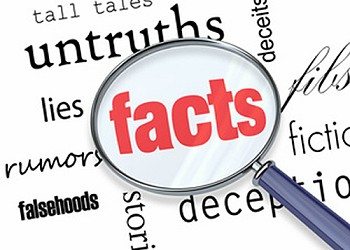
In the objective approach, fact-based judgements are not influenced by personal feelings or opinions.  In this case, facts are always the same for everyone.

True objective measures provide no opportunity for interpretation.  For example, two plus two equals four is a fact.  It is accepted as always being true.

Outcomes

Actions are based on our understanding and analysis.  Often subjective information (easiest to obtain) is readily available and what we act on.

Subjective information could be accurate or inaccurate resulting in decisions that might lead to success or might not.  Of course using  objective information does not guarantee success but results are far more predictable.

Analysis

Whether objective or subjective, sometimes a combination of both types, the quality of the decision will rely on the analysis, that is the interpretation of the data gathered.

Analysis should include weighing  the quality of the inputs relative to how certain the facts are.  Objective facts will always be more certain but determining what they tell you can be tricky.

Testing

Sometimes testing the facts through trials or demos is an approach to separate subjective from objective inputs as this can be a grey area.

Walking through the recommended solution(when feasible) can help identive weaknesses in the knowledge base. This validation process canbe a very useful quality check.

How do I know?

I have found a very useful quality check hinges on the answer to a single query.  The question can be applied to a product, service or process.

First, identify the outcome.  For example, if building airplanes, one outcome might be the plane can fly to its destination without mishap.

Question then Validate

The questions become things like.  How do we make sure this plane can fly the expected distance?  How do we make sure things don’t break in flight?

The plan to test the answers to the questions and make sure they are correct represents validation.

This simple process of repeatedly answering the question, (i.e.., how, ………….? ) while not infallible is a very valuable technique to determining quality, efficiency and effectiveness.

High Quality Outcomes

This simple questioning process is a great way to ensure outcomes will be what you expect (proactive) and then are what you expect (reative).

Asking the “ how do I know …..?” question reduces risk and increases predictability.  Based on the answers we can be condident that the process,service and ultimately the products will be consistent, reaptable and issues or deliberate attacks will be identified and can be avoided or at least mitigated.

Objective Measure

How do I know this blog is readable?  I use automated grammar and spell check tools.  I read the post at least three times before publishing.  I use feedback to improve quality of future posts.

My list actually goes on.  The point is, I am able to consistently produce a high quality post because I am always validating the outcomes using the how do I know questions.

How do I know the topic is interesting?  Hmmm.

Connecting the Results

People, both individually and in teams spend a significant amount of time and effort working to accomplish something.  Hopefully the achievement is both admirable and creditable.

The process of accomplishment usually starts with conception – what is the goal.  This is the ideation phase.  Planning is next, that is how are we going to proceed?

Once the plan is in place execution occurs and voila, the results are heralded as an accomplishment.  In the case of a group accomplishment this often entails back patting and declarations of achievement (i.e., we did it).

Measuring the Results

During ideation and planning work, the reasons for pursuing a particular achievement are paraded as motivators.  In essence the point is “I/we are going to accomplish this thing because it is worth doing”

Sadly, although the tasks arising from the idea are often completed the desired results are not achieved.  In these cases just the fact something was accomplished is paraded as success.

Checking the Achievement

Wondering how actual results mapped to the imagined benefits of a number of accomplishments I once totaled all the monetary benefits from a years worth of initiatives at a large corporation.

The value of increased revenue estimated for all the completed projects was less than the company’s total revenue for the company. Clearly, for some of these initiatives what seemed like a good idea at the time did not turn out to be all it was sold as.

For me, over this just highlights the value of confirming the accomplishment rather than just assuming it.  This is not to punish but rather to guide future directions.

Whatever you are seeking to accomplish, personal or business, check how you did before leaping to the next attempt.  Completion is not necessarily accomplishment.

Learning

Learning can take on a variety of forms from formal classroom, to experiential to one on one mentoring.   What is the best way to determine if learning has occurred?

Traditionally

A traditional and oft used technique is testing.  Whether written or practical the core objective is for the learner to prove their knowledge.

Unfortunately the context is artificial and this impacts the outcomes. For example if you are driving a vehicle alone, your responses and attentiveness might drastically differ from when the testor is sitting beside you.

Feeling nervous will definitely affect results.  Cynically speaking the test results might only prove the learner is good at taking tests.  Put them in a situation where the knowledge needed to be practised and the results could be catastrophic.

Is there a better way?

Demonstration of knowledge through execution ( like the driving test) resonates with me but is not always practical and the assessment of the results includes some subjectivity. (For example I would not recommend testing a surgeons skills on open heart surgery).

Japanese sushi chefs undergo a long apprenticeship which provides them with a great deal of practicle experience.  The final test is preparation of Fugu fish sushi.

Fugu is a highly toxic fish that when eaten, if prepared badly, results in almost immediate death.  The sushi apprentice eats the fish they prepared and if they live, they pass.  Now thats a test.