Celebrate, dance to the music

Celebration contributes to our ongoing joy, it behooves us to find a purpose for marking our pleasure at an important event or occasion or just by engaging in enjoyable, typically social, activity, every day.

Holidays are designated days of ceremony, on and off as both individuals and  social groups we select significant events and milestones to celebrate but these celebrations are selective and not continuous.

Life is Short

In the context of the Universe and time as we know it our own lives are just a drop in pond.  From that perspective celebrating everything continuously only makes sense.

While the following is a trite and a well worn phrase, our life is a celebration in and of itself we should not waste any moment under a cloud of fear, anxiety or other stressful feelings.

However small or large, beautiful or ugly scary or relaxing everything we experience is ours to enjoy and celebrate.  Logically why would we choose otherwise.

Choose Pleasure

One of the greatness opportunities of life is a feeling of happy satisfaction and enjoyment.  Why entertain anything but the joy we derive from pleasure.

We can find distinctive pleasure in everything.  An open and optimistic perspective is all you need to do this.  How you perceive your personal interactions and the things around you is core to achieving personal enjoyment.

Simply put, choose pleasure every-time, what possible reasons can there be not to.  It is only logical.

Pass it On

Another significant reason to find pleasure and celebrate everything  around you at all time is the fact it is infectious.  Your celebration will very quickly be joined by others.

Spread the joy.

Planning for the Unknown

It is hard to deal with things you do not know enough about or perhaps they are unfamiliar.  Risk management is a good example of developing plans to address or avoid the unknown, basically preparing actions just in case.

In general, planning for the unknown can have many applications in our daily lives and is not limited to mitigating potential or anticipated risk.  Sometimes our personal objectives relate to an unclear future.

Being that as it may be, we need to forge ahead as best we can.  Plans based on the unknown or as much as we do know with assumptions and guesses about the rest are needed if we are to be effective as we move on.

Objective Focused

Planning for the future, which is full of potential surprises starts best with a clear idea of what you want to achieve, that is the direction in which you are headed.

Building from these objectives, and using sound judgment founded on the consideration of optimistic, most likely, and pessimistic futures, you can craft an approach to reach your goals.

As time goes on things both become clearer and also change relative to your initial estimations of the possible.  To address these factors requires flexibility and the original plan you form will not work well if you intended it to be carved in stone.

Focus on the probable and the possible

When creating your plan of actions to achieve your goals and objectives, even if many relatively unknown factors exist, remember to always apply the litmus test, “could this happen and is it likely to do so?” (i.e., both probable and possible).

You can’t always get what you want

The external factors associated with your perception that prevention of the progress, success, or fulfillment is occurring can be very real to you, however,  letting this result in frustration is a choice.

As the Rolling Stones sang back in 1968, “You can’t always get what you want, but if you try sometimes you find you get what you need.”  For me, this is how we can avoid frustration.  Focus on what you need, not what you want.

 Focus

Getting what you need might require a significant effort but the result will be satisfying.  Focusing on things you require should never be frustrating, just plod on until you attain what is required. Ultimately you need it so you will find a way to get it.

Separating needs and wants (both of which can seem required, essential and important) is not easy but critical to avoid frustration.  Don’t waste time on the things you want.  Just relax and let it go, cause you don’t really need it.

Fine Line

There is a fine line between needs and wants and sometimes they are inseparable.  The yardstick is basically can you survive without it.  If no it is required.  For example, we need food to live ergo it is required.

However, this is an interesting requirement because of the devil in the detail.  How much and what kind of food is required.  We have our individual wants as it relates to food and we feel a need to satisfy desire but the reality is, core sustenance is pretty basic.

Separating wants and needs can be tricky but it ultimately it makes sense to stay chill about things that are nice to have but not absolute musts.


Who are you?

Years ago I participated in an online personality assessment where I answered a number of questions about how I would behave in specific circumstances.

Ten others, who all knew me well, anonymously answered the same survey from their perspective of me.   All the answers were subjected to an algorithm that calculated my perceived personality traits or most likely behavior types.

Know Yourself

Obviously individual perceptions (both yours and others) won’t map exactly.  How we view ourselves can be markedly different from how others perceive us without issue as long as we are not surprised by how others see us.

Empathy with others is critical to personal self-awareness.  This allows us to behave in the best possible way when interacting with others.

Sometimes this means acting outside of our base character or personality but purposely so.  To do this effectively we need to have a robust and accurate understanding of what others think of us.

Avoid Surprises

For me, the test results showed both areas of overlap as well as differences.  The key value of the output though was not that differences or conformity existed (obviously yes) but rather, did it match my own understanding of what others thought of me.

Testing like the one I describe here can be a valuable tool in validating your perceptions however it is just one tool in your kitbag and not always readily available to you.

Most importantly is to be able to evaluate what others are thinking and behave in ways that do not result in surprises.  When you are surprised by someone else’s reactions likely you have misjudged them.

Pay attention, listen carefully, observe, this sensitivity will serve you well.

Travelling Muddy Waters

Clarity begins with the fullest possible understanding of all the pieces.  When things are unclear the first task is to clean the glass.  That is, put things into a condition from which understanding can be derived.
Clarity requires viewing of all aspects of a particular set of circumstances in a way that is consistent with the practical world around you and specifically the state of things as they actually exist, as opposed to an idealistic or notional idea of them.

Interpreting Meaning

Once you have a clear picture of all the various components you can begin to discard the irrelevant factors and focus on those things that are truly impactful.
This analysis should focus on determining, what is reality?  To be able to parse the information, and thereby determine what it means, it is critical to a clear understanding which is not encumbered by things that don’t really matter.
The things that cloud your view (the dirt on the window pane) need to be removed if you are to achieve a valid and accurate perception of what is real.

Eliminate Distraction

Clarity requires focus.  Anything that prevents you from giving your full attention to determining the core information can result in misunderstandings, mistakes and misinterpretation.

Following the wrong path or undertaking wasted or potentially inadequate actions because you missed the point can be costly and perhaps even painful.

Avoiding being overwhelmed by a myriad of information begins by clearing away the unnecessary.   Those things that ultimately are not important in the overall scheme of things must be ignored.

Seeking clarity in all you do and you will lead to greater satisfaction.

Don’t Let Fear Overwhelm You

Our actions can be motivated by many factors both internal and external.  Our environment and other people can exert a strong influence
Fear driven behavior might not be the most appropriate, in these cases, it is best to take time to think through your options although this is often easier said than done given the presence of a sense of urgency.

Think

Some of our reactions to danger are an innate action and can be hard to control, in some cases controlling these is not the best option.

However, in many circumstances, taking the time to contemplate our fears will produce much better outcomes.  We cannot always control our external influences but how we respond is within our ability to manage, just not always easily done.

Allowing our fear or anxiety to take control of us and dictate our behavior might achieve acceptable results but in those cases, it is purely by accident.  Retaining control of your destiny at all times is a much smarter approach.

Choose

While sometimes external factors are out of your control, you can always choose how to react.  Overriding instinctive action is difficult and occasionally not appropriate but generally more satisfying.

Without a doubt, our choices are influenced by circumstances.  Picking the best alternative for any given situation, sometimes at the moment, is often overlooked due to expediency or just because the effort appears too great.

In reality, taking time to get it right is always a high-value proposition and worth the effort.  Avoid being stampeded by your fear, you won’t regret it.


Get Over It

Interacting with other people can lead to feelings of being upset or annoyed.  This can often stem from our own inability to change or influence change to achieve something.

When we need to get things done through others because we are either not capable or don’t have the access we need to do it ourselves, frustration will rear its ugly head.

Taming Frustration

Anxiety, stress, and anger are probably the most prominent emotions associated with frustration.  We find ourselves prevented from making progress and achieving success simply because others are not doing what we want.

This is one of the perks of having power, it is generally easier to influence others to do what you desire.  Even though they may not be in accord with your direction, through physical or organizational power you can drive to your goal, usually without frustration.

Having power is not always an option and being able to finesse what you need is a skill that can save you a lot of frustrating moments.   Getting things done through others is most effective when they want to do it, not because they must.

Core Tenants of Influencing

Understanding others’ wants and desires is the first step toward your goal.  What motivates them?  What are the kinds of things that will drive them to want to behave in a way that will satisfy your desires?

Listening carefully, observing, perhaps conducting some historical research will help you answer these questions.   Your approach to influencing is best founded on what others want, need, and believe.

It is that simple.

Changing Course

Changing our standard, usual, typical, and expected behavior every once and a while can be refreshing.   That is stepping out of the normal into the new and exciting.

When are behavior change becomes a long term or permanent change, more like the new normal it can be stressful at first.  Changing it up for short periods is exciting and can spice up our lives but forced change for the long term becomes a bit wearing.

The good news is, eventually, the new normal becomes normal, at least until the next shake-up.  However, it does take time to adapt, accept, and transition our behaviors so they become autonomic.

Focus on Better

I visited my dentist a couple of weeks ago for a check-up.  After the exam, we chit-chatted a bit about the covid worldwide pandemic and the impacts on his business.

Unexpectedly he actually positioned the additional anti-disease measures as overdue and his plan is to permanently adopt many of the practices.

Masks, outerwear, frequent cleaning (even more frequent than before) are best practices.  Although they were specifically mandated in many cases to protect against covid, it is of note the transmission of illness is not limited to covid.

These processes make sense in any case.

Embrace/ Enjoy

Resistance to the increased government-mandated health safety measures does not make sense to me.   This is a case where preventing transmission of a potentially deadly disease is common sense.

Ultimately we may develop vaccines for covid or even a cure but the next one is just down the road (perhaps months, years, decades, we just cannot be sure).

The lessons of this pandemic should not be discarded.  Let’s make the new normal actually normal.


True Wealth

Most often we define wealth as an abundance of valuable possessions or money.  Personal well being is founded not on fiscal abundance but rather on our mental state.

When we have a wealth of emotional stability and contentment we are happy and display a keenness of thought and vision.  For me, true wealth, indicative of real prosperity, lies within and is not based on physical ownership.

  Feeling Good

You may gain a false sense of happiness and joy by having solid financial resources which leads you to believe you are satisfied.  However, real personal satisfaction is based on your state of mind.

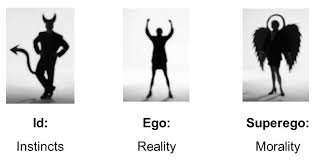
You are defined by the innate instinctive impulses and primary processes that are manifest within your brain.  This forms your ID and functions best when grounded in logic and kindness.

Give and Receive

One of the keys to personal emotional stability is freely sharing kindness.  By being kind to others you will receive kindness in return and the give and take increases exponentially over time.

For all of us, the outcome of shared kindness is a wealth of peace, contentment, and joy.

Seeking to gain solely through material wealth can actually detract from our ability to behave kindly because our actions are motivated by the need to acquire (they are not selfless).

Behaving with a focus on maximizing pleasure is not grounded in material wealth but rather your spiritual whole.  You need to act in accordance with your ID, fighting it only causes anxiety although we do not always recognize this as the root cause.


Mea Culpa

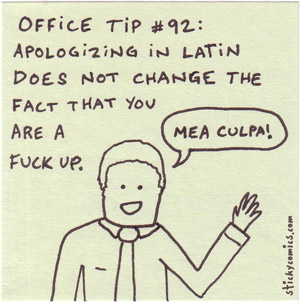
The Latin for guilt is culpa.  Mea culpa is a derivative phrase that can be incorporated into an English discussion as an acknowledgment of a personal fault or error.

I have always interpreted it personally as meaning something like,     “Yeah, I did it, I made a mistake, now get over it, and let’s get on with our lives.”  Not an apology or falling on my sword but rather a way to get the elephant out of the room.

Self Confidence

Having the confidence to own up to an error is very important.  This often should be accompanied by apologies and explanations of actions to correct the situation.

For trivial errors, it really is not about self-confidence but more about short-circuiting unnecessary finger-pointing and potentially wasting time on something that is done and over.

My mea culpa is just as much derived from exasperation as anything else.   We get it, a mistake was made, throwing out accusations adds little value.  Just move on.

Material Impact

For me, in the case of a significant error with some level of material impact, the focus should not be on responsibility (who did it) but rather what are we going to do about it.

For trivial matters, there should be no focus and I am unable to determine what the value of identifying the culprit is, beyond perhaps some personal satisfaction for the accuser.

Mistakes are subjective to some extent.  Where I perceive I have made one I either fix it or if the impact is minor I just plead mea culpa for clarity and reasonably expect everyone to move on.