All posts by steve@kerrzone.com

What by When?

Clarity of purpose, understood by everyone involved or impacted by your plans and objectives, is core to their achievement.  It has been asked many times but if you don’t know where you are going do you ever arrive?

Leadership first and foremost is about ensuring that clarity exists – universally.  The clearly and broader the message is spread the greater the likelihood of arriving at the destination but at least you will know if you are not there yet.

What by When

For everything we set out to do there is always the question “What are we doing?” and co-existing with the objective is timing “When will we finish?”  These two simple pieces of information completely define any and all tasks we undertake.

This is not to say plans are absolute and inflexible.  Both the what and when parameters can change as you meander along your journey.   Starting without knowing what you are attempting to achieve leads to chaos, changing it as you learn more does not.

Motivation

Everything we do , how we behave, our desires, all have some underlying motivation.  Nothing happens without motivation.  Both what you are seeking to achieve and the time frame underpin motivation and drive urgency.

Having a solid understanding of the strategy and direction can be very high level or intricately detailed but without some definition of purpose  why would we do anything.

Of course even doing nothing requires motivation.  That is to say nothing can be defined and so is something.  The level of motivation to do nothing (possibly the default activity) does not need to be strong but still must be present.



Compromise

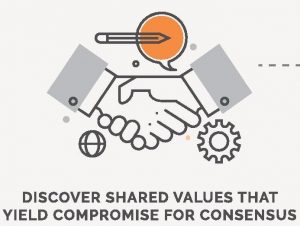
One method of getting everyone involved to arrive at problem resolution is for the stakeholders to reach a settlement of the disputed items by each side making concessions.

This approach varies from consensus agreement, which is not about anyone giving anything up but rather finding a solution that satisfies everyone, albeit to different extents.

Passive Aggressive

Compromise  is often a hallmark of situations where although resolution appears to have been achieved in reality discontent lurksclose to the surface.

Giving up or giving in can be motivated by a number of things like frustration ,disenchantment, boredom, etc.  None of these are really positive nor leave the giver in a positive mood.

Often the giving in (passive behaviour) leads to a hidden agressive response.  We haven’t actually given up, we just make it seem so to give us time to prepare our resources for attack.

Consensus

Although not true in every case consensus agreement  provides an opportunity for all parties to buy-in to the solution.  That is, there can be real satisfaction to participating in the outcomes if you were involved in their creation (not so much when you feel pushed).

Strangely, although a much more effective approach with outcomes proven to be more sustainable I often see agreements forged through compromise.

I believe this is largely because achieving consensus is much harder than either through compromise or of course the easiest method, pure force (also the least sustainable).

When working with groups to arrive at common goals and strategies,  facilitatIng  consensus over compromise Is always best.


Group Think

Working with a group of others to produce or create something as part of a common goal can be a very powerful way to achieve high-quality results efficiently.

There is a danger this cooperation might result in individuals setting aside their own personal beliefs or adopt the opinion of the rest of the group (i.e., groupthink).

Individual and Group

Collaboration is most effective when the participants do not lose their own identities within that of the group.  Being able to carefully balance the power of the whole with the diversity of the many is a key feature of high performing groups.

This task, incorporating the skills and abilities of individuals into a cohesive whole without loosing what everyone brings to the table but adhering to the needs of the group, is extremely difficult but also rewarding.

Dysfunctional

The practice of Independent thinking within a team or similar organizational construct without becoming advisarial requires all stakeholders to seek value from each other.

This does not mean to forgoe your independence to avoid conflict, which can lead to dysfunctional behavior and irrational compromises.

We are many but we are also One

Combining the best ideas or morphing disparate ideas to something greater and more effective requires only a strong believe that everyone is important and adds value.

If all members of the group practice this value. without deciet or prejudice everyone benefits and no one needs to sacrifice thier core beliefs to do it.

Avoiding group think starts with individuals seeking  the best solution without compromising their own identity.


Divide and Conquer

Bureaucratic organizations are typically complex structures with many departments and divisions that are administered by lots of people.

These kinds of organizations are a product of decentralization.   Focus areas or silo’s of expertise are created.  This results in multiple groups each with a very narrow focus, which can be easier to oversee but suffers from lack of integration.

Division of Labor

A side effect of creating specializations and divisions of labor is turf wars and acting in self-interest.   The central areas which govern the whole often end up participating in political skirmishes both between silos and with themselves directly.

Centralization can result in a diminishing focus, which can affect the overall quality, but will almost also increase efficiency resulting in quicker turnaround with fewer hoops to jump through.

Centralization

Centralizing functions within large complex organizations is often a change strongly resisted by the organization’s stakeholders.    This change can dramatically affect the accountability and control of de-centralized areas.

Moving to a more centralized structure does need to be done with caution.  The potential for passive-aggressive resistance must be both recognized and planned for.

Solidly entrenched positions can be torn asunder and the incumbents are likely to become roadblocks without working collaboratively to overcome this.

Motivation

From the start of any centralization exercise, it is critical to highlight the value of reducing the bureaucracy together with associated personal benefits (i.e., what does it mean to me).

Working carefully consulting throughout with all impacted stakeholders restructuring and organization can improve it’s ability to accomplish its goal.  If the change is simply rammed through though the results can be catatrosophic.


Matrix or Heirarchy

Groups we are part of, from family thru work to public and government, operate on a either a matrix or hierarchical structure or a mix of all points in-between.

While hierarchies have clear levels of authority and strong well-defined relationships between them a matrix structure will have multiple interactions and reporting relationships and is not rigidly organized around power and accountability.

For Example

The traditional family structure is very hierarchical.   It begins with  the male designated as the the head of household (top of the hierarchy), his wife second in command, and the children underlings.  The authority of the father was tantamount.

In most recent times this structure has multiple variations with the partners sharing authority and in some cases the progeny are even so independent as to live within their own silos organizationally speaking.

The traditional structure of layered well defined authority, where respect is more granted by dint of position versus being earned, has morphed overtime to a more flexible organization based on need.

Distinguishing Factors

Matrix structures tend to produce more creative and higher quality results.  The practices and outcomes defined by this type of structure demonstrate a greater degree of sustainability.

The downside of matrix organizations are a reflection of  the key benefit of the main plus of hierarchies, that is the ability to be nimble, make and enforce quick decisions.

Operating within a matrix structure can be harder to do and require greater individual effort from everyone within the organization but the results can be much more gratifying.


Are we Finished?

Measured progress toward personal goals is wasted if you quit before the ultimate end is achieved.  This assumes you know what the desired outcome is.

A boss I worked with years ago (one whom I really admired) would frequently prompt us during strategy and planning sessions with a simple question, “What does done look like?

 Clarity

For me the question was about both clarity and measurability.  If you are not crystal clear as to the destination how can you assess whether you have arrived or not.

This is a simple intuitive concept, yet I frequently observe (more often than not) people declaring success by morphing outcomes  to appear as meeting the goals.

Example of Project Success

One of my favourite examples  of slipper goals is measuring project success based on schedule and budget.  Frequently unexpected events occur and schedule or budget are modified accordingly.

In the end the project maps to the final timeline and budget, albeit miles from the original schedule and cost.  Without baselining it is easy for this success measure to be achieved but is this really what done was intended to be?

Accountability

To be truly accountable for outcomes you must be both fully in agreement as to what they are as well as buying in to their achievability Iif you aren’t convinced success is within your grasp can you really get it done?).

Absolute clarity as to what done is coupled with buy-in to feasibility will  not guarantee you will arrive where intended but it really increases the odds.


I’m Back

Warning, todays post is a rant about the vagaries of modern day social media technology. Really just need to get it off my chest.  Please accept my apologies if this causes your eyes to glaze over.

I noticed this morning my Dlvr.it  WordPress RSS feed automation has not been working since May 20th.  Neither was my Zapier automation which I use to post my feed to the Kerrzone facebook page.

Troubleshooting Yuck

I had an alert from Zapier last week but after spending several hours trying to figure out the problem I gave up.  Dlvr.it sent no error message so I figured the LinkedIn feed was still active and that is the one I really care about.

This morning I thought I would quickly check if my Zapier feed had miraculously fixed itself.  It had not and just in case I checked Dlvr.it and found the feed also was not working.

Strange Ambivalence

I have mixed feelings about trouble shooting technology issues.  I like the challenge and certainly feel good when I figure it out, however, I am never happy when things mysteriously stop working.

For well oiled organizations (public and private) documentation is a system and application documentation is a requirement.  For my home grown Kerrzone tech, not so much. Which of course makes troubleshooting even more fun.

Cutting to the Chase

For some unknown reason (I had made no changes) traffic to my WordPress blog was blocked from outside my network.  So, Dlvr.it and Zapier could not connect.

Within my own LAN I had no connection issues.  When it finally nally dawned on me some sort of weird partial Natty address blocking was going on I put the server into the DMZ and problem was solved.

Even weirder, I took the server out of the DMZ and the problem did not return.  Chalk up another one for the mysterious electronic gremlins..

What or How

Our goals can usually be described as the answer to the interrogative request  “What?”.    The response describes the nature, origin and identity of something.

Focusing only on the tangible and measurable part of what we wish to achieve is often at the expense of the how.  That is, the way or manner in which we behave to attain our objective.

Success without Substance

Unfortunately achievements that leave behind a field of dead bodies can be questionable.    In the movie Kill Bill the heroine exacts her revenge leaving unimaginable carnage in her wake.  Did she ultimately win?

To really be happy with your results it is important to consider how you proceed to get what you are after.  Without carefully considering how you can get what you want to ensure it is not at an unacceptable cost you may tarnish your success with regrets.

This may raise questions about the goal itself.  Was it worth it?

Plan before Leaping

We may feel we need something, the object of our desire.  This emotional tag can cause us to charge ahead without fully thinking out the practicality and feasibility of our approach.

Without forethought and a plan of action we may fail but in fact even worse we might get what we sought but given the cost suddenly we have no taste for it.  We may even be saddened by events.

Success is not simply accomplishing our purpose but rather doing it in a pleasurable and satisfying way is needed for us to be able to claim true success.

Choosing your Direction

The path forward (or backward) has many branches, take pleasure in choosing your direction.  When you come to a fork in the road (metaphorically speaking) you should allow it to bring you joy.

Making life decisions, should never come with regrets.  Whether your choice has positive or negative consequences (relative to your level of optimism or pessimism) the process of arriving at the choice should be fun.

The Moment of Choice

The act of selecting or making a decision when faced with multiple possibilities is not to be feared.  Embrace the opportunity to choose, it is your moment and regardless of influencing factors it is all about you.

Enjoy making the choice without letting the risk of poor or undesirable results color your thinking process.  Afterall life, everyone’s lives, have moments of joy and sadness and everything in between.

The chance to take charge and make your own decisions (good or bad) should never be shirked from.  After all it is these choices that form the results of your life.  It is your life, your choices and you should not let them pass you by.

Sometimes it appears easier to follow the crowd or let someone with a powerfull personality take charge but in these cases although you may feel okay accepting someone elses choice this approach will not bring you personal joy

Taking ownership and accountabilty of your choices is the only way to really feel satisfied , whatever the ultimate results of your choice might turn out to be.