Tag Archives: solutions

Compromise

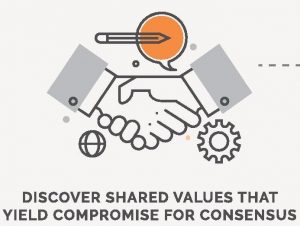
One method of getting everyone involved to arrive at problem resolution is for the stakeholders to reach a settlement of the disputed items by each side making concessions.

This approach varies from consensus agreement, which is not about anyone giving anything up but rather finding a solution that satisfies everyone, albeit to different extents.

Passive Aggressive

Compromise  is often a hallmark of situations where although resolution appears to have been achieved in reality discontent lurksclose to the surface.

Giving up or giving in can be motivated by a number of things like frustration ,disenchantment, boredom, etc.  None of these are really positive nor leave the giver in a positive mood.

Often the giving in (passive behaviour) leads to a hidden agressive response.  We haven’t actually given up, we just make it seem so to give us time to prepare our resources for attack.

Consensus

Although not true in every case consensus agreement  provides an opportunity for all parties to buy-in to the solution.  That is, there can be real satisfaction to participating in the outcomes if you were involved in their creation (not so much when you feel pushed).

Strangely, although a much more effective approach with outcomes proven to be more sustainable I often see agreements forged through compromise.

I believe this is largely because achieving consensus is much harder than either through compromise or of course the easiest method, pure force (also the least sustainable).

When working with groups to arrive at common goals and strategies,  facilitatIng  consensus over compromise Is always best.


Answers and actions

Having answers is good.  Knowing how to use them is better.  Actually acting on them is best.  In essence, being able to do stuff is not as valuable as doing it.

Accomplishments require action.  Providing action instructions, in and of itself, does not necessarily get things done.  Getting results requires more than just identifying what is needed.

Buy-In

Even when you know what outcomes are expected, achieving them requires more than just insight.   Whether you are undertaking the action on your own, with or through others, to be successful everyone needs to buy-in (including you).

Without explicit approval or agreement to the course of action proposed (i.e., the answer) those involved will not feel ownership for the solution and so probably do not perform to their maximum potential.

Building acceptance and ownership to an approach requires more than being told or even knowing the right answer.  Everyone has got to believe it is the best way.

Doing it Right

Just acting on the right answer, that is getting stuff done is only part of the equation.  The approach needs to result in the defined goal.  That is a success means you achieved what you set out to achieve.

Knowing the right answer includes understanding clearly what the aim or purpose of the answer is.  To say you understand and know how to proceed without a clear vision of what success looks like probably translates to you not really knowing the answer.

The approach to achieving the goal, answering the question or problem is not right unless it works.

Answers

The response to a questions is the answer.  By simple logic, if you seek answers all you need to do is ask questions.  Typically you would ask about things you don’t know.

Of course, therein lies the dilema.  If you don’t have knowledge about something, ( i.e., it is an unknown) how can you know what to ask.  Without the question, there is no answer and the unknown remains a mystery.

Question Types

Closed questions will get yes or no responses or limited information.      This type of question can be useful when you have a good sense of what it is you don’t know.

For example if you go to a store looking for hammers, asking “do you carry hammers?” or “where are the hammers located?” would be a good use of close ended questions.

On the other hand if you had a piece of work to do but were not sure  how to do it you are more interested in an informational focused answer.  The response can fill in unknown gaps for you, without limiting the scope.

This type of question is called open ended and is most useful when you are trying to find out some information  but you are not really sure what.

The key to getting answers is not really about just asking the question, but rather asking the right question in the right way.  How you phrase the question is very much a determining factor relative to kind of response you will receive.