Tag Archives: efficiency

Making it Better

Post-secondary education in Alberta is heavily reliant on government funding.  The current provincial government has studied funding levels in other Canadian jurisdictions and concluded the public cost of post-secondary education in Alberta is too high.

The conclusion is supported by the cost analysis of selected universities and colleges across Canada.   The result is a significant reduction in Alberta government financial support of post-secondary institutions.

Accept and Resolve

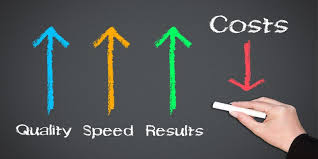
Resistance to the cuts, while a natural reaction is both probably futile but also the question arises, “Is it the best approach?”  Perhaps reducing costs could lead to greater efficiency and quality.

There is undoubtedly a human cost mostly due to a reduction in well-compensated jobs with a good personal work-life balance.   This job reduction does not need to reduce the quality or effectiveness of education services.

In reality, the layers which develop in large organizations over time often result in a costly bureaucracy that is both less efficient and produces lower quality than a more streamlined organization.

More with Less

Efficiency experts, largely now termed business process analysts have for years demonstrated the principle of better results from eliminating a bloated cost base of human resources.

Doing fewer things does not equate to poorer results.  I have personally experienced this truth on numerous occasions.

Initially,  I was extremely skeptical but over time, my own observations have led to the conclusion expense reductions often do lead to improved quality of operations and surprisingly increased revenue.

Spending Gets Results (Not Always)

Spending is necessary to achieve results.  People need to be fairly paid for their efforts.  However, more people and more cost will often reduce effectiveness and quality, the right balance is critical, more does not automatically equal better.


Divide and Conquer

Bureaucratic organizations are typically complex structures with many departments and divisions that are administered by lots of people.

These kinds of organizations are a product of decentralization.   Focus areas or silo’s of expertise are created.  This results in multiple groups each with a very narrow focus, which can be easier to oversee but suffers from lack of integration.

Division of Labor

A side effect of creating specializations and divisions of labor is turf wars and acting in self-interest.   The central areas which govern the whole often end up participating in political skirmishes both between silos and with themselves directly.

Centralization can result in a diminishing focus, which can affect the overall quality, but will almost also increase efficiency resulting in quicker turnaround with fewer hoops to jump through.

Centralization

Centralizing functions within large complex organizations is often a change strongly resisted by the organization’s stakeholders.    This change can dramatically affect the accountability and control of de-centralized areas.

Moving to a more centralized structure does need to be done with caution.  The potential for passive-aggressive resistance must be both recognized and planned for.

Solidly entrenched positions can be torn asunder and the incumbents are likely to become roadblocks without working collaboratively to overcome this.

Motivation

From the start of any centralization exercise, it is critical to highlight the value of reducing the bureaucracy together with associated personal benefits (i.e., what does it mean to me).

Working carefully consulting throughout with all impacted stakeholders restructuring and organization can improve it’s ability to accomplish its goal.  If the change is simply rammed through though the results can be catatrosophic.


Continuous Improvement

Doing better continuously should not be treated as a mandate, challenge, or chore but rather a lifestyle choice.  Like the Beatles sang so long ago “ It’s getting better all the time”.

We all have an opportunity to improve both our own and others situations through first recognizing ways to making things better and secondly acting on those observations.

Ongoing

The key to practicing ongoing improvement is a belief everything can be enhanced.  Resting on the laurels of it is good enough or it works so leave it alone can stall this practice.

The associated core value which underlies the process of continuous improvement is “We believe in better”.  This is without qualification.  Everything could be raised to a level higher quality, more efficient, bring more pleasure.  This never stops.

The history of human kind on the planet earth is an ongoing and  persistent example of continuous improvement.

There may be stumbles along the way and of course sometimes our better ways do have negative side effects, on the whole however, our lives our longer and easier than those of our predecesors.

Seize the Moment

When we have the chance to make a change for the better , there is little reason to hesitate.  We may not succeed with every attempt we make but if we don’t make the attempt it is unlikely improvement will ever occur.

Working to make things better all the time does require effort on our part, but the results easily justify the expenditure.  Simply put, better is best.

Working Smarter not Harder

My favorite catchphrase (not) came up in a discussion the other day.  The topic was getting more things done at a lower cost.  Typically salary costs are the greatest expense whether its a contractor you hire or employees of your business or organization.

Charitable organizations get around this cost somewhat by using volunteers but many still have a lot of paid employees which inflate the ongoing operational expenses of the organization.

Do more with less

For a vibrant organization (or even just from a personal or family perspective) if you can get more or even the same at less cost, well, go for it.

Doing less should cost less but cutting product quality or services does have negative impacts.  Hence the catch phrase, everybody needs to work smarter not harder.

Sneaky eh.  Basically the theme is we will reduce our resources so we have less to work with  but because you are smart you will be able to do more without increased effort.

Really! It is a bit insulting to think I am not smart yet nor have been smart in the way I work.  Due to cost  cutting I will suddenly become smart enough to do more with less.   What does that say about my work right now, ouch.

Overspending comes home

In the case of governments spending cuts often are tied to service reduction.  For other organizations who need to balance budgets to survive working smarter not harder becomes a mantra.

Squeezing the lemon for everything is the approach.  Unfortunately cost cutting usually is heightened in times of recession and high unemployment so we workers just put up with the squeezing.

We work harder all the time being told we are just being smarter.


Get it done sooner

Getting something done soon simply means within a short time.  This is, of course, a subjective measure and arguably depending on your perspective could be minutes, hours, days, months, etc.

The term is relative and so if the task would normally take a century, the term soon could refer to getting it done in half a century.  That is earlier (or soon) relative to the normally expected time.

Sooner

The comparative adverb of soon is sooner.  While still a subjective measure there is an implied baseline.  In essence, the expectation is the task would be completed before the initially selected duration.

Logically though, with the term sooner there is a bit of a paradox because any moment of time before another moment of time is sooner so the soonest time does not exist because there is always a sooner time (considered on an absolute basis).

Getting it done earlier

Finishing an activity or achieving a goal before the accepted duration could be sooner but it is not necessarily faster.  Doing it sooner is about reduced duration.

It can be achieved by doing less work but still attaining the same outcomes.  That is working smarter not harder.   Getting it done sooner does raise the question as to why it was not scheduled soonest in the first place.

This is not a question I ask when dealing with bureaucracy.  There is really no point.  The culture in these situations is largely focused on process versus urgency.  (In many cases mindless process).


Do organization structures matter?

After an almost 40 year career at various Corporate, Crown Corporation and Public Institutions I have come to the conclusion that organization structures really matter and fact can be the difference between high quality outputs (product, service) provided efficiently (time frames and cost).

A Model to Consider

Years ago I worked with an organizational psychologist.  I was fortunate to be exposed to his theories about companies structures.  There are many of these theories, however, those of Elliot Jaques really resonated with me.

Organizations consist of layers of complexity.  Let’s call these strata and number them.  The lowest number the most simple and the highest most complex.  So S1 (strata 1) is junior and say S5 would be much more senior.

In order to keep the model simple and effective we determine which strata of the organization you reside in, based on the time it takes to do your longest task and the complexity associated with that task.  Complexity ranges from do this/do that to do this, consider that, if this happens then possibly that etc.  Basically complexity is related to the information tree associated with making a decision and completing the task.

How about and Example

Take a bank.  A teller’s longest task is weekly balancing.  The decision tree is simple, count this cash, make a deposit.  Check the end of day balance and confirm it is correct.  Fairly straight forward.  So this role would be a S1.

The head teller’s longest task is scheduling the tellers over a month and the decision complexity a little higher.  What will the line up be at noon, should I schedule more tellers, if the commercial customers come in a ten in the morning I should have three tellers on duty but what if they come in at eleven. This role could be a S2.

You can following this process up the strata’s from supervisor to manager to director, vice-president, senior vice president, etc.  Regardless of the specific title the actual work can be mapped to an applicable level.

Note:  This model is not predicated on titles (although I have referenced those above, the key to this model is to determine each strata based on the work being completed by the role (longest job and complexity), not the title.

Using the model to improve organization structure.

Like the basic definition of the model using it to improve quality of organizational output and overall efficiency is very simple.

  • When people at the same level report to each other you get compression.  That is someone whose work fits the S3 criteria reporting to someone else whose work also fits the S3 criteria.  Typically these two individuals will both be frustrated, not feeling comfortable in their roles and this effects their work.
  • When a person at one level reports to another 2 levels or higher you get a gap (i.e, an S1 reporting to an S3)  This gap results in a deficiency in the level of support the lower level role is receiving and work quality is impacted negatively.

The fix is to identify gaps and compression within your organization structure by reviewing the work done by each role (e.g., tellers, head tellers, customer service representatives, assistant managers, deposit analysts and so on for whatever roles exist in the Corporate or Institutional area).

Then simply validate the reporting relationships and re-organize to eliminated any gaps or compression identified (i.e., add or eliminate roles and reporting lines as needed).

Voila, your organizations performance will improve within six months.