All posts by steve@kerrzone.com

Participant or Spectator

It’s important to keep the wheels turning, don’t stop to watch or you might be left behind.  The life you live is yours to define.  You can be a person who takes an active part in something or one who just watches.

Most likely you will do both these things at different times, whether spectating or participating (you cannot do both at the same time) the choice is yours and should be founded based on your personal goals and desires.

Taking Part

Being part of something typically requires an investment of time and effort.   Observing what transpires can bring us joy, for example, if a sporting challenge ends as we had hoped or a movie has a satisfactory resolution.

Usually taking action and being an important and key part of the result brings greater satisfaction than just watching.  Both being a contributor to the end result and being recognized as such can bring moments of personal pleasure.

Many times it boils down to a couple of simple questions, are you an integral part of the solution, or just a bystander?  Which role is more likely to be self-fulfilling.

Shape your world

Without active participation it is possible your world will be of a shape you are satisfied with, however, in that case it will have been purely an accident.

Clearly there is a time when spectating is more appropriate and will bring you greater happiness.  Like so many things, for optimal effect, there needs to be an appropriate balance.

Weighing participating or spectating it is likely acting more than observing will bring better results in the long run.

But is it Fair?

When I purchase a product or service my expectation is I will receive impartial and just treatment or behavior without favoritism or discrimination.

This particularly applies with a medium to a large organization that has been in business for some time.    That is, given their track record and absence the perception of dishonesty from the press and social media it seems to be a reasonable assumption.

The Fine Print

Of course, even large bureaucracies do focus more on self-interest over fair treatment of stakeholders to a certain point but usually, reason prevails so a fair balance is achieved.

Contracts with unreasonable clauses, usually in small print, are a popular technique to help employ one-sided practices that favor the business.

Today’s Rant

Almost ten years ago my wife joint Spa Lady Gym, as the name implies a gym exclusively for women.  New owners recently renamed the company GYMMVMT (weird name).

She was a regular at least a couple of times a week until Covid hit.  The gym, fairly in this case, offered the chance to suspend monthly payments, while gyms were not allowed to open, which my wife took advantage of.

Now comes the tricky part.  The gym decided to restart monthly payments in July (because gyms could now be open) but they did not announce it.

We had a 1-month credit so did not see the return of the monthly charge until this week.   Not ready to return to the gym my wife decided just to cancel her membership.

The Catch

The contract fine print required months notice so cancelation will not take effect until Sept.  So we pay for July, August, and September for a service that is not being used.

Is it fair?  I think not.

Customer Service

From time to time organizations are called on to provide assistance and advice to those people who buy or use its products or services. This can include people who work for the organization as long as they also purchase goods or services from the organization.

The prime motivation of this action of helping or doing work for someone is most likely primarily the monetary compensation received from the organization.   The customer must be dealt with because that is the specified task they are paid to do.

Company or Client

The biggest challenge in customer service is balancing the needs of the organization against those of the customer.  Loyalty to the company is imperative but effective customer service requires more than simply empathy.  The customer must be satisfied.

The most successful organization have empowered their front-line employees allowing them to act logically (within reasonable constraints) rather than simply preaching the corporate gospel, particularly when it does not make sense to them.

Using Common Sense

I recently encountered an example of a lack of common sense in a customer exchange with BMO (my former employer for 33 years).  The customer service representative I was dealing with blindly insisted on something that made no sense.

I insisted on speaking to her manager.  She reviewed the case with her boss and told me the manager would review and call me in 15 minutes.  They did not.

Ultimately the situation was resolved to my satisfaction, what I was proposing was accepted as totally reasonable, but the hoops I needed to go through left a pretty bad taste in my mouth.

Find the Balance

Disaffecting customers through blind stupidity is caused by a lack of empowerment.  The risk of not acquiring or retaining a customer needs to be balanced against the blind adherence to policy (or what the service provider thinks is policy).

Organizations with top-flight customer service understand this and enable their employees to do what is right without jumping through a series of silly hoops.


Making a Difference

Everyone has the opportunity to be important in some way.  We can make a positive difference both in the way we view ourselves, others view us, and most importantly the way others view themselves.

I don’t mean this in a truly altruistic way because every human has a genetic leaning toward life being all about them.  Being the catalyst for positive and healthy change is good for everyone.  I view making a difference for others as not a totally unselfish act.

Volunteering

In a recent post, I highlighted the alternate perspectives in which work can be viewed.  That is, either an activity to earn a livelihood or just using your strength and facilities to do something.

Volunteering is work but not specifically undertaken to earn a livelihood but rather to improve the common good of all.  This probably categorizes it into leisure time or time-off when compared against working for a livelihood.

The focus of leisure time is for pleasure, we choose to do it, ergo volunteering can give us pleasure.

For Example

I recently joined the board of Camp Quality  Canada as a volunteer director.  I had been open to joining a non-profit board as a volunteer since the early 1990s but personal motivation and opportunity never matched up until recently.

The organization’s focus is on providing uplifting experiences for children with cancer and blood disorders, largely through summer camps.

Due to the pandemic, the camps have been held virtually this summer.   I had the opportunity last week to attend a virtual cabin session.  I was blown away.

The volunteer counselors’ dedication and desire to make a difference was crystal clear.   And they succeeded in spades.   The whole experience reinforced for me the huge value of working to make a change  for the better.

The benefits are clear, everyone wins.  The campers, counsellor’s and myself all had an uplifting experience and felt good about it.


Set your own bar

Everyone is subject to the expectations of others.  We also hold expectations of both ourselves and others.  Ideally what we expect of ourselves matches what others expect, although this is not always the case.

While our personal accountability drives what we invest our time and effort in motivation and capabilities play a key role in the type and magnitude of results achieved.

Syncing to External Desires

What others want you to do (i.e., their expectations of you), might not map to your self-expectations but it is very important to know what others want.

This is not necessarily so you can meet the demands of others but rather so you can choose in a reasoned manner how you should respond to these external expectations.  This is about the benefits or associated negative impacts.

Knowing what others seek is key to being able to build your response motivation, regardless of whether it will be supportive or not.  Most critical though is knowing what you want.

Setting Personal Expectations

Mainly the level of performance you desire to achieve is measured by results and these outcomes represent your objectives.  When setting your personal expectations you must first know what you plan to achieve.

This could be a stretch goal and your expectation might be only to make the attempt.  Achieving the goal is not always a certainty but doing everything you can to make it so is fully within your power.

Determination and fortitude underpin the level of success associated with your attempt to perform to the level you desire, this can vary by individual but the more determined you are the more likely you will succeed.

Leisure

I have always found work to be one of the most deceptive words in the English language.  Especially when coupled with the concepts of leisure time and time off.

Depending on your perspective, work is either an activity in which one exerts strength or uses one’s faculties to do or perform something: or activities that a person engages in regularly to earn a livelihood.

Poor Description

Earning a livelihood or exerting yourself to do stuff that will result in the achievement of something are actually very different things.  Of course, the do compliment each other and have similarities but at the core, the meaning is very different.

My challenge is that both leisure and time-off activities are in fact work, just work for a different purpose.  This is my pet peeve.  Many consider leisure time more pleasurable than “work” because you have freedom.

My argument is work is work whether you choose it freely or are directed to it by others or even just your own sense of accountability.

Focus Differentiation

I could be working in my garden during my leisure time (although why I would freely choose this type of activity to do this is beyond me).

Gardening is work, most likely my spouse directed (requested) me to it so while it’s not work focused on making a living it is work with a purpose – to keep the peace.

Constantly Working

Ultimately we are all constantly working on something (maybe as simple as just breathing).  The objective and value of the work clearly varies but is very contextual.  Often it will have nothing to do with earning a living.

Vaccine Games

Big news item the other day, Russia announces the covid vaccine is approved for use.  This although stage 3 (widespread testing) has not been conducted.

Based on the best information cobbled together by the press about 87 people have tested the vaccine so far.  This raises very real questions about both the safety and ultimate effectiveness of the vaccine.

Jumping the Gun

While the continuing positive progress toward the development of a vaccine is welcome, Russia’s announcement is very negatively colored by the doubt it is generating worldwide.

Is this really an effective preventative solution or is it just Russia eager to empress the world with their capabilities.  Even the virus name (Sputnik) seems to be more focused on marketing than anything else (first manned space vehicle, first covid virus).

Harm or Good

It is unlikely many other countries will adopt the Russian vaccine without rigorous testing.   This announcement gives hope (that is good) it could be a false hope (that is bad).

Efforts on phase 3 vaccine testing throughout the world will continue and it is unlikely countries like Canada or the U.S. will approve any vaccine for use without completion of the normal full testing protocols.

Of course in the case of U.S., it is hard to predict what Donald Trump will try to do.  Hopefully, there are enough checks and balances in place to ensure the country does not take to many risks (although past behavior makes you wonder).

Bottom Line

This political positioning by Russia could very much backfire.  If the vaccine is not as effective or does have unidentified negative side effects moving quickly might be a mistake.

On the other hand, if the vaccine is effective this will be a great win for Russia.  All in all this is a risk decision which could go either way (good or bad), the jury is out.

Using your Inner Voice

Sometimes it is not appropriate to express publically what we are thinking.  Doing so creates the risk of negative outcomes.  In these cases, the thoughts and feelings we choose not to express outwardly can serve to seem to warn, self-criticize, or influence our actions.

Using our inner voice can be a powerful tool, aiding us to behave in ways that will lead to the best results.  However, since only you can challenge your inner voice caution does need to be exercised.  The guidance you are giving yourself might not map to reality.

Let it Go

Active use of the inner voice may lead to frustration.   Typically these thoughts are negative or bridge on the more harmful emotions (e.g., anger, hate, sadness, frustration) frequent use can mire you in negativity.

Unquestionably there are occasions when the use of your inner voice can defuse a situation.  This should not become your “go-to” approach though as you will become disillusioned and basically tend to checkout.

Present as Humor

Sometimes the things you are thinking need to be said but blurting them out or boldly stating what you really think can often cause more damage than good.

Couching your ideas in humor, stating them in an offhand way and then perhaps saying something like “Oops, inner voice” and laughing can defuse the situation but still enable both making a point and letting off a little personal steam.

Use it, Don’t abuse it

Our inner voices can be very valuable in helping us behave appropriately outwardly without ignoring the issue.  When overused they can cause us to be morose and inwardly focused in ways not beneficial to our mental help.

Use you inner voice but exercise care to use it to the best effect.


Importance

We each view different things as being of great significance or value as opposed to the perceived significance or value of other things.  This can be a very subjective measure.

As with so many things, the level of importance can be viewed by many as a state of fact but the interpretation of the facts remains subjective.  Is anything absolutely factually determined?

I’m Okay – You’re Okay

Back in the 1960’s the non-fiction book “I’m Okay – You’re Okay” by Thomas Harris opened me to some interesting concepts.  The book explored (among a number of other concepts) four simple life positions we all adopt from time to time.

  1. I’m Not OK, You’re OK
  2. I’m Not OK, You’re Not OK
  3. I’m OK, You’re Not OK
  4. I’m OK, You’re OK

Over time I substituted OK for  importance based on my observation of human behaviors and how we often treat each other.   So the life positions became:

  1. I’m Not Important, You’re Important
  2. I’m Not Important, You’re Not Important
  3. I’m Important, You’re Not Important
  4. I’m Important, You’re Important

For me, the fourth option was best, this translated to a value, “Everyone is important”

Subjective Analysis Aside

The importance we apply to others is a choice each of us makes.  By focusing exclusively on our own importance, option 3 or even perhaps the lopsided options 1 and 2 above we are only fooling ourselves.

Real pleasures and satisfaction can only be achieved in conjunction with the recognition that the happiness of the human race is truly based on the whole.

Everyone matters.  By reminding ourselves daily, I‘m important – You’re important we reinforce the basic tenant of humanity and position ourselves to live full filled and happy lives.


ourselves.


Anticipation

Predicting what is probable relative to others’ expectations is the first step in being proactive versus reactive.  The anticipation and provision of other people’s needs and desires before they ask is a great way to impress them.

The primary purpose of this kind of pro-active behaviour does not necessarily need to be making others happy (although that is good) but rather can be simply to position yourself for gains by gathering their support.

Help Others/ Help Yourself

Personal enjoyment and self satisfaction can often go hand in hand.  For example I often find giving a gift and seeing others joy is often better than receiving one (and based on my observations I am not alone in this)

The act of gift giving is a win-win situation (everybody is happy.). Similarly providing help or acting before being asked has value both for the anticipator as well as the recipient.

Those whose needs you anticipate benefit directly from the outcome,i.e., they got what they wanted or needed with little effort on their part. You both feel a good and create a positive impression.

Self Directed

Will power is a highly valued personal trait for leaders.  This can actually apply to everyone as we use our initiative to get things done (albeit they should be perceived by the majority as worthwhile accomplishments)

By anticipating others needs and using our own believes and self determination as foundations to help ensure these are achieved, often even before they are clearly elucidated,  we demonstrate our leadership capabilities.

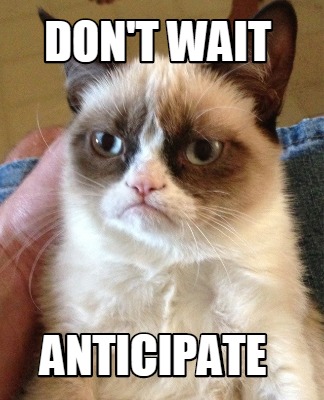
Don’t wait, anticipate.