Tag Archives: fairness

But is it Fair?

When I purchase a product or service my expectation is I will receive impartial and just treatment or behavior without favoritism or discrimination.

This particularly applies with a medium to a large organization that has been in business for some time.    That is, given their track record and absence the perception of dishonesty from the press and social media it seems to be a reasonable assumption.

The Fine Print

Of course, even large bureaucracies do focus more on self-interest over fair treatment of stakeholders to a certain point but usually, reason prevails so a fair balance is achieved.

Contracts with unreasonable clauses, usually in small print, are a popular technique to help employ one-sided practices that favor the business.

Today’s Rant

Almost ten years ago my wife joint Spa Lady Gym, as the name implies a gym exclusively for women.  New owners recently renamed the company GYMMVMT (weird name).

She was a regular at least a couple of times a week until Covid hit.  The gym, fairly in this case, offered the chance to suspend monthly payments, while gyms were not allowed to open, which my wife took advantage of.

Now comes the tricky part.  The gym decided to restart monthly payments in July (because gyms could now be open) but they did not announce it.

We had a 1-month credit so did not see the return of the monthly charge until this week.   Not ready to return to the gym my wife decided just to cancel her membership.

The Catch

The contract fine print required months notice so cancelation will not take effect until Sept.  So we pay for July, August, and September for a service that is not being used.

Is it fair?  I think not.

Trade War

On its own war is defined as a state of armed conflict between different nations or states or different groups within a nation or state.

A trade war does not include armed aggressions (which typically has life or death consequences) but all of the other aspects of widespread conflict including unpleasant results apply.

Illogical

War, whether violent and destructive with associated loss of life or just destructive making lives miserable rarely have outcomes that are worth the cost.

The trade war results in negative impacts for all participants and even for the innocent bystanders (the global community).  Waging this kind of operation has an emotional foundation but if logic were applied there would never be a war of any kind.

In the television series Star Trek, the fictional Vulcan race was culturally based on pure logic.  As a people, they could not think and act in any way that was not logical.  Hence, no wars, of any type, ever.

Justification

The current US versus China trade war is based on fairness.  The US accused the Chinese of not operating with fairness in the realm of trade.

Fairness defined as impartial and just treatment or behavior without favoritism or discrimination.  Unfortunately, all of these descriptors are very subjective.

What one person, group or another entity view as just or without favoritism could easily be quite different from others perspective.  So ultimately the trade war is justified by a biased opinion leading to emotional angst between all the stakeholders.

We can see how this can lead to war.  How illogical.


Truth and Lies

Reality is factual.  It exists and their proofs which can be used to validate reality.  The assesment of reality is objective.  It is real or it is not and generally the state should be inarguable.

What is the truth?

Truthful statements or other communications are those that accord with the facts or reality.  This is an objective measure but, as we all recognize, almost anything can be argued.

No matter how real or factual the circumstances, whether the assessment  of a given set of facts or reality is clearly objective could be arguable.

Thus determination of truth, something that is accepted as true, is not necessarily a simple task and often the determination can include a subjective component.

Lies
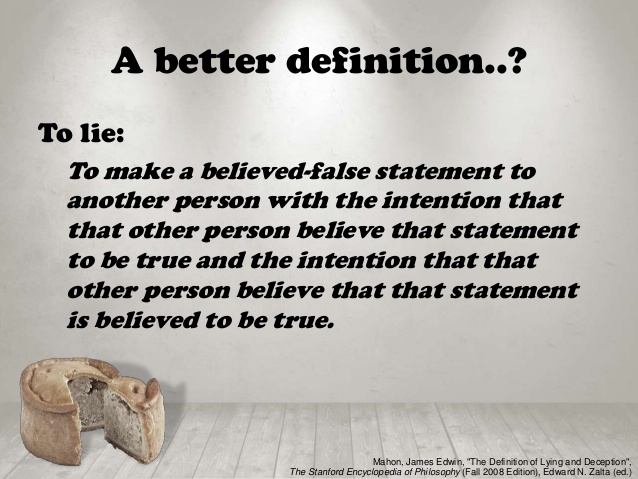
Rather than being the opposite of truth, a lie has the added qualification of intent, that is an intentionally false statement or communication.
Lies are founded on deceptions or false understandings, but if you do not know it is a lie, than it is not.  The logic here is based on the principle that without knowledge there cannot be intent.
Conceptual Analysis
It is likely most believe truth is good and should be valued while lies are bad and to be avoided.  Given neither truth nor lies have an absolute determination, the assessment of value (good or bad) has a subjective component.
Additionally a falsehood might not be truly false if the propnent of the thought or idea believes it to be true.  In this case those that view it as a lie could be doing a disservice to the believer.
Truth and lies are actually complex concepts and  how we interpret them and what they mean to us are points of consideration that deserve great caution before letting our assements of statements we believe to be lies (or true) colour our behaviour in ways we may later regret.

Trade War

Canada has announced retalliation against the steel and aluminum tarrifs the U.S. has decided to enforce against Canada.  Laughably the U.S. rational for the tariffs is national security.

I refer to this as  laughable simply because the tight political and geographic alignment between Canada and the United States makes the consideration we pose a security threat simply ridiculous.

Nobody Wins

Free trade should be a prized practice and lack thereof disdained.  For me this is very much like the basic philosophical misalignment between communist economies and capitalist.

Human motivation is a very real factor in these two models.  At a very high level, conceptually, the reward incentive is reduced in a communist economy because everyone shares.

When effort is not tied to gain there is less incentive to work hard and therefore output suffers.  In the capitalist model effort is linked to results.  If you work harder, your gain is greater.

Free trade works like capitalism, what you put into it affects what you get out, without having to worry about artificial constraints.  If the government is influencing your ability to profit, through trade restrictions, this may have a short term positive effect but in the long term,  like most purely communist economies, all will crumble.

Why Fight

Ultimately everyone looses in a war, whether physical or a trade war of wits.  War is bad for the human condition and those who believe it is a way to achieve what is right are in fact very wrong.

Free trade or restricted trade, it is what it is (albeit free trade is obviously better).  However war is very bad no matter how you look at it.

Checks and Balances

The law of supply and demand can act as a key behaviour control.  Action and reaction can also serve this purpose.  These two practices can be used as tools to effect change.

It’s So Unfair

I had a conversation the other day about people being mistreated.  Things like unrealistic job performance demands, little sympathy for hardship, or taking a hard line on working hours or working conditions.

Clearly wrong or harsh behaviour cannot always be corrected or resolved through a reaction or by managing supply or demand.  However, these approaches can influence change and do provide the opportunity to drive outcomes.

Whether successful or not, at least you tried.  Taking action is far more likely to achieve a result than just hoping the “luck of the Irish will prevail”.  That is, if you take no action you should expect no result.

(Side note, luck of the Irish refers to winning or succeeding at something for no apparent reason.  Like finding gold when others cannot or winning at gambling).

For Example

An obvious example of using the law of supply and demand to affect behaviour change is trade sanctions (limiting supply). In this case one group of countries might apply a trade blockade to another country to influence them to change their behaviour (e.g., stop developing nuclear arms)

At a more granular level, if an employer cuts your wage, you could just accept it but alternately you could refuse to accept the insult and provide supporting evidence of your value, (measurable evidence) and outline the impacts of losing you as a valuable resource versus some short term monetary savings.  The ability to react and how you react is up to you.

Give it a try

Next time you see unjust behaviour, try to effect a change.  What can you lose, beyond the time and effort to try.

Breaking Down Taxes

Taxes are what we pay to our governing body to cover the cost of the provision of common services, common that is to everyone one who comes under the control of that governing body to some extent (in some cases that includes visitors who don’t necessarily pay taxes for services they receive when visiting) .

To make that less general, say you live in a city and there is an elected group (the city counsel) that oversees the cities operation.  That is the governing body.  You pay them to provide and manage the common services for the people living in the city (everyone under the control of that city council).    In this case common services are things like police, recreation centers, parks, etc.

In reality most people are aligned with a number of governing bodies (e.g., cities, provinces, countries)and pay taxes to each in a number of ways and receive different services from each (in some cases overlapping services).

Are Taxes Fair?

If everyone received the same level of service and paid the same amount taxes you could argue this was fair.

However, you could also argue individuals with more resources (i.e., money) should pay more and support the services they use as well as some of the services those with less money use.  This kind of pay what you can afford thinking has a number of supporters who argue it is fairer than equal distribution of cost and usage.

There probably are those who argue the “you should only get what you pay for” approach as being the fairest.  That is if the park cost $100 to build and there are 10 residents they all pay $10 taxes and get to use the park exclusively 10% of the time.   England briefly tried a variation on this approach with a poll or head tax – every man women and child paid the same basic tax.  (no surprise this did not work out well)

And reality strikes home!

Of course in the societies which we live it is not practical to match cost to service received and this is even more complicated by the multiple government jurisdictions we generally support.   So we practice the principle that those who earn more pay a higher percentage of the taxes (theoretically if you earn more you can afford to pay more).

Say you go to out to a restaurant for dinner with your parents.  If your parents pay the bill you get a free meal, odds are though they wanted to pay for you.  I will assume they can afford it and probably wanted to cover your meal cost to help as you have less resources than they do (not because of ability but rather probably due to age, experience and opportunity). They know if the situation was reversed you would pay.

I am not sure those that pay a higher percent of the tax bill giving others a “free meal” want to do it, but the concepts do have some parallels.

And the usual disclaimer and caution

Effective societies operate on the principles of collaboration and charity, not equality (one of the key reasons communism does not work .   The key consideration though is balance.  That is everyone is equal probably does not work but nor does overtaxing those with more resources.  The tax scenario works best if balanced for all parties.

A parting thought (and great book for you to read if you have not already done so)  in the book “Atlas Shrugged” author Ayn Rand creates a world where the differences before those that can and do and those that do not is exaggerated.  Basically balance does not exist those that cannot feed off of those that can.  Those that can succeed drop out of the society, no longer supporting the government (they had enough because the balance was off) and the result – I won’t give away the ending of the book but you can probably guess.