Category Archives: Random thoughts – keeping you on your toes

Clear Sailing

Clear sailing is a common English idiom used to describe a situation that is free of obstacles or challenges.  This can be especially relevant after said obstacles or challenges have been overcome.

In this case the challenges (or as optimists say – the opportunities) are identified, plans to overcome them are created and then executed.  Once completed, with a sigh of relieve a state of clear sailing is declared. 

Historic Reference

Travel by sailing ship was a common practice in the 19th century and earlier, it was not until the early 20th century that self powered ships (steam, gas or otherwise) became common.  

Sailing ships were very much at the mercy of the weather.  Motive power was derived from the wind and if there was no wind then their was no power.  

Additionally of course the level of sea turbulence (a factor dictated by weather) also determined the ease of a journey by sailing vessel.  Rough weather led to rough unpleasant trips, even dangerous ones. 

Planning to avoid rough sailing, or if it was encountered overcoming it, led to clear sailing and ultimately today’s idiom which is based on the conceptually meaning but does not necessarily apply to sailing alone. 

Setting yourself up for clear sailing

The concept of clear sailing can help with planning.  The primary goal of any plan, first and foremost (a little redundant emphasis) is for execution to proceed smoothly (i.e., smooth sailing).

Keeping this objective top of mind during planning can make it more likely for risks to occur to you as you draft the activities, schedule and resources.  Remembering the trip will not be clear sailing if things go wrong, focus tasks that contain on low risk, high probability of success. 

And then, sit back and enjoy clear sailing. 
 

Concision

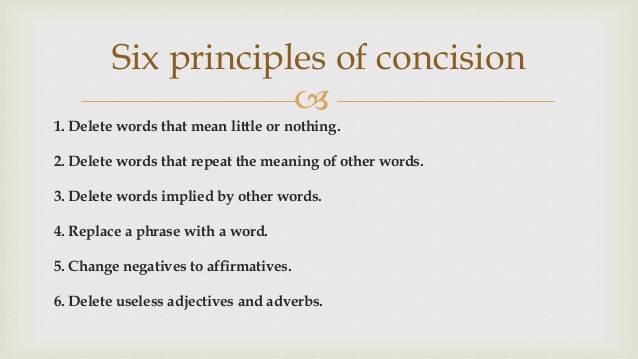
By minimizing the words used in conveying an idea we should enhance the ability of other to attain full understanding.    By eliminating redundancy without omitting important information clarity increases.

This is the practice of concision.  Being concise is not mainly about using fewer words but rather focusing on being meaningful with fewer words. This applies to both spoken and written communications.

The key skill associated with being concise is the ability to identify and then convey the critical meaning without requiring the recipient to expend much effort.

For Example

I enjoyed crafting the above paragraphs, but I admit they are not concise.  It is easier to write without concision but when the message is critical and the impact potential is high, being concise is a wise approach. 

I believe the lead to this post could have conveyed the same message with fewer words, for example:

Concision is a critical communication practice whereby important information, verbally or written, is relayed in as few words as possible. 

Unpack that for me

When explaining something or sharing an idea or concept when someone responds “could you please unpack that for me” or similar words, it is a virtual certainty you were not concise.

The path to concision almost always requires review and reconstruction before delivery.  This applies whether it is to be averbal or written format.  

Think about your key messages and remove all the extraneous stuff (i.e. unpack the message) before you proceed with delivery. 

In a verbal discussion this means being silent until you have atightly formulated message and in the case of written comminication try rewriting it for brevity several times before issuing.

Anticipation

When you expect with a high probability that an event will occur, you are experiencing anticipation.  This can be something pleasant or not so pleasant and the anticipation reflects that prediction.

Positive anticipation is associated with excitement, in fact it seeds it.  Anticipation can be also be worrisome particularly if there is uncertainty about the outcomes.  This can be stressful. 

Anticipate – Manage

Recognizing circumstances which are underpinned by your anticipation of the ultimate results is a worthwhile skill.  Conscious identification of an anticipatory situation enables you to control your behavior. 

Often associated with the unknown is worry.  Consider the case where you have left your car with a repair shop.  You expect the result will be a resolution to your car trouble (a good thing) but worry it might take longer than you anticipated and/ or cost more. 

To a large extent worrying about this has little impact on the end result, it will be what it will be.  The danger is in the effect it has on your behavior.  You may have trouble concentrating or be vague or curt in your interactions with others as you worry about what is going to happen. 

Common Sense

Applying common sense, anticipating bad results probably will not change anything but can negatively affect your reactions/ behaviors.   So concentrate on the positive, anticipate good outcomes, be happy, after all, why not?

Let your anticipation be exciting (a positive emotion).  Or more forcefully put, anticipate the positive, be excited, act accordingly. 

Don’t worry about unexpected results, according to Murphy’s Law they can and will occur.  

Freedom

Freedom is the power or right to act, speak, or think as one wants without hindrance or restraint.  Freedom is a choice, not a right.  If you choose not to be constrained, then you will not be. 

Some argue the ability to make a choice can be overridden.  When the exercise of the power needed to be free meets a stronger power, your freedom can be diminished.  That is the strength overcomes resolve. 

Take It

If you choose to behave without hindrance or restraint there should be no need to request or even demand the right to do so, rather it is a case of exercising your prerogative to act as you see fit.

Realistically, there are obstacles to this approach and caveats that should be considered.   Social and cultural considerations are valid constraints on your freedom. 

Choosing freedom does not mean disregarding your environment.  Consideration of others is a cornerstone of appropriate behaviour, albeit a subjective assessment to some degree. 

It is reasonable to have an expectation the behaving freely is a choice you can make but to take this approach without recognizing the impacts on others is not recommended.  

Overcoming Opposition

As alluded to earlier, others may exercise their power and this can appear to effectively limit your options to act freely.  For example, armed aggressors may threaten to harm you for not following their dictates. 

You may choose to fight this aggressively or passively, whatever you decide it is your choice, not theirs.   The point, you do not need to accept the limits on your freedom but you can choose to do so.

In some cases the consequences drive your choice to adhere or not, but it is still your choice to accept rather than overcome the constraints.

Overcoming Aprehension

Basic human biology plays an autonomous role governing and controlling our behaviour.  While we might believe we are in control of our thoughts and actions there are many biological influencers which need to be overcome if we are to achieve full control

Consider the simple fight or flight response.  The body produce adrenaline involuntary as a reaction to a perceived harmful event, attack, or threat to survival. 

The hormone prepares the body to repel the threat (fight) or flee the threat (flight).  Its production is automatic and conscious thought is needed to override it’s effect, for example, a false alarm.

Communication Apprehension 

Apprehension is the anxiety or fear that something bad or unpleasant will happen.  Typically it is not consciously derived but rather an unconscious control we develop over time.

In the case of communication apprehension, this may result in holding your tongue when speaking out is more appropriate.

The level of apprehension we may experience arises based on the context of a situation but the underlying individual propensity for apprehension is derived from both nature (genetic) and nurture (learned through experience).

Take Control

Clearly, there is value to these unconscious bio-influencers as they drive appropriate behavior where time is of the essence (fight or flight) or cases where we might do the wrong thing through unclear thinking.  

There is a time though when the unconscious control (e.g., involuntary communication apprehension) does not lead to the better behavior.  In this case, recognize it’s presence and conciously override it.

A guiding light

Leadership should not focus on personal accomplishment.  A leaders prime function is to act as a guiding light.  Keeping this concept in the forefront is the number one attribute of an effective leaders behavior.

Leaders who practice “guiding light” principles influence others by showing them how to do something successfully through the exercise of impact and influence behaviors that create acceptance and understanding, not by force. 

Everyone is Important

It is critical, to be an effective guide that you recognize the value everyone brings toward achievement of groups goals and objectives.  Leaders who believe it is all about them are less likely to be able to sustain their influence over longer periods. 

If I have been able to see farther than others, it is because I have stood on the shoulders of giants

Issac Newton

The concept that everyone is important only works if founded on a deep believe.  A a personal value understanding that no one overshadows anyone else is a cornerstone of combating personal bias. 

That is not to say unconscious bias will not still be present to some extent, however deep held beliefs have a greater chance of influencing unconscious thought.

Lead by Guiding

Enable others to excel by guiding them but not in an overbearing way is the best approach for everyone.

Believing everyone is important can override your unsupported bias that arises involuntarily from your sub-conscious from environmental impacts.  

This will enable you to be an effective leader for the greater good.

Taking Time

The progression of time leads to change.  Something occurs in every moment and these occurrences represent a change.  Whether the activity was the similar to a past activity, or not, something changed.

For example, if you get up in the morning, shower, shave, dress the actions seem similar.  Each of these activities results in a change, for example from sleeping to waking state, from whiskers to clean shaven, from dirty to clean, although the activity itself and order of the activities might be unchanged.

Accepting Change

In fact the only way to freeze change would be to stop time, something that can be conceptualized but is unlikely to be actually realized.  Time marches on mercilessly.

We do of course have some control over the extent and magnitude of change we are comfortable with and can influence or impact the amount of change we are willing to accept. 

Like the daily march of time, change is inevitable and some things we must just accept, “it just is” and move on.  Being able to recognize when to accept and when to take action is critical to your ongoing peace of mind. 

Passive/ Aggressive

One common method to address change is to create the perception you accept it, while aggressively resisting through sabotage and other indirect practices

Open resistance is a far better practise both from the perspective of the challenger and the champion of the change.  Open discussion can enable the changes to occur with less anxiety and frustration by all parties while allowing for the potential of collaborative modifications.

The key is recognizing change is inevitable and resisting is a far less productive practice than participating. 

Clear thought

Clear thought is the bedrock of logical outcomes.  Today’s environment has a multitude of complexities that have developed over-time and can lead to sensory overload. 

As our society has advanced,  so have the associated cultural complexities.  Obvious examples of this are the behaviour changes associated with automation, communication advances and the omnipresent social media options.

Focus

Intuitively, the first step to a clear mind is to focus on nothing.  This is the basic principle of meditation.  This technique causes your brain becomes cleared of all thoughts except what you are focusing on.

As you are focusing on nothing,  beyond involuntary thoughts, which you cannot control, the brain becomes thought free.

Meditation is often thought of a a relaxation technique, this is simply because the elimination of every day sensory overload, which we are all subject to, is nothing if not relaxing.

Clarity without Meditation

Meditation is used only a an example of a mind clearing technique.  It is not always practical to meditate and is best done in a quiet isolated place where you will not be bothered.

The principle of clearing the clutter that burdens your thinking is the same.  It requires focus.  When you are seeking to employ logic, and are not able to find a quite place or time to enter a meditation state, simply focus on the objective.

That is, place all your attention toward the data set you want to understand, parse and resolve.  This singular focus will enable you to follow a logic path to the best outcome.

Focus on the A

Experiential learning is a extremely powerful way to identify opportunities for improvement.  Through observation and feedback you can uncover things to change, try or even not to do.

Surprisingly, often the learning is something you already knew and you might  think “ I knew that, why did I ignore my inclination and proceed anyway”?

There is no answer to this auestion, that I am aware of, beyond the fact it is human nature to not always pay attention to your inner thoughts.  Sometime they are just  present to be ignored.

Play to your Audience

The other day I encountered a clear case of experiential learning.  It was about something I understood intuitively, but ignored.

I failed to focus on the audience perspective during a recent information share to a group of colleagues.  I often interract with groups of technologists with a strong foundational knowledge of digital software and infrastructure.

Without thought to the core background of the audience I proceeded on the assumption basic technology concepts did not need to be explained.

Assumptions are Dangerous

Assuming knowledge leads to misunderstanding, confusion and worse disenfranchising the audience such that they are not receptive to any message.

The opportunity to share information for the benefit of all could well be lost because of the simple misstep of assuming rather than confirming, ( i.e knowing with certainty)

Through observation and subsequent feedback it was clear I had been guilty of this simple principle.  This is not to suggest being overly simple but rather tailor the information exchange to match the audiences perspective.

Action/Delay/Reaction

When the results of an action are delayed there is a risk the outcomes might not be what you expect and a danger it will be too late to make a correction

Trade Wars

The looming effects of various trade actions, either recently implemented or being contemplated are unknown.

Of course, various stakeholders have made various prognosis of the outcomes but these often differ and may well be forrgotten by the time the impacts are felt.

The real danger in trade action is over governance.  Typically free markets self adjust according to the environmental factors .  This is both natural and expected.

Playing with Fire

By altering the natural order there is a real and present danger of causing significant damage. The plan (I would cynically call it a hope) is the tarriffs or other types of controls will alter economic activity in a favourable way.

Sadlly this is often not the case.

Governing by Tweets

A recent tweet by Donald Trump to the effect the trade sanctions he had authorized were working makes me shudder.  

Declaring policy victory for actions which we cannot know the real impact of for at least one to five years is ludicrous.  Posturing for sure with a digestable sound bite, but really is anyone fooled. 

Unfortunately there may be some.  The bad news is those whom are fooled by such silly posturing fuel such actions, and by the time the negative impacts are clear it is often too late to remedy.