
Tag Archives: expectations

Understanding Service

Helping others, providing advice, resources or undertaking requested action so others can achieve their goals are the most common activities of service organizations.

Service can be provided by sections or departments of large organizations focusing solely on the provision of service to a target audience, often called customers, or just individuals for the pleasure of helping others.

Expectations

I am often surprised by those providing service to me.  They tend to either guide me to conform with their practices or even taking  action without first taking time to understand my expectations.

Anticipating the needs of your customer rather than concentrating on their expectations leads to dissatisfaction more often than not. This happens when the goal of the service provider is to meet their organizational expectations versus what the customer is expecting.

Focus on Understanding

Regardless of the situational context, before providing any service, the priority should always be to determine what the requestor is expecting of you.

Assuming what is required might be expedient and could hit the target occasionally but more often it can lead down a path of confusion even frustration both by the service provider and the receiver.

Perception Matters

The customer might perceive the person they have contacted can assist them because of their own assumptions about what a specific area, contact or knowledge source is capable of.

The best way to start a service interaction is to clarify what is beIng expected first, that is not what the requestor wants but rather the outcome they are seeking.

Granted these are related but the distinction can be critical to ensure the service is appropriately target.  Time spent up front to ensure the request is understood is a great way to avoid disappointment.
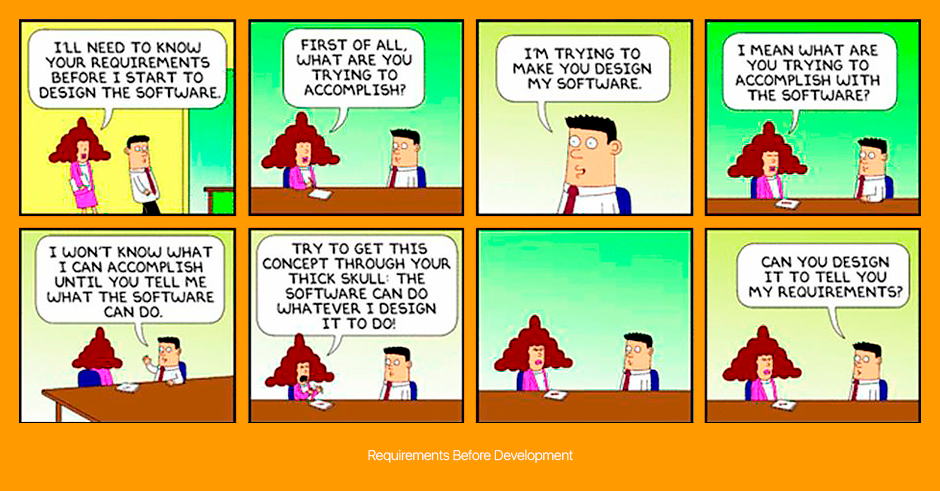
Requirements are Important

When we need or want something that is necessary to satisfy our desires we need to document/explain clearly what the requirements are (in detail).

Providing a high-level objective can define what you are trying to achieve, but as often stated the devil can be in the details.  High-level requirements might get you started but without more detail, the results might not be to your liking.

For Example

You might engage a builder to construct a custom home for you.  The objective is simply stated to build a single-family home on this empty lot that conforms to the building code.

Without much more detail than that you could get a home that does not conform to your needs.  How many floors will there be, how many bathrooms, what color will the walls be and the list goes on.

In this example, the requirements can be quite straight forward coming from a single source, the homeowner.  There are many other cases where the evolution of the requirements can be much more complex.

Building Software

In the information technology space, application software development is a good example of a more complex requirements management  process.

Often there are many end-users of the software product and each may have an individual requirement some of which are contradictory.  Many of which are confusing and almost never with enough detail.

The cost or feasibility to provide all the desired requirements might be prohibabtive or for the sake of expediency.   Additionally because detail is often not provided or clarification sought the final software often does not meet the requirements.

If you expect to receive what you wanted clarity and detail is required.

Anticipation

When you expect with a high probability that an event will occur, you are experiencing anticipation.  This can be something pleasant or not so pleasant and the anticipation reflects that prediction.

Positive anticipation is associated with excitement, in fact it seeds it.  Anticipation can be also be worrisome particularly if there is uncertainty about the outcomes.  This can be stressful. 

Anticipate – Manage

Recognizing circumstances which are underpinned by your anticipation of the ultimate results is a worthwhile skill.  Conscious identification of an anticipatory situation enables you to control your behavior. 

Often associated with the unknown is worry.  Consider the case where you have left your car with a repair shop.  You expect the result will be a resolution to your car trouble (a good thing) but worry it might take longer than you anticipated and/ or cost more. 

To a large extent worrying about this has little impact on the end result, it will be what it will be.  The danger is in the effect it has on your behavior.  You may have trouble concentrating or be vague or curt in your interactions with others as you worry about what is going to happen. 

Common Sense

Applying common sense, anticipating bad results probably will not change anything but can negatively affect your reactions/ behaviors.   So concentrate on the positive, anticipate good outcomes, be happy, after all, why not?

Let your anticipation be exciting (a positive emotion).  Or more forcefully put, anticipate the positive, be excited, act accordingly. 

Don’t worry about unexpected results, according to Murphy’s Law they can and will occur.  

Friendship

Probably the framework of friendship is simply defined as a relationship of mutual affection between people.  A stronger bond than acquaintance, but weaker than love.

Simple description aside,  friendship is a favourite study  topic of academia.  The cornerstone behaviours associated with friendship can be very subjective in behaviour, hence the quest to better define the term.

Relationship Driven Behaviour

Typically there is a bond between siblings.  This familial relationship can include friendship, love or even hate relationships but typically there is a positive respect respect and close relationship with your siblings.  (A caring relationship).

Civil wars create a fascinating perspective in the study of relationships.  Friends, family even lovers can be pitted against on another just on the basis of geography.

Do you live in the north and your brother in the south?  Regardless of your relationship, circumstances might drive you to take arms against one another.

The typical behaviour associated with your relationship (e.g, friend) might be transformed to foe overnight.  All for the sake of political expediency.

The point is, typical relationship behaviours can be overcome by circumstance.  Your friend might not act in accordance with your expectations.  It is important to consider the root cause of this disappointment to help you understand what is happening.

Loyalty

A relatively common trait of friendships is loyalty.  You expect support from your friend but circumstances can cause loyalty to waiver (civil war being an extreme case)

Setting the bar

A favorite quote of mine comes from motivational speaker Les Brown.  It is ” No one rises to low expectations”.  I interpret this to mean strong performance requires motivation and the setting of clear and challenging expectations can be motivational.

Be careful though, set too high and the result could be  despair or frustration so a careful balance is needed.  If you are seeking to help yourself or others excel the right level of expectation is critical.

Yours or Someone elses

Self expectation is the most powerful motivator.  This can come wholly from within or be influenced by others, for example a leader or manager.

What ever the source, ultimately only you can set your personal expectation bar.  External factors, for example  competitive drivers, can assist you in setting your expectation bar high enough that you need to stretch to it.

Whatever the source of expectations you have a personal accountability to ensure they are something you can rise to, that is making sure they are challenging.

The harder it is, the better you feel

Although it might not seem intuitive, achieving a challenging objective increases your happiness proportional to the difficulty.  The harder it is the more satisfying the accomplishment.

Not only do you owe it to those around you to strive for high achievement you owe it to yourself, and you will feel better for it.

For leaders, understanding this principle can be very helpful as you create environments where everyone can excel, continuously.   The expectation bar should only be reached in time for setting of the next level.