All posts by steve@kerrzone.com

Wasted Time

When you allow time to pass in an unproductive manner, it is wasted.  In essence by devoting our time to a useless activity we expend efforts for no result.

Of course devoting your time to doing nothing does not expend effort but also, seemingly, does not produce results.  While the value of doing nothing could be arguable, I would suggest it is not necessarily wasted time.e

With Intent

On occasion we may purposefully waste time, (i.e., work more slowly and inefficiently) just to fill the time and stave off boredom somewhat.

In the long term staving off boredom through wasting time resolves little.  It does not address the root issue and so just provides

Taking initiative, finding productive and worthwhile ways to expend our free or unassigned time is actually far more beneficial than wasting time, albeit requiring greater effort.

Boredom is a Choice

Staving off boredom through time wasting does not address the root issue and so does not resolve the problem .  This approach provides temporary relief at best.

Whatever is the meaning of life it is certain life without purpose has little value and so little meaning.  Wasted time is an acknowledgement of a lack of purpose.

Being bereft of immediate goals we simply decide to coast until provided an opportunity not too.  Why not create our own opportunity.

Reason for Being

We can always find a purpose and expend effort to achieve it.  Wasting time is a choice, not something thrust on us for which we have no control.

At any given time, determine your reason for being and act.  Only you can make this choice.

Destiny

Do we have an inescapable fate?  Are things just meant to be?  Destiny refers to things that will necessarily happen to us in the future.  Out of our control is implied.

Although it is outside of the intended meaning of the work I wonder if we can create our own destiny through action.  The concept is based on acting in a strategic and visionary way such that your pre-determined fate is actually morphed.

Pragmatic Approach

It is important to deal with things sensibly and realistically in a way that is based on practical rather than theoretical considerations.  If something is inevitable however you behave won’t change that.

However, sometimes we can be too pragmatic in our approach.  Stretching into the area of theoretically possible things and believing in them means we do have a chance to overcome our destiny.

It may be easier to believe in the pre-ordained, that is there is nothing I can do to make a change so why try?

Taking Action Works

The history of humanity seems to demonstrate an inevitable destiny is not reality.   Events throughout history have clearly changed the course.

While we cannot yet travel back in time and change the actions and behavior to see if the results would actually change we can logically and intuitively visualize this to be the case.

The outcome of world war two is a simple and straightforward example of this re-imaging.  Numerous treatise has been written about what-if scenarios and outcomes if different political and warfare actions were undertaken.

Destiny is within our grasp, we just have to be clear what we seek and plan the best approach to achieving our goals.


The numbers game

Since January we have been bombarded with numbers related to the Covid pandemic.  Statistics ranging from the number of active cases in a country to the number of deaths and everything in-between.

Analysis of numbers is a bit of a passion of mine.  For me, interpreting the story being told is in some ways like reading a good murder mystery.  Can I figure out what they are telling me and I guess I will only know with certainty when they confess?

If they don’t confess, in other words, there is no definitive proof my interpretation is correct (it is only a theory, not a law) I might believe I have figured out the story, but have I?

Same Facts, Multiple Conclusions

Typically strong arguments can be made supporting a variety of conclusions based on the same set of facts.  Facts used to decide courses of action do not, therefore, provide an absolute or unwavering solution.

Until your theories based on a data set are actually confirmed they are just well-educated guesses.  An abundance of data does not necessarily improve the quality of the conclusions.  It may even provide some obfustication.

Pandemic Data Overload

Given the huge variables involved in measuring the progress of the pandemic, from the level of testing to severity of the illness and ultimate impacts, it is almost impossible to arrive at supportable conclusions.

In some cases governments are using the data they have to create fear that enables them to implement the actions they feel necessary but given the lack of control data and measurement standards, this is really unconscionable.   Honesty about what we do and don’t know should be the byword of the day.

Bad News Overload

Everywhere in the world, the current pandemic has created an overload of bad news.  From the price of oil to job loss and economic destruction, there is a broad choice of worrisome news.

Keeping current about what’s up is probably a best practice. Ignoring or avoiding the news might appear to be a way of reducing your stress but there could well be more danger in not knowing.

Post Bad News Stress Syndrome

I recently read an article about the impacts of bad news on our mental states.  The author compared what he called post bad news stress disorder (PBNSD)  to the more commonly known post trauma stress disorder (PTSD)

I view this view as a bit of an exaggeration.  PTSD is much studied and well documented while considering our over reaction to an abundance of bad news as a potential mental disorder is a bit much and too hypothetical for me.

Maintain Your Perspective

Without a doubt a constant stream of disturbing news, particularly when it is close to home and impactful, is stressful.  We do need to both be able to absorb and understand the news content while maintaining perspective.

We can survive and overcome, allowing stress to drive ourselves to illogical behaviour can be harmful  and actually worsen the situation.    It is an over used mantra but I encourage everyone to keep calm and carry on.

It’s really important to remember, don’t be stressed about the things you can’t control (what could you do anyway).  Focus your actions on things that are realistically within your prevue and achievable.


Empathy

Understanding the feelings of others coupled with the ability to imagine their current  emotions and the impact there-off is the cornerstone of positive human interactions.

One of the best ways to contain an interpersonal interaction from exploding into violent disagreements or  spiralling out of control is to acknowledge how others feel and work toward understanding why and what it means.

Understanding/Not Acceptance

Empathy focuses on understanding others thoughts and associated feelings, this does necessarily equate to acceptance or agreement.   It is through shared understanding that we can build collaboration.

Sensitivity to your own feelings and actions impacts on others is a key part of empathy.  Empathetic people use their awareness of others feelings for the betterment of all.

Typically,  acting with empathy provides benefits to  all parties and while it is an unselfish way to behave it can increase your own personal enjoyment as well as that of others .  Basically a win win behaviour.

Collaboration

Empathy can be a very powerful go to behaviour for both leaders and followers who wish to benefit from the best everyone has to offer.

Working together to produce or create something can produce high quality results but is to be effective the process is very much dependent on all parties sensing and acting on the needs of others.

A lack of empathy does not mean good results will not be attained but the most efficient and effective results will always come from situations where everyone is empathetic to others.

Not Knowing

We do not know everything.  Is it a failure to not know?  Absolutely not.  Acting without knowing everything is normal.  Allowing the fear of the unknown to limit your actions reduces your capabilities.

Acting in your best interests is a balance between what you know and the risks associated with the things you are not aware of or misunderstood.

Balanced Behaviour

Most importantly, to be effective we must overcome our fear of failure but not at the expense of proceeding without full confidence.

Blasting ahead like a bull is probably not the most effective approach but neither will hiding your head in the sand like an ostrich.

Outside Influences

Everyone serves somebody (Bob Dylan song title) even it is only none but God.   Our leaders can play a significant role in how we behave.

Micro-managing others often reinforce their natural inclination to caution.  That is taking a chance and trying something where you might fail is unlikely.

If your boss, leader, colleague, etc is unsupportive and likely to be derisive if you make a mistake or do something incorrectly possibly because you just didn’t know, it’s most probable you won’t try.

Effective leaders need to encourage us to be empowered and take action.

Taking a Chance

Making an attempt at anything, taking the initiative and giving it a try is a positive behavior as long is it is tempered with logic and reason.

I advocate taking chances but not high-risk ones.  In leadership situations, the best results arise when your followers understand the fact that you support them and won’t fault them (within reasonable limits.).

Maintaining Focus

The current pandemic represents a significant distraction for everyone.  Pandemic related stories have pushed virtually everything else that is newsworthy aside.

From experience I have found the best results, those achieved most efficiently and of the highest quality are derived from being the center of our interest or activity (i.e., the focus).

 Prioritize

Even with lots of serious highly and impactful events going on around us, being able to concentrate and act on whats really important is a best practice.


Dealing with more than one task at time can result in the spreading of your attention to an extent that although everything might get addressed,  important aspects could be overlooked leading to mistakes.

Perhaps surprising, as well, studies haves shown  multitasking can actually result with more overall effort being expended than if each task was addressed separately although overall duration is greater.

Distractions

Recognizing distractions and allocating appropriate attention to them lets you ensure your focus is on the things that matter most at that point in time.

Things that don’t require your immediate attention, albeit worrisome and nagging at you, rising to that call for attention could easily negatively impact the effectiveness of resolving your priorities.

That is, the  things that provide the greatest value at any point in time are the things that are bested served by getting our prime focus.

Pay Attention

If you recognize yourself trying to pay full attention to multiple things concurrently, press the pause button.  Think it through.  What can I change and what is largely out of my control.?  What should I focus on?  Answer the question and act accordingly.


Enjoy the Moment

Relative to the age of the universe, as best we can guess it, our earthly human lives are but a brief moment in time.  We can speculate what happens after this life but it is not definitively known.

During our short lives, we have the opportunity to experience joy and pleasure.   Of course, we can also experience pain and unhappiness and every range of emotion in-between.

Control

What we experience is not totally in our control.  Events, the activities and interventions of others and perhaps extra-sensory factors are not always fully in our control.

How we react to the things going on around us, what we feel can be controlled by us consciously albeit sometimes requiring quite a bit of effort.

Our sub-conscious can take over sometimes without us even realizing it.  Hence negative emotions and feelings can arise within us before we are able to take control and quench them.

Blind Happiness and Joy

I firmly believe how I feel at any point in time is up to me and fully my choice however reality does intrude and I do find this is not always the case.

Or perhaps it is and I choose (even to a largely sub-conscious extent) to worry, be fearful, sad and unhappy on occassion.   Given the negative context of these feelings though, I wonder why I would ever choose this route (but maybe that is part of life).

I wonder if joy, pleasure, and happiness can be continual and uninterrupted if I choose to make it so.  My experience seems to lead to the conclusion this is not the case.

That being said, taking control of how I feel and channeling my thoughts and behavior to the positive is always worth the effort although sometimes it is not always doable.

All things must pass

Working out of my home these days, like millions of others around the world, I have the opportunity to listen to some tunes more often during the day than I would otherwise.

Back in the nineteen-eighties, I read a psychology study focused on determining the impacts of listening to music while studying.  The results demonstrated measurable improvement in test results by those who tried this.  So I don’t feel guilty, heck I am improving my productivity.

George Harrison

One of the songs on my playlist was “All Things Must Pass” by George Harrison, former Beatle and successful solo artist during the seventies and eighties.

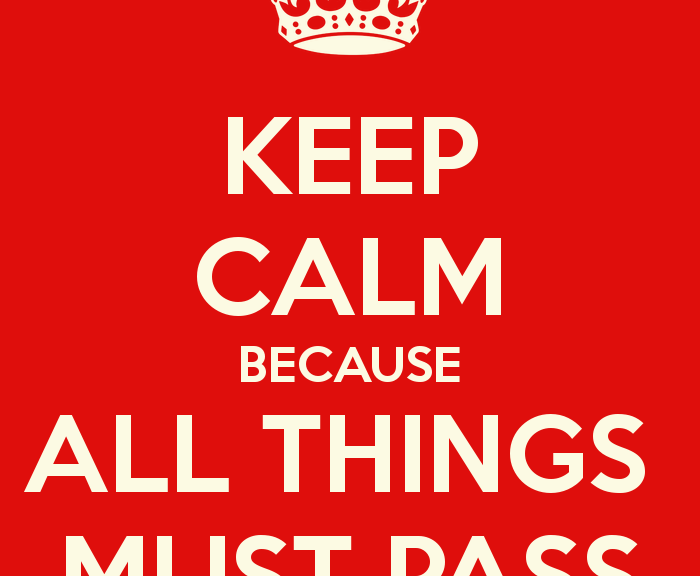
The sentiment is simple but so accurate  in the current pandemic environment, it really resonated with me.  This may seem like a period of heightened uncertainty but when you think about it, this too must pass.

A pretty pragmatic way of thinking, not overly optimistic but patently accurate.  What I like about it is the subtle message, not that all things will pass but rather “must” pass.

Will or Must

It is a subtle difference but things that will happen in the future are inevitable while things that must happen have an obligatory element but is more along the lines of “should” then inevitability.

In the context of the pandemic, it certainly should pass, but is it for sure and when will it happen? The human race must overcome this virulent disease and based on past experience, we will.

I am not overly concerned, risk conscious yes, but I am of course this must pass.


The key to leadership success

The responses to the current covid – 19 pandemic provide an opportunity to observe and rate leadership.  The crises present a chance for leaders of all types (whether political or otherwise) to exercise their power (earned and granted) to good or bad effect.

As observers, we can gauge the effectiveness of the leader’s efforts and use this information to build on our existing personal inventory of effective leadership strategies.

It’s Not What You Do

Not surprisingly for me, the most effective leaders are leveraging the power of the populous.  It is not what the leaders do individually, rather what things they are able to motivate everyone to do collectively.

A key response to stopping the spread of the illness is to keep those who are disease-free away from carriers.   Of course, this is a herculean task when carriers are not easily identified nor is the transmission vector well defined.

This task requires consistent behavior among the entire populous (even the leaders) and the best leaders are the ones able to do this.  Again it’s not what they do but what they are able to get everyone to do.

Faith/ Trust

The second key observation I have made relative to those leaders with the greatest success is they are believed and trusted (i.e., the covid-19 spread is flat versus an exponential curve).

The actions being asked of everyone are both disruptive and full of unknowns.  Will they resolve the problem?  What are the impacts of these actions and how will we ever overcome them.

Leadership is not only about facilitating actions to achieve successful results but engendering faith that those results will be achieved.