Tag Archives: learning

Be Calm

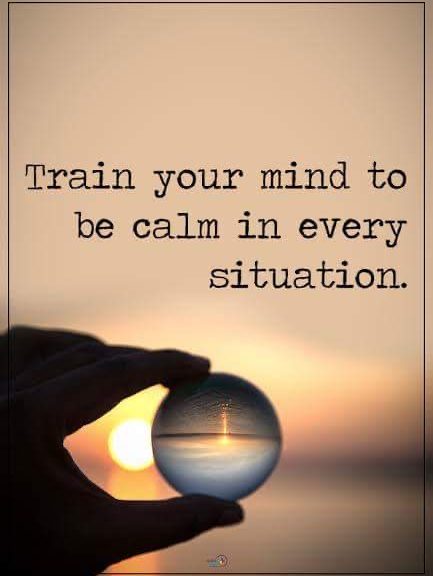
The time you spend with your thoughts can be refreshing and invigorating.  Thinking is a foundation of creativity.  However, anxiety and overthinking also begin with thought.

Our thoughts can take over and be in control.  Typically when negative feelings are generated during moments of focused thinking it is not because we desire to be become anxious, depressed, fearful or something similarly negative.

Be in Control

Putting science fiction aside, today outside of extreme cases (e.g. brainwashing, torture, hypnotism) we are solely in control of our minds.

The subjects we focus our thinking on may arise from our sub-conscious but always we have the ability to take control and decide where these conversations with ourselves will lead.

Why Worry?

Giving way to anxiety or unease by allowing one’s mind to dwell on difficulty or troubles is a choice.  What do we achieve by making the decision to worry about something?

Worry leads to feeling troubled or concerned and typically creates stress together with the associated physical reactions (e.g., high blood pressure, reduced ability to focus, tiredness).

There is little positive value resulting from being worried about things.  We our in control of our own thoughts so choosing to be calm enables us to avoid the negative results of being worried.

It is a Choice!

For each of us there are different ways to manage our thoughts, take ownership and be in control.  By taking control of our minds we determine what the outcomes of our thinking will be, that is choosing to be calm whatever the scenario.

The key point is not which technique you select to avoid worry and become anxious but rather recognizing it is your choice to do so and choosing wisely.

Learning for Life

Do we need a reason for practicing continuous learning?  Whether formal or informal is the motivation to learn best just driven by the potential to gain knowledge, rather than a specific social or monetary goal.

The ongoing acquisition of knowledge or skills through experience, study, or by being taught directly by others undoubtedly has value even if the return on investment cannot be specifically defined.

What percent of my personal health and wealth is attributable to ongoing learning?  I do not have an exact measure in monetary terms but  I have always found ways to leverage my knowledge gains even if only to improve my feeling of personal well-being.

Embrace the Experience

Learning objectives are generally focused on specific topics and learning objectives (e.g., mathematics) however the ways we are taught and how it is received is an important part of the learning experience itself (beyond just the content).

Ongoing interaction with teachers and other learners can go well beyond the learning objectives.  Social interactions or working together with others to gather and collate information provides a side learning opportunity to increase our overall maturity.

Sometimes the most important knowledge gains are derived from the ad hoc or informal practices associated with structured learning.

Practice

All areas we undertake to upgrade our knowledge from time to time don’t need to be associated with specific future plans.  That is we do not need to take a course or training with a specific goal in mind.

Ultimately should find a way to employ the outcomes of our training when done. Without practice or actually using the knowledge we gained, learning may be wasted.

In some cases though exactly how we are going to leverage what we learned might not be clear to us until we are done.

Coaching

When we are lucky enough for someone to take the time to instruct or train us on how to improve the way we act or behave in order to enable us to attain greater achievements, we should embrace the opportunity.

People in these roles are often called coaches or mentors.  Surprisingly many of us resist a coaching or mentoring opportunity.  To some extent, this is due to personal pride and a strong feeling of independence.

I Don’t Need Help

Unfortunately or maybe it is fortunate, we all need help.  Humans are described as social animals for a reason.  With few exceptions, we need to interact with others.

None of us are so great as to not benefit from others knowledge and ideas.  This does not mean we need to accept or adopt them but sharing/collaborating has been demonstrated in study after study to lead to better results.

Even the outstanding individual athletes require and also have coaches.  Filtering what helps and what does not is a task for the coachee, not everything is of value but if you refuse the instruction or training you miss the chance to be the best.

Coaching Quality

How we coach or mentor others very much determines the receptivity to the teaching.  Not just knowing what is the best method is needed for good coaching.

More importantly, you need to know how to communicate in a way that is understood.  Providing clear benefits in a way that is understood will motivate the trainee much better than telling them to “just do it” or as some coaches are want to be “just fucking do it”.

Let it Grow

The simple pine cone on the ground seeks only reproduction of its species.  Let it lie.  This sentiment speaks volumes towards human interference with both human and the earth’s ecology (don’t do it).

By interfering with intrinsic growth processes great damage can be done.  This applies whether the object is plant or animal.  In the case of humans letting development occur naturally is the optimal approach.

Normal Growth

Normal physical or mental growth (aka natural development) in humans varies by individual.  As we age, our chosen activities (both physical and mental) dictate the type and magnitude of personal development.

From youth to an adult much of our growth is a mix of pre-programmed genetic factors and our environment which can be largely manipulated by the adults around us.

As time goes on our ability to make our own development choices grows.  However, even in adulthood, sometimes others try to direct and constraint our choices.

Helping Others Grow

If humans were mushrooms putting them in a dark room and feeding them shit would lead to sustained growth.  Unlike mushrooms, people need light and opportunity to develop best.

Providing guidance coupled with an enabling environment will allow others to make choices that fit their needs and thus are more likely to lead to positive results.

Framing expectations and funneling the learning opportunities can restrict development and actually be detrimental.  When assisting others with personal growth, share your knowledge, provide support and guidance but do not direct.

This approach may not cause mushrooms to flourish but it works wonders for humans.

Invest in Yourself

When you have the opportunity to provide yourself with something,  that has a particular quality or attribute that enhances your life, now and in the future, take it.

Investing in yourself is your choice.  The value equation needs to be considered.  Does the effort to gain that certain something outweigh the benefit.

For Your Own Good

When I was younger my parents encouraged me to undertake many activites like swimmimg, socceer, tennis, clubs, outdoorsman and so on.

I would ask, why?  The answer was consistently, “ For your own good”.  Unfortunately I came to dislike the phrase because it has negative connotations.

Today I fully embrace the concept and I am truly grateful to my parents for perservering against my rebelliousness.  For their dedication to my improvement worked.

I would be far less the person than I am today had I not invested in myself so ferociously at my parents urging (perhaps a little beyond urging), albeit against my will.

Hidden Benefits

The personal payback for spending a little time, learning exercising, socializing, helping others can be enormous but is not always apparent.

Sometimes the thirst for easy fruit backfires.  We will overlook the long term benefits of spending some time and effort updrading versus instant gratification.

Motivating yourself to invest in yourself is not always easy and takes thought.  Not reconizing the benefits to you down the road for completing a work intensive activity now is a large part of the reason.

Take time to think through the value down the raod and don’t discount yourself when an improvement opportunity exists.  Take it, you will be glad you did.


Mentoring

Mentoring describes the relationship between a more experienced/knowledgable person focused on imparting guidance to a less experienced/ knowledgable individual.

The mentor/ mentee relationship is two way with both parties satisfying a need. One to share experience and the other to gain. Ultimately both recieve value.

Not Mandated

Prescribed mentoring is usually doomed to failure. That is, the process really only works when desired and embraced by both people, a forced relationship really just does not work.


In the past I have been asked by a third party to mentor individuals they viewed as having high potential but lacking experience. My response has always been, this is not a request that is yours to make. They need to ask me directly.

My own experience has shown arranged mentoring has little chance of success.

In a similar vein, I would argue leaders/ managers have an accountability to create an environment for followers/ subordinates to develop and thrive but this practive is quite different from a mentoring relationship.

Two Way Strret

Effective mentoring involes a bond of respective from both participantsand is not heirarchical in nature but rather an exchange between equals. This is a key distinction.

It is critical for both persons to learn and improve, the key to mentoring is not treating it as a master/ student relationship. This is what amkes it a powerfully effective process for developing enhanced skills and capabilities.

Mentoring is mutual, everyone gain, is not authority or power based in any way. For these reasons it is a great approach is you but not simple to arrange, participate and create a good relationship.

Education for all

With the growing expanding scope of Massively Open On line courses you can study almost anything for no cost.  This education is of value to you personally as a way to enhance your knowledge and skills.

So far, the impact on your employment/ carreer is relatively negligible.  Organizations still look at the documented degree or certificate as the value piece.

If an institution with a recognized brand (e.g. Harvard) issues you a degree or certification it can be leveraged to raise your professional standing.

If you take a free series of on line courses, which were created by the same recognized institution (and are the same as those taken by the paying students) , you obtain the knowledge and skills, but not the certificate.

Sadly without the documentation, the free learning won’t earn you more status or money, but the knowledge is what counts, right.

Business Model

Post secondary education is a big business in most countries we classify as developed and just a important in all the other areas of the world but generates less revenue in the less developed regions as there is less funding available.

Free education, in regions with less money to allocate to education works in providing skill and knowledge that get put to use by the populous whether that can prove it with a piece of paper.

The action is the proof.  If you have the skill and put it to use, how you got it and being certified as having it are not critical factors.

Education for the public good

Over time we can only hope that education will migrate from a profit model to focus on improving the human condition, worldwide.  It’s a dream.

Arguing

A very cool aspect of post secondary environments is the propensity to argue.  This is done in a respectful manner with a prime goal of learning.

The discussions give reasons in support of an idea, action, or theory, typically with the aim of persuading others to share one’s view.  This results, whether the argument is resolved or not, in the acquiring of new, or modifying and reinforcing of existing, knowledge (i.e., learning).

Enlightenment versus Action

The key attribute of these discussions is the intended result.  That is the creation of knowledge.   These arguments are not focused on changing behaviour or proving superiority, rather to create or expand u derstanding.

For me, as I move into the twightlight of life (there are more seniors in Canada than children under 14) it offers the opportunity to exercise my intelligence in ways I have not done heretofore.

The focus is not based on a tangible business case.  The purpose is not to improve profit, satisfy shareholders or customers but rather  for the good of everyone.

Ultimately that is what knowledge does, it improves the whole human race.  Whether philosophical, medical or scientific; understanding might or might not have real economic or other measurable benefits but it does have value.

On the whole it results in the betterment of the human condition.  So kudos to the human race for recognizing this and  supporting and promoting higher education.

Risk Adjusted Return

I read an amusing article on on the weekend in which an investment advisor noted he finds many clients and even other advisors struggle with the concept of risk adjusted returns.

The greater the risk an investment might not be returned, the higher the return expectations.  Why would anyone  make a high risk investment without motivation; ( e.g., a higher return).

For Example

The article was about a typically Canadian investment vehicle, the Mortgage  Investment Corporation (MIC).  Created years ago by the Federal government to entice some alternate funding into a generally highly regulated sector (retail mortgages).

The advisor in question noted how a number of high net worth investors crowed to him each year how they were invested in a low risk high return mortgage investment corporation.

He asked these investors why the borrower took a mortgage loan from the MIC at 9% when all the major banks were offering mortgages at around 3% or less.

Do you think maybe the banks considered the loan too risky with a higher potential for loss.   That is the borrower represented a high risk investment.

In that case, the borrower took a mortgage from the MIC because they were the only ones that would take a chance on him.  And for the privilege he paid a premium (i.e., 6% above mortgage market rates).

Smarter than the Banks

It is doubtful those that invest in MIC’s have a good understanding of risk adjusted return, but these mortgage investment corporations are a great example of the principle.

Unfortunately there are far too many ill informed investors (and the MIC salesman isn’t going to tell them). It is not unusual for someone to make a large investment in an MIC only to be stunned when they can’t get their money back.

So, while these funds sell well, probably only a small number of the investors won’t be surprised if they suffer a risk event.  Sadly many are potentially in for a shock.

Vocabulary Lesson

My mother held a Bachelor in Arts from the University of Manitoba. She was an English major  and believed her children should become masters of a large vocabulary (among other things of course).

For her, and by association her children, a large vocabulary represented  a key underpinning for reading, writing, and verbal communication skills.

Of course reading itself  is a good way to build vocabulary.  Since I was ten I have read at least 60 books a year, often more.  As a result of my mothers encouragement I often find, in general discourse with others, I am able to use words they are not familiar with.

Who Cares

Todays post is definitely a bit self effacing, so might not strike broad empathy among my readership. It is however prompted by the fact I received an email the other day with a word I was not familiar with.

The word was antithetical, which means directly opposed or contrasted; mutually incompatible.  For example, “people whose religious beliefs are antithetical to mine”

The really cool thing about the English language is it’s specificity.  I would like to say there is a word for everything (probably a bit of an exageration).

This enhances the ability to use English to create a message with extreme clarity and power.  In the case of the note I received yesterday, once I understood the word, the simplicity and clarity of the statement was obvious.

Thanks Mom

So well I did not appreciate it growing up, I owe my Mom a vote of thanks for forcing long strange words on me day in and day out.  Imagine, instead of looking up the odd word occassionally I could be leaping to my dictionary over and over.