Category Archives: Random thoughts – keeping you on your toes

Importance

We each view different things as being of great significance or value as opposed to the perceived significance or value of other things.  This can be a very subjective measure.

As with so many things, the level of importance can be viewed by many as a state of fact but the interpretation of the facts remains subjective.  Is anything absolutely factually determined?

I’m Okay – You’re Okay

Back in the 1960’s the non-fiction book “I’m Okay – You’re Okay” by Thomas Harris opened me to some interesting concepts.  The book explored (among a number of other concepts) four simple life positions we all adopt from time to time.

  1. I’m Not OK, You’re OK
  2. I’m Not OK, You’re Not OK
  3. I’m OK, You’re Not OK
  4. I’m OK, You’re OK

Over time I substituted OK for  importance based on my observation of human behaviors and how we often treat each other.   So the life positions became:

  1. I’m Not Important, You’re Important
  2. I’m Not Important, You’re Not Important
  3. I’m Important, You’re Not Important
  4. I’m Important, You’re Important

For me, the fourth option was best, this translated to a value, “Everyone is important”

Subjective Analysis Aside

The importance we apply to others is a choice each of us makes.  By focusing exclusively on our own importance, option 3 or even perhaps the lopsided options 1 and 2 above we are only fooling ourselves.

Real pleasures and satisfaction can only be achieved in conjunction with the recognition that the happiness of the human race is truly based on the whole.

Everyone matters.  By reminding ourselves daily, I‘m important – You’re important we reinforce the basic tenant of humanity and position ourselves to live full filled and happy lives.


ourselves.
 

Anticipation

Predicting what is probable relative to others’ expectations is the first step in being proactive versus reactive.  The anticipation and provision of other people’s needs and desires before they ask is a great way to impress them.

The primary purpose of this kind of pro-active behaviour does not necessarily need to be making others happy (although that is good) but rather can be simply to position yourself for gains by gathering their support.

Help Others/ Help Yourself

Personal enjoyment and self satisfaction can often go hand in hand.  For example I often find giving a gift and seeing others joy is often better than receiving one (and based on my observations I am not alone in this)

The act of gift giving is a win-win situation (everybody is happy.). Similarly providing help or acting before being asked has value both for the anticipator as well as the recipient.

Those whose needs you anticipate benefit directly from the outcome,i.e., they got what they wanted or needed with little effort on their part. You both feel a good and create a positive impression.

Self Directed

Will power is a highly valued personal trait for leaders.  This can actually apply to everyone as we use our initiative to get things done (albeit they should be perceived by the majority as worthwhile accomplishments)

By anticipating others needs and using our own believes and self determination as foundations to help ensure these are achieved, often even before they are clearly elucidated,  we demonstrate our leadership capabilities.

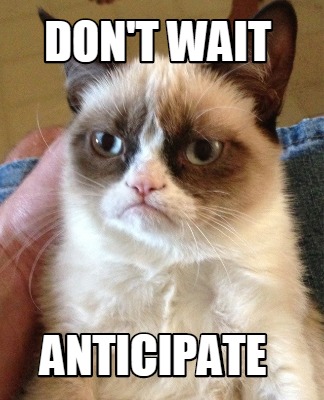
Don’t wait, anticipate.

Lockdown Lingo

Language is constantly evolving.  New words and phrases developed from emerging cultural norms and environmental shifts are really common.

I recently encountered a new term, seemingly quite popular on Facebook, which is the term coronacoasster.  Just a quick way to describe the emotional rollercoaster we are on due to all of the news each day about the Corona virus.

Excitement Every Day

From high numbers of new cases every to, to a drop off in new cases, back to high numbers, the rollercoaster analogy is quite apt.  Although rollercoaster give us a quick thrill I am not sure the corona virus ride will be all that quick or even thrilling.

The daily dose of corona virus news streaming on social media or from emergency press conferences is exciting in a way but not really positive or anticipatory, beyond hope for improvement.

Catch Phrases

Like headlines are to newspapers,  in these days of mutiple social media channels, catch phrases get a special nod from communicators.  It is an easy way  to send a message.

Clarity is not always the intent for these channels, grabbing interest and getting views is often the goal.  For example, Want to hear about my coronacoasting?

You might not be sure what the word means, nor is the author, but it sounds cool.  Here is a phrase that slips off the tongue, people listen because it’s snappy and with it.

Flavor  of the day,  coronacoasting comes and hopefully leaves.  With luck this new phrase won’t hang around for long.

Activating Inspiration

The ability to be inspired lies dormant within each of us, we only need to activate it.  Becoming mentally stimulated to do or feel something, especially to do something creative, is a personal choice.

The opportunity to do so is neither unique nor limited by intelligence, everyone has the capability.   The defining factor is desire.

Passion

Caring or being passionate about something is a great way to ignite inspiration.  Inventors often describe how their passion for a particular topic was a key motivator to create.

The trick is to let your interest flower into a passion, explode as inspiration, and voila a brilliant creative outcome will blossom.  It is just a personal choice.

Something Special

The ability to be inspired is not something special that exists in a select few.    The level of innate intelligence and talent granted to each of us unquestionably has a genetic component.

However, everyone is capable of personal inspiration.  The results of our inspired behaviors are subject to the extent of our capabilities but inspiration will drive results in every case.

Everyone has the ability to choose to stretch themselves, to examine, explore, and be excited by the possibilities around them.  We can use this excitement to drive both actions and ultimately achievement.

Wasted Opportunity

Every missed chance to become inspired by something is a missed opportunity.  When your curiosity is aroused let your interest be peaked, go with the flow and forge onwards.

Take heart in the fact that you can, and only you can, choose to be inspired.  No-one can block you, the only roadblock is yourself.

Persistance

Personal beliefs are the foundation of your value system.  These concepts and principles which you hold to be true are the fundamental drivers of your behavior.

We are not always able to sustain our beliefs.  External factors ranging from environmental, other people, legalities, and so on can force us to compromise or just give in.

Personality Cornerstone

Not staying true to your heartfelt personal beliefs can have a significant long term effect on your well being.  Unfortunately, these beliefs might not be widely held by others nor even based on scientifically proven facts.

However, they are ours and however, they were formed by us it is this personal ownership that makes them so powerful.

Our beliefs can, and should, change over time mapping to changes in circumstance but by and large, the basic principles we adopt at a young age will remain intact (i.e., our personal values)

Staying the Course

Accepting cases where others overrule what you believe is right is just a part of living.  It does happen.  Most important for your own well being is to find a way to accept these decisions without harming your own psyche.

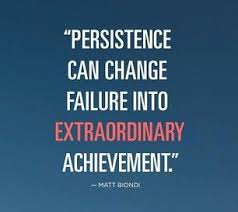
This requires a reasonable level of persistence to influence change to align with your core values and beliefs.  That is you must try in a measured and logical way to influence the change.

Reasoned arguments/discussions will help you shape the decision/ imperative in a way that either leads to change or acceptance on your part without remorse or regret.

When seeking to influence change based on your own personal beliefs, remember persistence is critical but not to the point of banging your head until it bleeds.

Passive Approach

Email became the prime business communications tool starting in the nineteen nineties, overtaking snail mail which was the prime source to that point.

Today, with all its warts and even with the advent of a variety of messaging tools (SMS, Twitter, Linked In) email still remains firmly entrenched as the easy communication tool of choice.

Submit and Hope

While email is a far more efficient tool when compared to written or typed documents sent by hand, internal or external mail services (and occasionally courier) this ease of delivery and tracking has some drawbacks.

Many now use email as a passive messaging method.  Issues and concerns are often disseminated to multiple parties at the push of a button.

The receipt can be tracked/proven electronically and so the sender is able to say “I told you so” in defense if an untoward event occurs and the those who should have known about it and reacted accordingly did not.

It’s not my fault, I sent you an email about it.

Information Overload

Sadly, the ease of writing and sending emails creates a massive overflow of electronic communications, such that many recipients are often overwhelmed and just cannot get through them all.

Just personal observation, in the days before emails, daily correspondence going through a small ten-person office was likely a tenth of what it is today with email.

Given this context, for really important messages I strongly recommend direct contact with immediate feedback.  Sure follow up with an email if you wish but don’t rely on it.

You may be able to massage your own guilt using the email technique, (i.e., I told you via email) but it does not address the real issue, communication that gets the results needed.  Actually solving the problems before they occur.


Upheaval

The covid-19 global pandemic has caused many changes in our daily lives. Some of these may have a lasting effect on our behaviours.  For example travel and tourism are greatly restricted.

Central office workplaces are empty with many working from their homes, restaurant’s focus on takeout, bars are closed or limited capacity and online shopping is the order of the day, to name just a few of the obvious impacts.

Disruption

This sudden change is unwelcome by many if not all of us but we are adapting.  Covid-19 is not the only upheaval underway for many of us.

Even before the dawning of the pandemic the energy industry was in turmoil with the price of oil and gas sinking like a stone.  Traditional brick and mortar retail was (and is) under seige.

These changes and their impact on our lifestyles are not just regional or limited in scope, but span the globe. and impact a multitude of things.  Virtually no one is immune from their reach.

Adaptation

The causal factors  of the ongoing upheavals we are  experiencing are broad and largely out of individual control.  We can work within our social groups for changes and impact mitigation but largely the best approach is to accept and by embracing reality, thrive.

Even when remedies for covid are discovered (cure and or vaccine) and oil and gas supply and demand comes back into balance it is unlikely the changes wrought over these past months will not remain to some extent.

The new normal has arrived.  Find ways to enjoy it.  As the Borg in the TV show Star Trek The New Generation would say, “Resistance is futile”


Balancing Duty with Responsibility

Occasionally we run into situations the person who commands our group, organization, or country (i.e., a leader) makes decisions we do not agree with.

For some of us, these proclamations or approaches to action can be patently incorrect but we need to deal with them.  This raises a question of accountability, do we diligently work to make changes or just buckle under and support the leader?

What is Right?

Our personal decision as to what is right may be valid, however,  based on the relationship and agreed societal or social norms we have some obligations to support our leaders regardless.

It is critical though that this should not equate to the practice of god-like idolization, however, hierarchical groups require boundaries to operate and acceptance of the need for leadership roles is part of this.

There is an important balance between mindless adherence to others’ directions when they are simply role-based.  The exercise of appropriate change influence to promote the best alternative (if not the right one) is needed.

The Leader Says

An early lesson my father taught me many years ago that still sticks in my mind related specifically to follow the leader syndrome.  He asked, “If your leaders jump off a bridge will you follow them”?

Unfortunately, most things are not that simple or straightforward or easy to decipher but the message is clear and has been very relevant to me throughout my life.

There may be times when our leaders should be questioned.  This needs to be in a reasoned and carefully thought out way but you could regret blindly following the leader so giving it some thought is well worth it.

Test for Clarity

The quickest way to screw things up is believing your message is fully understood, or that you understand an incoming message perfectly.

If your belief is nothing more than an assumption the well known and overused truism  “Assume makes an ass of U and Me” takes effect.  Simply put, the risk of a negative impact, if your assumption is incorrect, is large than you think.

Validate

Avoiding this risk is pretty simple.  Check the meaning.  This is not like check the meaning at the door but rather confirmation what you are thinking is what others are thinking.

Words regardless of the language used only to have the meaning we assign to them.  Technically each word has well defined common meanings that everyone understands.

The way the words are strung together (i.e., sentences) also have rules that ensure common usage and interpretation.  That of course depends on whether you are familiar with the rules.

Reality

The concept of using language, coupled with actions to express meaning in a way that is subject to common interpretation is of course logical, but is it a reality?

With individual perceptions and bias along with the physical constraints such as hearing and eyesight limitations, our interpersonal communications are open to being misconstrued more often than not.

Paraphrase

One very simple verification technique is to replay the message with different words and sentence structure while retaining the meaning.

This will often expose those quirks we are all subject to when sending and receiving information from others.  Taken to an extreme don’t just paraphrase but act it out as well.

Did you get my meaning of this post? (This is the weakest form of validation of all, i.e.,  asking the direct question to which almost always the answer is Yes, regardless. )

Change is Good

Every moment we of our lives change is occurring.  It might be outside our field of perception or could directly impact us.  It might impact us later but the process of things becoming different is inevitable.

Change can be transformative or relatively minor in nature however even the smallest change can might not impact until months or years later.

For example, a butterfly might create a small breeze in South America as it flutters through the meadow that later becomes the impetus for significant weather changes perhaps a hurricane in Florida.

Quantifying Change

Subjectively we might approve of the change considering it desirable (maybe we initiated it) or conversely we may consider it of low value to us even harmful.

Given the subjective nature of our assessment and the fact change will occur it behooves us to find some good in all changes.   Accepting change, adapting and thriving in it is far better than the alternative.

Managing Change

Although most people can find ways to accept and support changes this is rarely the first reaction.  Change management needs to focus on helping everyone impacted see the good that comes from the change, as it relates to them.

Without effective change management, whether someone helps you through a change or you do it yourself, our default approach is often to seek out and find the bad things.  Ultimately this makes the change distasteful to you, unnecessarily so.

Change is good, you just need to find out how it is beneficial to you and adopt the best approach to embracing it.