All posts by steve@kerrzone.com

Getting Help

Independent behaviour is characterized by actions that seem to not be influenced by other people, that is we  resist the pressures to conform or obey others, rather we decide and act on our own.

Independence is a cornerstone measure of self esteem.  Not to say high self esteem requires a lot of independent behaviour but rather choosing to act independently or to follow the direction of others comes easily and naturally and feels like a personal choice.

Independent living

Most cultures around the world if not all are founded on the  principle of individual indepence built on a framework of societal dependence.

The level of control exercised by societies can vary significantly but largely the focus on basic human needs, food and shelter starts with the individual.

This concept of individuality has a genetic influence and during our lives the inate need for individual independence is balanced out by the environmental context.  That is we learn conformance behaviour.

Accepting Dependence

Sometimes all of us benefit from, control direction and direct help of others.  The optimum balance between dependnce and independence is a very individual assessment.

There is a balance, it would be impossible to operate fully at one end ofthe spectrum or the other, although conceptually this is what hermetic behaviour is trying to achieve.   That is a very high level of independence.

Recognizing a balance does exist and seeking the best for you is the point of this post.  If you need help, take it.
Frustration

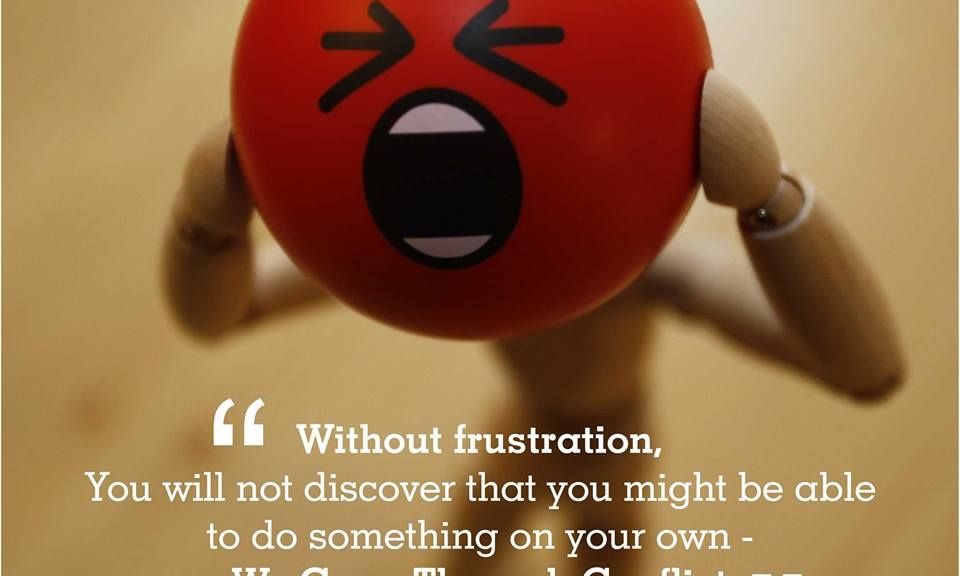
Frustration describes a state of mind which is exists when you are upset or annoyed because of your inability to change or achieve something.  As a general rule, frustration does not lead to productive behaviour. 

Most if not everyone experiences frustration on and off.  Obvious examples are things like how you felt in a long line waiting for something or the when the actions of other drivers lead you to anger (road rage). 

bAnimosity

At the core of the frustrating experience is desire and caring.  You are seeking a result and unhappy it is not readily attainable or perhaps not attainable at all.  

Animosity, dislike or hostility toward your objective makes it less appealing and your desire to change something or achieve a goal diminishes.

That is, anomisty toward something, a repulsion to it, will diminish your frustration although it may turn to anger.  Developing anomosity may eliminate frustration but anger driven behaviour is probably not optimal.

Root Cause

Frustration derives from a barrier.  You are blocked from a sought after change or achievement.  There must be a cause of this barrier.

Determining the underlying reasons for your inability to succeed is the first step toward resolving them.  Of course you can just let anomosity kick in but I suspect removing the cause of your frustration will be more satisfying.

This does require a pause, analysis, a plan and then action to confront and remove the cause of your frustrations.  My recommendation would be to employ finesse.

The direct approach can work but often has some negative side effects.  

Prioritize

Our daily activities include many options.   What we choose to do at any moment is our choice.   In this context, the activity can be related to work, leisure or just rest (sleeping).

Often the environment or other people influence the choice of action to such a strong degree we declare “I had to do it” or “You made me do it”.  This is a fair comment, as overriding influences external to yourself is not always easy but it is not accurate. 

Ultimately, it’s up to you

At one extreme, if you are being robbed at gunpoint, it is arguable there is only one right behavioural choice, give the robber what they want.  While that might be the most common response to this situation, different responses have been known to happen (e.g., resistance, attack). 

The way you choose to behave or respond in any given situation may well feel like it was situational, often simply because the circumstances dictate it is the best response.  

However, notwithstanding all the influences present,  you make the decision.  Whether made in the moment or time is available for consideration having an advance understanding of your priorities can really help shape whatever you decide to do. 

Personal Priorities

Personal priorities stem from your personal life goals and values.  In many cases, you will apply these without forethought.  For example in the robber situation, it is very common for our personal value to preserve life to kick in. 

For some, preserving personal wealth is a higher priority and the response may be to resist giving the robber what they seek.  Having an advance sense of our priorities can enable us to make better choices.  Or at least be very comfortable in the choice we make.  

Staying Informed

As communication practices have advanced the great irony is our ability to stay broadly informed has diminished.  Simply put, the multitude of souces and variety of content can be overwhelming.

When I was growing up staying informed on key local, national and international information meant subscribing to a daily newspaper and watching the main TV news, say the evening brodacast.

Filtering

Todays flow of information from social media feeds to mobile device alerts, updates on your watch, the list of ways to both get and share information both quickly and easily is really large.

Many of my colleagues, acquaintances, freiends and family, in fact most of them, are on email overload with 50 to 500 messages daily.

This type of fast and frequent communication did not occur with snail mail.  Verbal contact used to require access to a phone in a fixed location, home or phone booth, of course today you just carry it with you.

Choosing When to pay Attention

Staying informed used to largely based on what the limited information sources choose to prioritize and share with you.  Usually it was just fine.

Today you need to do the analysis yourself and that can be challenging.  You might have access to critical information you should be aware of and just overlook it.

Personally, to some extent I continue to rely  on the daily news paper and news cast to select and inform me on what I need to know, sadly those the days are slowy coming to an end.

Traditional media is being transformed and the formats I am most familiar with continue to dissappear.  I am adapting ongoing but do miss the past practices a bit. 

Change is largely good, we just need to accept and adopt the most current ways if we want to continue to thrive.  

As the world turns

We all live on a spinning ball.  It is not obvious from our normal perspective, travel by land or sea does not appear to move around the circumference of a circle. 

In fact we seem to travel on a flat surface affected only by the contours of the landscape.  Even in the air it is not obvious we are flying around a ball. 

We take the round earth for granted, yet the shape of the earth was not viewed and independently validated until the advent of space travel. 

Flat Earth Society

Even today, in spite of satellite photographic proof the International Flat Earth society promotes the flat earth theory. 

One supporting comment to the theory is the consideration that non experts can be easily fooled by satellite photos.   Experts can understand these photos really depict the earth as flat.

Ancient transcripts show Pythagorus (Greek astronomer and mathematician) had proposed the earth was round based on his observations of the movement of the moons terminator line (the line between the dark and light side of the moon) in 500 B.C.

Subsequent analysis by scientists throughout history continued to provide powerful proofs the world was round.  Arguably after the advent of space photography we obtained visual proof.

My Universe

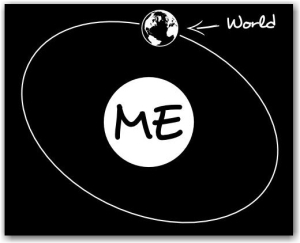
While I don’t dispute the fact the earth is round, my own interpretation of the spinning ball is that is is revolving around me, not vice-versa. 

This might sound like an odd interpretation of the earths movement relative to my own position, however, in fact for each of us, while we might not state it explicitly, it is inarguable that we are the center of our own universe.

Anarchy as a process

Is it possible for an organization to operate in  a state of disorder due to absence or nonrecognition of authority (e.g., social, family, corporate, charitable, etc).  

The answer is a resounding yes and many of us can probably think of examples.  At first impression such an operation might be considered inefficient. 

Accepted Practices

Organizations define processes for conformity, quality and efficiency.  To some degree this boxing of how things are done can stifle innovation and creavity. 

If consistency is not a top priority and timelines for outcomes are nice to have but not critical cultural anarchy can define the processes, and is intended to do so. 

That is, anarchy is a choice rather than an accident.  Like most extreme practices, approaching absolute disorder (total anarchy) is probably not a good idea, but balancing loosely defined processes within the context of some level of constraint can lead to positive, even powerful, results. 

Collaboration and Anarchy

Working in a group with defined authorities and simple operating principles that are easily understood by all (ground rules) can be the underpinning of collaboration. 

Drawing the best of everyone on a egalitarian basis is a goal of collaboration.  Reducing the structure and allowing for some level of disorder might make achievement of desired outcome more challenging but on the contrary side they may well be better outcomes. 

Caution

This is a cautionary tale to some extent.   It is true anarchic approaches bring some merit to an organization processes and practices, however, on the flip side lack of structure can lead to some chaos. 

Blind anarchy might not bring the desired improvement in outcomes.  

Inclusion

When interacting with others to achieve an objective through the process of collaboration, a key consideration is who to include. 

As a rule of thumb, the more people involved the longer it takes to achieve a conclusion.  The quality of the result can be impacted, theoretically more input leads to a stronger foundation for action.  

The shifting balance

Fast or slow, high or low quality are considerations but there is not always a direct correlation between involvement (who and how many) and the results.  

The balance between who to involve and when is very much dependent on the context of the situation.  The important aspect is considering the balance before starting the collaboration. 

Additionally as information is uncovered or objectives are modified it may make sense to shift the participation balance. 

Participation Roles

When working collaboratively it is important for the participants to be clear on what is expected of them.  Being inclusive does not mean full mandatory participation by all the stakeholders. 

Feedback can be solicited through a number of methods from face to face meeting to a casual water-cooler conversation.  

Effective collaboration is often founded on planning (as with so many things).  That is who should be part of the process, when and what is their role.  

Thinking this through before beginning work on the objective is will enable the collaborative processes to proceed efficiently. 

Ultimately, planning for inclusion, making changes as things progress, is the better approach and more likely to avoid disgruntled stakeholders whom were not fully communicated with in advance (but thought they should be). 

Persistence

Yesterday the Calgary Stampeders major league football team (Canadian Football League) won the annual Grey Cup.  The leagues penultimate trophy. 

This was their third consecutive appearance in the Grey cup game and first win.  Although the intent is to succeed on the first try this is not always possible.

Keep on Trying

Firm or obstinate continuance in a course of action in spite of difficulty or opposition (i.e., persistance) is not always the order of the day, but on occassion it is the best practice. 

Of course, for the Calgary Stampeders given the nature of professional sports, persistently pursuing the annual championship is not really a choice. 

In a loose analogy though, it could be said of Stampeders efforts, sometimes it only takes three tries for the win.  That is to say, the opportunity for success only exists as long as you continue to make an attempt. 

Constantly Assess

Possibly more importantly than blinding persisting is the need to constantly evaluate and modify your methods. 

Sticking with the sports analogy, a team like the Calgary Stampeders do not win the league championship just be trying to do it. 

Practice, strategy and change management (recognizing the constant presence of change and using it effectively) at all key contributors to winning. 

 It is an old saying but has some merit, “If you persist you might achieve your objective, but if you don’t try you will not succeed”.  

Short and Sweet

When communicating with others there is a lot of good things to be said about being brief but still complete, accurate and to the point. 

Over many years of practicing both written and verbal communication to small, medium and large audiences, I learned from feedback, short and sweet was best. 

Retention

If your intent is to for the audience to absorb the messages short and sweet is the way to go.  I have often heard other describe how a long monologue or book length explanation is needed. 

My response, as cynical as it may sound, is always, “Why to bother, most of your content will be wasted effort.”  Experience has made it clear to me, length rarely, probably never, adds clarity. 

Motivation

Length also is a great motivator to incent the reader to procrastinate.  How often have you followed up on a message you left and been told: “Saw it but didn’t have a chance to read or listen yet.”

Basically,  the message to you (which is short and sweet) translates to: “Your massive input is a bit overwhelming, I know I have to get to it but hopefully later rather than sooner.”  

Call to Action

 Every communication should have a purpose.  Broadly you can think of this as a call to action.  That is, what do you want the recipients to do.  This could range from do nothing beyond increasing knowledge and awareness, to a very specific measurable activity (e.g., buy the car).

Whether the call to action is physical and measurable or just an increased awareness understanding your intent and how you will confirm it was achieved are all part and parcel of the short and sweet communication strategy. 

Ultimately, over time, it is likely you will find much more success achieving your call to action when practicing short and sweet, than otherwise. 


Constant Change

In the past I have posted about the constancy of change.  It is unavoidable.  One second of life contains changes albeit small and perhaps not quantifiable, something occurs in every moment. 

Quantifiable change may occur with a small frequency and the pace of definable changes varies by individual, however, one piece of wisdom is always true. 

Embrace the Change

Embracing change is the most likely path to greatness.  Ignoring or even worse resisting the change usually has poor outcomes.  In some cases ignoring or resisting can minimize the impact on you but this is not necessarily a good outcome.

Letting the change pass by without hopping on board my not harm you but the opportunity for achievement is likely lost.  Embracing the concept of change, it will occur and resistance is futile, allows you some element of control. 

Carpe Diem

Taking a little license with the latin phrase which translates to  “seize the day”  I would recommend we seize the opportunity for change, make it our own and use it to better ourselves.  

We are embedded in the constant stream of change that is occurring both around us and directly impacting us.  Often though,  we don’t notice the volume of changes except when we pause and consider the past.  

Increasing your conscious awareness of the creeping changes around you gives you an opportunity to leverage them to your advantage.  Additionally you can integrate your own changes into the flow.  

So, seize the moment, make the change