All posts by steve@kerrzone.com

Decision Analysis and Resolution

Reaching a conclusion or resolution to an outstanding question or issue appears to be a straightforward process. Basically determine the options, and select the one with the best value.

Unfortunately maintaining objectivity, particularly if input is sought from a number of stakeholders, is not always that simple. Opinions and subjective assessment creep in.

Follow a Process

The purpose of a formal decision analysis and resolution process is to enable analysis of possible decisions using a formal evaluation process that evaluates identified alternatives against established criteria.

This practice promotes objectivity over subjective assessment.  Also by definition it must include tracking how the decision evolved. This allows for post decision improvements..

That is, if something unexpected or undesirable becomes apparent after the recommended solutuion is implemented, the analysis process can be backtracked and improved for future decisions.

This continuous improvement aspect of the process is a critical underpinning of the overall practice.  Being able to continuously improve the quality of solutions, over time, has obvious benefits.

Justification

Documenting why a choice was made also motivates all involved to be more careful in their judgement.  After all, post decision, a look back is possible and logic flaws could be embarrassing for those that were responsible.

This highlights the need for strong and solid justification of the solutions elected.  Impacted stakeholders often take more care with their input.

Use as Needed

While a formal decison analysis practice will improve quality of choices over time, following well defined steps can sometimes be more effort than it is worth. 

Choose critical decisions with far reaching impacts when following a formal practice.  For day to day, do this – do that decisions it often is not practical, nor necessary to follow a full blown process.



Making it up

When in doubt you can always create a story, excuse or pure invention. This can be to decieve others or it could just be a clever marketing device.

When creating a story (i.e., making it up) it is important to do no harm. Inadvertently libelling, insulting or motivating an action not in someones best interest are to be avoided.

Of course marketing is intended to elicit positive action, sales, recognition, or support and it can be a bit subjective whether this is beneficial to others.

Humor

Keeping it light while sending a message (e.g., an obvious exaggeration or story) can often be an effective technique . In this way the exaggerated or often made up point can be useful in highlighting a hidden truth.

Satire is an example of this technique. The danger lies in the level of acceptance of the veracity of the story. If believed, when not intended as anything more than a philosophical message, harm could ensue.

Truth and Accuracy

Reputations are made and lost on the percieved level of trust granted them by others. Use of exaggeration and story telling can be an effective communication technique but overuse or misuse can erode the level of trust others have for you.

It is imperative a careful balance be exercised between the use of veracity and making it up. Each method has pros and cons and ca n be useful communication techniques but to avoid being misspercieved one must be cautious in how the technique is used.

Oh Behave

To be a living human being means every moment involves some action. This may be passive (e.g., breathing) or active (e.g., speaking to someone) or all points between.

The point is that we are always behaving, that is acting in response to a particular situation or stimulus. Our behavior defines us. How your behavior is interpreted in the eyes of others is key to who you are.

Self Awareness

The way you view your own behavior, your motivation and rationale for what you do, is a key to self actualization but understanding how others perceive your actions is also critical.

For me, being self aware encompasses the ability to adapt your behavior for maximum personal pleasure within the context of other peoples views of your actions.

Although it may sound simple, behaving within the context “it’s all about me” while giving full credence to not impinging on the needs of others is actually a very difficult and complex activity.

Execution

The conundrum is being true to yourself while adhering to the views of others; views which can often be diametrically opposed to your own.

The ability to behave with a goal to make both yourself and everyone else happy – pleasure to all – is the underpinning of success. Our heroes and those we admire most can typically be (though not exclusively) both self centered and philanthropic (they love all people).

Self awareness starts with consciously paying attention to both how you are behaving at any given moment and how others are reacting to it. This is the easy part.

Deciding how to behave in a way that does not compromise your personality (your go to behaviors) while meeting the needs of others, now that is the tricky part.

Persistence

Sometimes it is difficult to achieve your goals. Firm or obstinate continuance of your efforts, in spite of the difficulty or opposition being experienced may be in order.

Persistence can be an admirable trait as long as it is well thought out. Persistence for it’s own sake could be characterized as stubbornness.

That is, having or showing dogged determination not to change one’s attitude or position on something although there may be good reason to do so, does not make sense (i.e., stubbornness should be avoided).

Achievement

Being persistent can be a key underpinning of many great successes, however, knowing when to quit is critical. The proverbial banging your head against a concrete wall in frustration is typically not a useful approach.

The keys to the effective practice of persistence are:

  • Achievement of the goal is feasible (it can be done within the constraints you are under)
  • The value equation is positive, that is the outcomes merit the expenditure of persistent effort that will be required.
  • The application of common sense, i.e., stopping based on changing circumstances or revising approach

Determination

One facet of persistence is the exercise of determination. Demonstrating a firmness of purpose based on logical analysis is key to persistence.

Most importantly this is not blind determination at all costs. To be most effective it should be apparent the motivation underlying the desire to achieve is well reasoned.

Being determined does not equate to never giving up but rather not giving up if that is appropriate based on the circumstances. Showing determination when success is unlikely is most likely a waste of effort.

Managing Accountability

For most of us our accountabilty increases with age. As a youth we usually have not yet accumulated ownership of things that need to be maintained (e.g., house, offspring, steady income). We are often considered, carefree.

We can look skyward for answers, there is no urgency for immediate action and well, the sky is the limit. As our accountabilities grow, so do our limitations.

Building your Accountability Base

Living includes ongoing changes, every advancement in time creates a change in space. It is a never ending continuum (I know this sentence includes a redundant element but it sounds good).

As we progress through our lives activities (both those we participate or just observe) the changes that result often add to our growing list of accountabilities.

Though it may sometimes seem these are thrust on us unwilling, often we are both the originator and ultimately a willing participant.

We may think we choose actions simply to conform to societal expectations ( e.g., keep up with the neighbours) but by and by most things we take on are by choice.

Staying Underwhelmed

As you are making life decisions, (e,g, career, offspring, leisure activites) it behooves you, for ongoing happiness, to make sure you do not become overwhelmed.

The carefree days of your youth can extend across your whole life as long as you maintain the balance between capabilities and responsibility. As time progresses your capabilities increase and so therefore can your accountabilities.

The challenge arises when you allow yourselves to be saddeled with more than you are capable of managing. The reponsibility for allowing this imbalance to occur is solely your own.

If your happy and you know it …….

A childrens ditty from my childhood, simple as it seemed, actually contained some real insight. Happiness is a state of mind, however, to be happy this state of mind must be both acknowledged and accepted.

Situations or material things may influence your state of mind but in and of themselves they do not constitute happiness. Only you can do that by embracing the associated positve emotions.

No Clapping, No Happiness

The childrens song encourages you to acknowledge your state of happiness by clapping. This is a symbolic lyric. The key is acknowledgement.

Happiness is personal (it is about you after all) but letting others know how joyous you are feeling is all part of the condition. Being happy shows and if it does not you are probably not truly happy.

Pursuit of Happiness

The active seeking of happiness, although enshrined as a right in the U.S. constitution has always fallen flat for me. Happiness is not an object or treasure to be sought.

Rather it is a state of being, you don’t find it , recieve it or have it given to you, happiness is attained. You must consciously arrive at a state of happiness through mental processes.

Of course the physical world, other people and your own condition will affect your state of mind and could make achieving a state of happiness difficult, but it is never impossible.

You are in Control

You, and only you, can determine the conditions that lead to a state of happiness. While is is not always obvious how to create these conditions, it is always possible.


Expectation

When interracting with others there is always a a belief that they will or should support achievment of something. The thing could be tangible or intangible, but the expectation exists.

Failed or unsatisfactory interactions, whether individual, team or a large group, often stem from unmet expectations. Others might not be aware of your expectation and hence the unsatifactory performance might be fully unknowingly.

Share Openly

A good start to avoiding cases of unmet expectations is to make sure they are not hidden. Let others know what you expect. Although just because you expect it does not mean it will be accepted.

Your expectations and those of others may differ. A mutual understanding enables the forging of outcomes that are acceptable to all, even if not optimal.

Understand Your Expectations

Often what we believe should occur has an unconcious component and even though it might not be in the forefront of our thoughts we will be dissapointed if it does not happen.

In order to share your expectation with others you must have a conscious understanding and most importantly it needs to be feasible.

Eliminate Disappointment

If you are aware of what you expect to occur, have shared it with others and discussed variations that are acceptable it is unlikely to be dissappointed.

This does not mean the outcomes will always delight you but they won’t surprise you.

Don’t keep your expectations secret, they should not be demands but reasonable desires. Following this practice eliminates unpleasant surprises and the associated negative emotions

common sense – please

Blind completion of any activity, focusing only on a “do this, than that” approach, can result in disastrous outcomes. Actually, the product of your efforts should be the priority.

Process is a foundation of efficiency and reaptable, sustainable quality, but process in and of itself does not dictate good results. For this common sense must be included in the mix.

Rules are made to be Broken

A simple overused phrase has been a personal mantra for years. I do not interpret this literally but rather it is indicative of the need for flexibility versus blind conformance, for optimal results.

As usual I have an exagerrated example of this. The rule is stop at a red light. Say you were approaching an intersection with a red light, no other traffic in sight from any direction execpt behind you a vehicle obviously travelling at an excessive high speed.

Would you stop and be hit from behind or break the rule and steam through the intersection to avoid being rear ended. Only one right answer, common sense says, break the rule.

Why?

Taking action to achieve a goal should always be punctuated by understanding of the purpose. Blind adherence to a process without linkage to supporting rationale, that is understanding the reason for doing it, is often a wasted effort.

Linking cause and effect allows for reasonable varience in practice when the outcome is clearly better ( e.g., avoiding an accident). Completing a task for the sake of doing it serves little purpose.

To avoid this problem, always ask yourself, what purpose or goal does this action support, even for prescribed tasks. If the reason is not obvious, maybe a variation is needed.

Focus on why you are doing it, not what.


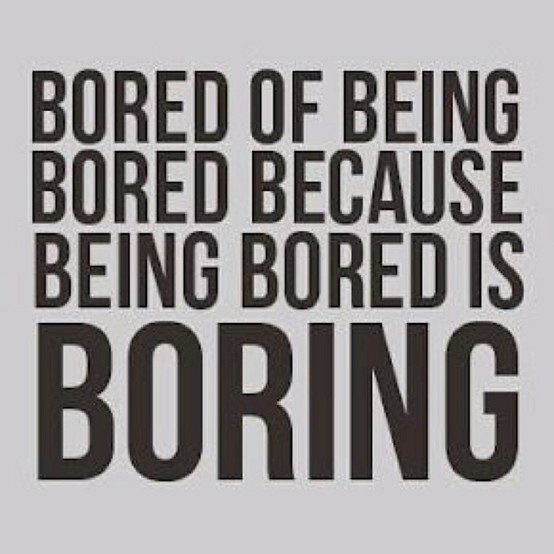
Boredom

Sometimes we have nothing particular to do or are not interested in whats going on around us. We are not stimulated nor motivated to become stimulated.

This is boredom (i.e., the state of being bored). Time passes slowly and is tedious. External factors can often create the opportunity for boredom but it’s presence always requires personal acceptance.

That is regardless of circumstances there is always an opportunity to choose not to be bored. Some argue entering a state of pervasive lack of interest (boredom) is not always a concious choice. I disagree.

Taking Control

Undoubtly circumstances can lead you to boredom. Mostly this process is unconcious, that is you don’t plan to be lacadasical nor do you actively work at being bored.

After all boredom is not a pleasant state so there is little motivation for one to go there. Perhaps you are sick, exhausted or recovering from so trauma.

Perhaps circumstantially you do not have the energy to focus or be interested in your surroundings. Your motivation for physical activity or deep thinking is low. in thiscase, going with the flow could well be boring.

Prehaps you are forced to be somewhere with little option for stimulating behaviour (e.g., a store clerk with no customers).

In these situations allowing boredom to set in is still a choice although probably the default choice. Break out. Take control, and exercise your ownership of your life.

Consider the options, there is always something feasible to do even if it is just writing a novel in your head. Boredom is a choice, decide not to select that option.

Mentoring

Mentoring describes the relationship between a more experienced/knowledgable person focused on imparting guidance to a less experienced/ knowledgable individual.

The mentor/ mentee relationship is two way with both parties satisfying a need. One to share experience and the other to gain. Ultimately both recieve value.

Not Mandated

Prescribed mentoring is usually doomed to failure. That is, the process really only works when desired and embraced by both people, a forced relationship really just does not work.


In the past I have been asked by a third party to mentor individuals they viewed as having high potential but lacking experience. My response has always been, this is not a request that is yours to make. They need to ask me directly.

My own experience has shown arranged mentoring has little chance of success.

In a similar vein, I would argue leaders/ managers have an accountability to create an environment for followers/ subordinates to develop and thrive but this practive is quite different from a mentoring relationship.

Two Way Strret

Effective mentoring involes a bond of respective from both participantsand is not heirarchical in nature but rather an exchange between equals. This is a key distinction.

It is critical for both persons to learn and improve, the key to mentoring is not treating it as a master/ student relationship. This is what amkes it a powerfully effective process for developing enhanced skills and capabilities.

Mentoring is mutual, everyone gain, is not authority or power based in any way. For these reasons it is a great approach is you but not simple to arrange, participate and create a good relationship.