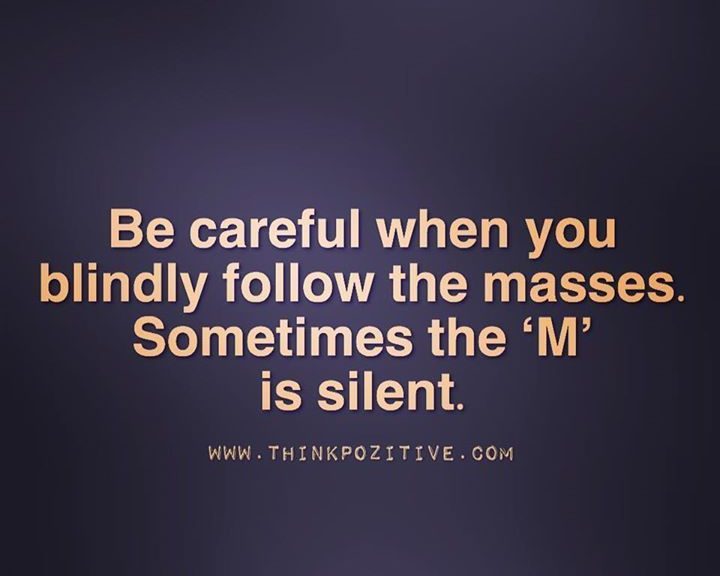
Tag Archives: following blindly

Driving with your eyes closed

Back in 1984, Don Henley, guitarist and former member of the rock group the Eagles, issued a tune he wrote, titled “Drivin With Your Eyes Closed”.

I view this as a metaphor, that is a figure of speech which is not literally applicable but is more symbolic.  Sometimes we do proceed with an action without fully seeing the consequences.

Danger

Intuitively, actually driving with your eyes closed in a literal sense is a very dangerous activity.  You might hit something or someone and cause damage.

Your life could be considered somewhat analogous to a journey.   How you drive forward is probably most effectively managed if you keep your eyes wide open.

Impulsive Behaviour

Undoubtedly, there are occasions when a case can be made for blindly stampeding ahead.  The adrenalin and excitement associated with such a choice can be exhilarating.

Sometimes not seeing ahead is an advantage.  Full visual could well block us from proceeding, of course, in some cases this could be a good risk management approach, saving us from awaiting disaster.

What do you see?

Another question of course, “Are you seeing the real thing?”  What we see does not alone create an absolute shield against danger, but it sure does help.

This is not a strong supporting reason for moving ahead without seeing where you are going (who cares, I might not be viewing it correctly anyway), however, in any case, the danger still exists.

To boldly go where no man has gone before or wait until you can see everything clearly, that is the question of balance we must consider before leaping onwards.

 

common sense – please

Blind completion of any activity, focusing only on a “do this, than that” approach, can result in disastrous outcomes. Actually, the product of your efforts should be the priority.

Process is a foundation of efficiency and reaptable, sustainable quality, but process in and of itself does not dictate good results. For this common sense must be included in the mix.

Rules are made to be Broken

A simple overused phrase has been a personal mantra for years. I do not interpret this literally but rather it is indicative of the need for flexibility versus blind conformance, for optimal results.

As usual I have an exagerrated example of this. The rule is stop at a red light. Say you were approaching an intersection with a red light, no other traffic in sight from any direction execpt behind you a vehicle obviously travelling at an excessive high speed.

Would you stop and be hit from behind or break the rule and steam through the intersection to avoid being rear ended. Only one right answer, common sense says, break the rule.

Why?

Taking action to achieve a goal should always be punctuated by understanding of the purpose. Blind adherence to a process without linkage to supporting rationale, that is understanding the reason for doing it, is often a wasted effort.

Linking cause and effect allows for reasonable varience in practice when the outcome is clearly better ( e.g., avoiding an accident). Completing a task for the sake of doing it serves little purpose.

To avoid this problem, always ask yourself, what purpose or goal does this action support, even for prescribed tasks. If the reason is not obvious, maybe a variation is needed.

Focus on why you are doing it, not what.