All posts by steve@kerrzone.com

Aging

Growing old is inevitable.  Growing wiser is a choice.  Leveraging years of experience to gain wisdom is not a default practice but it is a wise one.

You may be older but you are only wiser if the information you gathered along the way was treated as an opportunity to create personal knowledge.

Knowledge

Knowledge is created through use.  Through collaboration and interaction with others, you convert information into knowledge.  This is a process of self-education.

Your knowledge is supported by relevant information and data acquired over time. In turn, this serves as building blocks in the creation of new knowledge.

Older is Better

Being older does not equate to better or wiser by default but the opportunity for becoming personally better and wiser is fully available to you, but it does require some effort and you need to make the choice to do so.

You cannot choose to stop the aging process but you can embrace all the things life offers you, right up to the very end.  There really is no motivation not to use every moment to build up your wisdom.

Longer Life

Treating the creation of wisdom as a life long exercise has an effect on your life force.  In and of itself this can be a motivation to live and you live longer without even noticing.

Most importantly wisdom be used to guide you toward happiness.  Knowledge based decisions are far more likely to have beneficial results than otherwise.   Aquire knowledge, build your wisdom and enjoy.
The Secret Cave

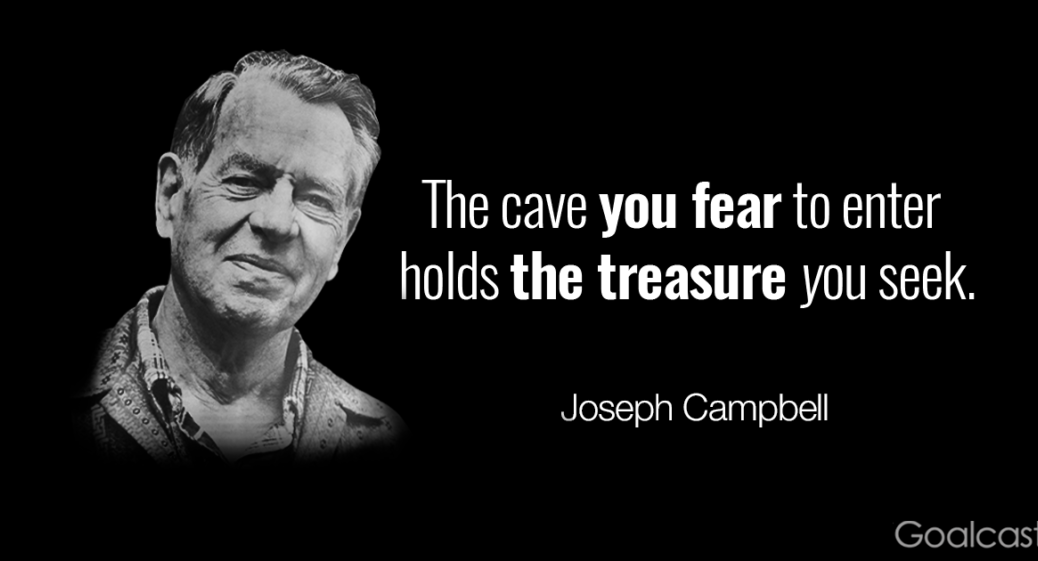
Building on yesterday’s post which focused on a metaphor today’s musing is about an analogy.  Do not be afraid to enter the secret cave to find the answers you seek.

The secret cave is analogous to the hidden knowledge we don’t have.

The cave is ominous and a little scary.  Should we enter it to find out the things we don’t know.  There is an appropriate quote by the character Yoda from the Star Wars movie, Return of the Jedi.

During a scene where Luke Skywalker is hesitant to enter the cave lest he finds out things he does not want to know, Yoda prompts him  “Find the answers you seek, enter you must”.

Fear of the Unknown

Caves are dark.  We cannot see what awaits us inside.  It could be dangerous, even life-threatening.   Overcoming this fear is necessary if we want to unlock the knowledge within.

Of course, this does lead to the very pertinent question, is there knowledge within?  Otherwise, why would I waste my time and take the risk of proceeding into a potentially dangerous situation?

Motivation to overcome the fear of the unknown is sometimes hard to achieve because you are not sure if the reward will be there.  Is it worth the risk, is it worth the effort?

Enlightenment

Unfortunately, sticking with the analogy, you need to enter the cave if you want to achieve enlightenment.  To paraphrase the earlier quote in order to find the answers you seek you must enter the cave.

It is the only way.

Driving with your eyes closed

Back in 1984, Don Henley, guitarist and former member of the rock group the Eagles, issued a tune he wrote, titled “Drivin With Your Eyes Closed”.

I view this as a metaphor, that is a figure of speech which is not literally applicable but is more symbolic.  Sometimes we do proceed with an action without fully seeing the consequences.

Danger

Intuitively, actually driving with your eyes closed in a literal sense is a very dangerous activity.  You might hit something or someone and cause damage.

Your life could be considered somewhat analogous to a journey.   How you drive forward is probably most effectively managed if you keep your eyes wide open.

Impulsive Behaviour

Undoubtedly, there are occasions when a case can be made for blindly stampeding ahead.  The adrenalin and excitement associated with such a choice can be exhilarating.

Sometimes not seeing ahead is an advantage.  Full visual could well block us from proceeding, of course, in some cases this could be a good risk management approach, saving us from awaiting disaster.

What do you see?

Another question of course, “Are you seeing the real thing?”  What we see does not alone create an absolute shield against danger, but it sure does help.

This is not a strong supporting reason for moving ahead without seeing where you are going (who cares, I might not be viewing it correctly anyway), however, in any case, the danger still exists.

To boldly go where no man has gone before or wait until you can see everything clearly, that is the question of balance we must consider before leaping onwards.


The Champion

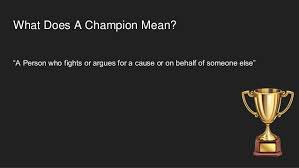
The definition of champion in the context of sports or competition is the undefeated or grand winner.  In the context of achieving goals, a champion is a person who fights or argues for a cause or on behalf of someone else.

Whether the goals belong specifically to us or are part of a group effort, failure is almost guaranteed without a champion.  We can act as champion ourselves however typically the more granted power the champion has the more effective they will be.

Motivation

Objectives that can be fully achieved on our own without support from anyone else rely on us being our own champion.  Our level of motivation and desire directly contributes to the overall level of achievement.

These completed self-contained goals are however quite rare.  Think even of a foot race.   How you perform might seem to be all about you.  What about coaching, financial and moral support.

Our internal motivation can be raised and improved through leveraging a support network or even just knowing someone is routing for us – our champion.

Cooperation

Getting things done often requires the cooperation of others.  There are many personal impact and influence techniques you can and should use to elicit cooperation.

That being said I am not averse to using the momentum that can be provided by a champion in a position to exercise their granted power.

This is a great supplement to the effort required by you to influence change on your own.  I advocate combining and balancing both approaches.

In fact, as noted earlier in this post, without a “power” champion of some sort the risk of failure to achieve your goal definitely rises.  Remember as well a good champion is not just helpful to influence others but you too.

The Third World

During the cold war Western largely democratic and capitalistic economies were referred to as the first world.   They were aligned against the Eastern/ Asian communist bloc which were referred to as the second world.

The Asian, African and Latin american countries not specifically aligned with either bloc and largely representing developing countries were classified as the third world.

Stereotypical

This classification, primarily instigated by first world leaders  was a clear example of bias and stereotypes in action.  The pompous first worlders assigned themselves status by using a numerical superior label (i.e., first).

Following the cold war, we continued with the need for unnecessary classification, where politics and market economies figure prominently in the grouping.

The third world is still a popular term for developing countries while emerging economies is now applied to countries with capital markets more stable than those of developing nations but still having a ways to go  before being robust first world countries.

BRIC

Leading the emerging economies is the BRIC block, that is Brazil, Russia, India and China.  Our need to classify as if one size fits all never seizes to amaze me.

A big problem with these broad groupings is they contain attached broad perceptions which are really unfair in some cases and clearly inaccurate in others.

I am sure we are all aware of impoverished war zones throughout the US with some  area of major cities no go zones for the police and other authorities.

Many so called third world and emerging market countries have well developed areas.  This mass labeling based on perceptions is really a poor practice.


Passion

Valentine’s day is coming tomorrow and it is typically a time when people show passion for the one they love.  Passion is both emotional and powerful.

Demonstrating strong feelings or beliefs about something is the hallmark of passion.  These feels can cover many topics from success (a passion for achievement) to love (being passionate about somebody).

At the Expense of Logic

Typically passion is a good thing.  It helps supply the underlying energy and motivation we need to achieve our goals, i.e., things we are passionate about.

The downside is passion can blind us to reality.  Our ability to conduct a logical analysis of a situation can be overwhelmed. Our earnest and enthusiastic search to achieve the object of our passion might lead us to inappropriate behavior.

We may even injure our chances of attaining that which we seek.  Certainly, stalkers have some passion for their prey but it manifests itself in a totally inappropriate way.

Embrace with Caution

Passion can include belief in the spiritual and occult and other concepts that do not necessarily have physical proof of existence.  Actions in accordance with these beliefs should be treated with some measure of caution.

Recognizing passionate feelings have us in their embrace is important.  This is not to enable an override of those strong feelings and desires but rather to let us manage them appropriately.

Embracing those things you feel passionate about and acting on them is natural, it feels good and mostly is a worthwhile exercise.  Caution is recommended only to prevent headlong rushes into something you will regret.

Full Steam Ahead

Do life’s challenges and concerns end by the time you reach old age (say 65, 75)?  Is it easier when you are older than when you are young and constantly struggling with stress from worrying about what is next?

This is a strange way to look at it.  Life can be just as sweet and fulfilling no matter how many birthdays you have had.  The daily challenges, stress and joy we experience only end when we are dead.

Sweet Failure

Whether you are 12 or 80, living is made up of challenges and successes and these are the things worth continuing to live for.

There is no age in which life’s failure to be sweet at any given point in time is not painful but likewise the enjoyment of success gives pleasure.

Age and experience may well result in changing perspectives but we don’t stop living fully just because we are getting older.  It is not easier to cope with age because you have done it all, it is just different.

Purpose

The most important aspect of any life at any age is purpose.  Believing you have a purpose, a raison d’être, is really the only basic requirement to living a long life of great enjoyment, decade after decade.

Whatever age you are it is critical for you to believe they are all worthwhile.  Anticipate the enjoyment coming with age.  The end of your life does not occur until death.

Up to that point cherish and enjoy every moment, they will not be repeated.


No, No, It Wasn’t me.

I heard the classic rock song  “It wasn’t me” by Chuck Berry which appeared on his 1965 studio album ” Fresh Berrys”  on the radio this morning.  This was his 9th studio album.

The title and chorus line appealed to me as a potentially great blog topic.  And so here we are.  In this case, the author is me, but for everything else you want to blame me for, well, it wasn’t me.

On the Defence

It is natural to defend ourselves.  Our unconscious can play a big role in this leading us to explain why it was not us even before we have thought it through.

Self defence can begin even before conscious logic kicks in.  Not surprisingly, this is not always the best approach.  We revere honesty in others and so owning up to mistakes and taking the blame right out of the box can put us in good stead with others.

However, that takes more than a little effort, in main because we will both naturally and unconsciously immediately defend ourselves.  Not sure what the accusation is but “No, No wasn’t me” is often our first reaction.

Own Up

It has been my experience accepting blame, without excuse or explanation (and thats a real important part) focusing on resolution works wonders.

This is not to suggest we should accept responsibility for ever accusation, in particular those for which we really are not to blame.

That said falling on our sword, while not  a natural inclination can very often be the best approach and a way to turn failure into success.

Give it some thought next time the opportunity to avoid blame comes up, maybe you should be singing “ Yes, Yes, it was me”.


Silence

The absence of sound can create a void.  In particular, when associated with a situation where you are interacting with others maintaining silence can be a daunting task.

Taking a philosophical bent, personal silence can be a pathway to enlightenment.  It is difficult to listen when you are talking or even just thinking about what you are going to say next.

Contemplation

Deep reflective thought can occur without silence but noise can be a distraction and silent contemplation is often more effective.  This enables us to have a sharper focus on the object of our thoughts.

When interacting with others, first listening, then contemplating in silence before reacting is far more likely to result in well thought out responses which are more likely to have a positive influence.

Beauty in the Quiet

Although it is natural and human nature to want to express ourselves and share our thoughts with others this is not always the best way to get our point across (or even ever the best way).

It is not easy to be silent and wait for the best moment.  Sometimes there is a fear the opportunity might never come and our thoughts come bursting out.

Unfortunately, this can lead to emotional outbursts and poorly founded logic.   There is nothing wrong with quiet moments.  In fact, they are most often more beneficial than nought.

Fill the Void

There is no need to break the silence.  Be comfortable in the quiet moment even in the presence of others.  If they can be silent until there is something worth sharing, why can’t you.

Everyone benefits.

Who, What When

Through experience I have come to believe accomplishing a goal requires three things, at a minimum.  Of course you need to be clear on what the intended outcome is be you start.

The three simple things are:

  • What do we need to do in order to attain the objective?
  • Who is involved in executing the “what”?
  • When will it be done?

Anticipating Failure

Whether a very simple or complex task unless what, who and when is clearly defined I am never surprised by failure.  Failure is more likely than success when clarity of purpose, approach and accountability is not present.

That is not to say you cannot stumble upon success miraculously (often called luck) but even with luck, intent is usually present which implies some level awareness of the objective being sought.

While being very clear about the steps to achievement, how they are executed, by whom and when does not guarantee success it does increases the likelihood.

Guaranteed Results

Understanding how to achieve the results you seek  is certainly a best practice it does not mean you are guaranteed to reach your goal.

If that were the case, this practice would be universally employed.  We simply decide, I want that, here is how I can get it, with these peoples help and this is when I want it.

If this approach was always assured of success everyone would, after all if what I want is guaranteed just by making the attempt, what barrier to trying?

Sadly it is not that simple and good planning and preparation do not equate to absolute achievement (the possibility of failure is omnipresent).  Still good process is more likely to lead to success so well worth undertaking.