All posts by steve@kerrzone.com

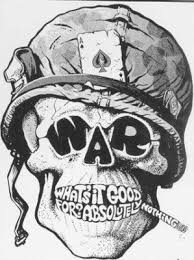
War, what is it good for?

This remembrance day I had the opportunity to listen to some deep track song themes on Sirius XM radio.  A number of lyrics really caught my attention relative to a number of philosophical questions.

One interesting thought was without war there can be no peace.  Or to turn it around peace requires us to wage wars so we can reach peace.   Yikes, a scary thought, if peace is an outcome of the war then I don’t need it.

Without Soldiers

Another fascinating concept was contained in the Buffy St. Marie epic “Universal Soldier”.  The basic theme was without the soldier there can be no war.

Simply put, soldiers are the instrument of war.  If they do not exist we could not wage war.  There would be no-one to attack or defend.  Kind of along the lines of “What if we held a war and no-one came?” There would be no war.

Manufactured Goals

A further aspect highlighted during the musical theme was the focus on the objectives of the war.    The winner’s goals become righteous objectives simply because they won while losers are evil.

Without war, this arbitrary definition of right and wrong becomes a collaborative negotiation with the ultimate goals being a win-win.  That is to negotiate something that leads to good for everyone.  War does not allow for this kind of result.

So really, as highlighted by the Edwin Starr song title “War, (What is it good for?).

Remembering

Remembering those that have fallen in past conflicts is truly a noble exercise.  No life should be ended through murder (in essence soldiers are sanctioned, murderers.)

For those that have been forced to make the ultimate sacrifice, I am deeply saddened and do believe should be honoured but ultimately, the main question is why does war exist in the first place?

 

Leading without Followers is not Leading

Each of us has a variety of people whom we consider to be our leaders from time to time depending on the context (i.e., our group, organization, geographic region)

These leaders might be our choice or by a combination of appointment and personal selection.  Their power might have been earned by them, granted to them, or a combination of earned and granted.

Power Base

To lead you must have a power base.  This can be something you developed through your actions or perhaps you are designated the leader by dint of organization or election.

More often than not guile, wit and intellectual prowess versus physical strength are the cornerstones of effective leadership although the use of brute force has been known to be somewhat effective if not usually sustainable over long periods.

Followers

Even if you are designated as a leader, without followers you are nothing.   Typically if you disaffect your followers because of inappropriate behavior your leadership days will be numbered.

This applies whether you earn your power base or start with it by default.  If you are not able to gather and retain followers there is nothing to lead and by definition, you are no longer a leader.

Observe

Effective leaders are aware of how their followers view them and most importantly are empathetic with how their followers are feeling.

Without empathy, followers will view you as a narcissist.  This adulation will most likely be brief and accompanied by mass defection.  Leaders need to be focused on their followers not on themselves

The most effective leaders, those that both retain and build their followers observe carefully and then act accordingly.


Winning/Losing Graciously

Years ago a soccer teammate of mine quipped after a close match “winners rule while losers check the rules”.   I believe the jubilation of winning clouded his judgment.

Win or lose respect for your opponents, the process, and culturally correct behavior should be the only option.  Gloating or behaving like a spoilt child should be condemned as unacceptable.

Accept Defeat

Being able to take on an opponent, put forth a credible fight, and seek to win within the context of playing field boundaries and the rules of the game is honorable in and of itself.

While winning is the goal, defeat does not make you less worthy.  Questioning the rules, cheating, and disrespecting your opponent are dishonorable behaviors.  Losing is not part of this.

Watching soon-to-be former President Trump’s behavior following his recent defeat in the US Presidential election is a classic example of how not to react to losing.

Once again he is ignoring time-honored political traditions to concede gracefully.  Dragging it out, contending when you are obviously done, and encouraging your supporters to follow you down this path disrespects us all.

Civil Behaviour

Democracy expects, no demands we behave civilly.  In this way, everyone wins.  Even with different political views, we are one society bonded together by a common belief in cultural norms, freedoms and respect.

Donal Trump is not a leader but a narcissistic dictator for whom the majority of the population has rightfully and thankfully finally defeated.

The lies, disrespect of fellow humans, and continuance of the reign of the worst President of the United States has ended, it is time to rejoice.


Get Excited, it is a choice

It is not unusual to encounter periods of great uncertainty during your life. Things that we do not recognize, are unfamiliar to us, or outside the scope of our knowledge exist for everyone.

Our perspective, that is how we view the unknown, is critical to personal well being.  Allowing the unknown to create fear and anxiety is common and often the default path.

Take Control

For me what is coming, even though I don’t know what will happen is always best viewed optimistically.  The sense of foreboding is of my own creation and it is just as easy and more productive to focus on a feeling of great enthusiasm and eagerness (it is your choice).

We may not know what is coming in our futures, and we can easily visualize the worst.  I am not sure why the genetic predilection is toward pessimism when it comes to the unknown but my general observation, that is often the case.

Why not be excited.  Probably because this does require the ability to view the future as an opportunity and typically takes effort.  Excitement though is a much more pleasant and empowering approach.   It is well worth the effort.

Make it Real

Focusing on positive outcomes, even when factors outside of your control exist, also makes it more likely to occur.  That is not to say if you wish for something it will happen but if you don’t even consider the possibility, chance takes over.

Uncertainty is really an opportunity to get excited about the future by taking charge.  Plan to make your desires become reality.  Of course, you might not always succeed but neither will you always fail (unless of course, you don’t even try).

Choosing Wisely

The U.S. presidential election which was held yesterday (although the vote tally, law-suites, and results dispute will go on for weeks) makes me wonder about the democratic process.

For me, the key question will be is the population as a whole capable of selecting a leader in a way that shows experience, knowledge, and good judgment.  The results so far really make me think not.

Popularity Contest

These days the process of becoming elected by the general population is an expensive proposition which by its very nature limits who can be a viable candidate.

We have gone from the elected office being a noble role reserved for those that demonstrate worthiness by their actions to what is now largely a popularity contest.

Actors and reality TV stars have a better chance of being recognized and thus elected by the general population than seasoned politicians who actually can do some good for the public.

Emotions Versus Logic

Voting is a privilege that allows us to take a moment for ourselves and choose the option which best suits us.  That is,  a choice we feel good about and believe will be to our benefit.

Choosing does not require us to do rigorous analysis or think it through logically, rather it is usually easiest just to focus on what makes us happy.

Unfortunately, this methodology is prone to bad choices.  As a collective group many of us truly desire the best for everyone but when voting it is all about us and the candidates’ list, who do we like?

This concept of democratically elected officials to provide guidance to the whole population has a lot of merits but when it comes down to just the selection process it can really suck.

Finding Answers

From the day we are born, humans grow, do stuff, are subject to continual change, have the opportunity to reproduce, and then die.   The meaning we create defines our purpose.

The way we live our lives is (in essence) an answer, but to what is a mystery.   The search for answers begins with questions.  Like the TV game show Jeopardy often we start with the answers spending an entire lifetime working to determine the question.

Seeking Questions to Explore

We may live our entire lives answering the unasked questions often wondering what are they?  In one context our purpose is to first define the question and then answer it.

Many of us will normally consume food each day.  Our purpose in eating is the answer to the question “Why do we eat?”  However, the answer to this question is not straightforward and contains a contextual component associated with the individual.

Working from the question we can understand better our own behavior and its purpose.   What we do in response to any questions may be different in any given situation although the question remains the same.

Questions Guide Answers

Focusing on the questions that define our goals can assist us in giving validity and meaning to our answers.  Reasoning before action is more likely to achieve positive results.

Understanding the underlying behavioral motivation (i.e., what was the question again) mapped against the context is more likely to lead to the right answer.

This is not a typical approach to living.  Act first, question later is much more common but can be a very haphazard approach often living the questions to be asked afterwards, “Why did I do that”?

Continuous Improvement

Everything is constantly changing.  Sometimes in small increments and sometimes change is very rapid and the impacts can be  of a greater magnitude.

By definition working to achieve or produce something better than it previously required a change.  This will be a change for the better (or at least that is the intent) but still, it is a change

Little Steps

Constantly getting better intuitively makes sense.  Making changes in small increments is most often better than the big bang approach.

Moving rapidly and doing everything all at once has been demonstrated through numerous studies to initially reduce productivity and quality as people worry about the impacts of the changes.

As you seek to move forward try not to step on those in front of you or leave a trail of crushed bodies behind.   Continuously improving in small increments is a solid approach to achieving better results with minimal disruption.

Often the changes can happen seamlessly relatively noticed by those impacted the most.  Ultimately better results are achieved by stealth.

Minimal Impact/ Maximum Gain

The concept of continuous improvement is associated with change management.  Rather than modifying processes, practices, and behaviors all at once  thus creating greater stress and resistance the goals are slowly progressed toward in increments.

It is important to have the overall goal in mind and even mapping out the steps fully help make sure the result is coherent and integrated but this does not mean the change needs to occur all at once.

Continuous improvement is continuous changes and thus becomes the norm so that in a way it is not really a change but rather the usual.


Building Resilience

At various times in our lives, virtually everyone goes through a process of adapting in the face of adversity, trauma, tragedy, threats, and other significant sources of stress.

Situations that require the practice of resilience as a major part of perseverance through the unsettling change are unavoidable.  Our ability to adapt and move to the other side has a natural and learned component and strengthening this skill enables us to move on.

Get Through It

While it is important to get past a change without adverse effects on our health (mental or physical) this is not a process to be rushed nor ignored.

Just hoping it will resolve itself with time often leads to the deeper internal stress which festers.  Likewise rushing to get it over with does not address the root cause and again might not really resolve problems.

We need to move through the change leveraging planning, communication, and problem-solving skills to help us overcome the stressful and adverse impacts.

Focus on Opportunity

Our innate resilience can be a counter to change resistance.  However, it is important to bolster your level of resilience by behaving in ways that enhance the change experience.

Ask questions, seek clarifications, speak out clearly (but calmly) about how you feel.  Sharing can elicit helpful feedback from others which can guide you in ways to help yourself.

Plan how you will behave rather than react.  This gives you time to think through scenarios and is more likely to result in positive responses from others, as opposed to them experiencing explosive behavior on your part.

Studies have shown we can enhance and grow our resilience skills.  Change is inevitable, strong resilience will be needed from time to time and you will thank yourself for being ready.

Obligations

Sometimes we are morally or legally bound to do something, it is our duty or a commitment we made.  Are we obligated to work based on the explicit or implicit contract we made both with our employer and those we serve?

A case in point is the recent wild cat strike by health workers in the Province of Alberta.   Classified as a wild cat strike because it was not officially sanctioned as a union activity by the leadership but rather just an uprising by the rank and file.

In this time of a worldwide pandemic when medical support is critical do, the workers have a duty or commitment to the general public?

Freedom of Expression

In countries with democratic based political structures, we are fortunate in the ability of an individual or group of individuals to express their beliefs, thoughts, ideas, and emotions about different issues relatively free from government censorship.

However, there are boundaries, some structures, and rules, and it is the administration of these that is not always either exacting or easy.  We do have structures to make the assessments of fairness (e.g., our legal system) but sometimes the results are contentious.

Is it a right to express our dissatisfaction with our employer (in the case of health workers the employer being the government)?  Generally yes but what about when it affects the public good?

A Fine Balance

Freedom does not equate to anarchy and sometimes the separation of the two states can be a fine balance.  Groups (union members) have rights but does that mean they can be righteous?

The answer to this question is sometimes a real moral dilemma.  I support the right to express disagreement with the government policies but also the need to maintain public health services (particularly in times of crisis) is critical.

There probably is no clear answer to this situation, fortunately, we do appear to be muddling through with some civility.  Yeah for democracy.


It’s all about the People

Throughout our lives we both belong to and interact with many different organizations ranging from government through corporate, small business and non-profit.

The public’s opinion overall for some organizations is a strong positive sentiment (e.g.,  like 100% for a good movie on rotten tomatoes) while others are disliked or badly thought of.

It is often the way the organizations people behave that is the first place this opinion becomes formed.

Who is the Organization?

For all these organizations how they operate is key to their success, regardless of their product or service, although the nature and quality of the products and services do matter.

People make organizations great, nothing more, nothing less, it is all about the people.  An organization, regardless of it’s purpose, is basically first the people who are part of it and secondly what it does.

Sadly, I find this simple fact, that is your organizational identity is formed by those who are work to achieve it’s objectives.  I find this basic truth  is often overlooked by a focus on the institutions financial viability.

Less People More Profit

Cutting costs to get more done with less is admirable whether the organizations main purpose is financial profit or just to improve the quality of life.  Less cost mean more resources to allocate, grow and get better.

Typical salary costs are most easily reduced (and often the largest cost) However, fiscal benefit can be outweighed by reputation  costs and this impact should be carefully weighed when deciding to affect your organizations human resources.

Remember your brand opinion will not be positive if the people that make up your organization are not viewed positively both by those who avail themselves of your products and services as well as their colleagues.