ResiliencE

Some times life is tough, things can be difficult.  We each have an enate capacity to overcome, that is take the hard stuff in stride and deal with it.

Resilience is about resolving your problems without them actually becoming a significant problem, that is follow these simple steps, accept, plan action, take action, no problem.  Perhaps slightly easier to write than execute.

The key concept is a belief that no problem, no obstacle is insurmountable.   This does begin with understanding and acceptance.

Identification

The first step to acknowledging a problem or obstacle exists goes beyond, well beyond, the initial discovery or realization something is up.

For ease I will outline this identification process with a relatively simple example, the process can apply to all problems but admittedly some cases are much more difficult.

Driving to work, your car suddenly becomes hard to steer and the ride is bumpy.  Your intial reaction is “flat tire” coupled with I will be late for work.  I am not dressed to change a tire. 

Other cars are getting impatient because I have stopped in the road way.  Emotions flood in, anger, fear, frustration.  Stop, think.  First what is the problem, cast aside the other thoughts for a moment.  Focus on the fact it is simply a flat tire.

Consider Options

What should I do with the car, leave in the road or pull over.  What are the consequences of each action and what makes most sense?

How do I deal with the flat, fix it myself, hire someone and if so what are the logistics.

These are just some of the rational ideas you can come up with to develop a resolution plan.  The key here is don’t let the obstacle or problem own you, you can own it.

Fair Treatment

Do other people treat you the way you expect to be treated?  Believe it or not, you are the largest influencer of how others behave toward you. 

Studies show other people judge our behaviour in just seven seconds.  Your attitude, how you ask for something, respond to a request or your body language are all key tells as to how you will be recieved, percieved and ultimately reacted to.

Think it Through

The you want people to react can be influenced.  Both your body language and verbal communications are key contriutors to this.  In fact though everything from appearance to demeaner are factors.

There are times when how you approach a topic is well worth planning in advance, mainly that is when you are seeking to get something. 

Increasing your chances of success can be as simple as  juding the other persons bias and catering to it.  Juding others in seven seconds is a two way street, how you use this judgement is a choice.

Plan yourApproach

If you can plan the best way to achieve your goals, getting treatment that meets your expectations, before engaging someone, it is helpful.

 This is not always possible and  even if advance preparation is not possible  careful crafting your approach in context of what the other person seeks in the moment will increase you chance of being treated as desired.

Basically, give the people what they want.

Change and Communication

Most if not all people enjoy and embrace routine, that is the familiar.  That is not to say many do not derive pleasure from the unknown or unique activities but on the whole constancy is appreciated. 

If everything was well understood and constant it would be a bit of a boring life.  That being said, most of us do enjoy consistency of simple routine tasks.

For example, your daily travel routine, where you park your car, the time you eat breakfast. This need for routine does not detract from the excitement of say taking a trip to an unknown location, we like that too.  

Supporting Change

With a basic understanding of resistance to change it is possible to plan ways to help both yourself and others to embrace the unknown.  That is to recognize the value and so have fun changing it up. 

The key to making change work, probably 90% of the approach, is communication.  Two-way communication by those promoting the change (could be you) and those on the receiving end (also could be you) is critical.

Being a Part of the Change

hange includes unknown factors, things we have not experienced or practiced regularly or at all.

Understanding the reasons to alter our behaviour and believing we are at least able to voice an opinion, can make the change very palitable. 

Change is exciting.  It is invigorating and constant.  Believing in the power of change, accepting and embracing it, can be a powerful and pleasurable experience. 

Getting Help

Independent behaviour is characterized by actions that seem to not be influenced by other people, that is we  resist the pressures to conform or obey others, rather we decide and act on our own.

Independence is a cornerstone measure of self esteem.  Not to say high self esteem requires a lot of independent behaviour but rather choosing to act independently or to follow the direction of others comes easily and naturally and feels like a personal choice.

Independent living

Most cultures around the world if not all are founded on the  principle of individual indepence built on a framework of societal dependence.

The level of control exercised by societies can vary significantly but largely the focus on basic human needs, food and shelter starts with the individual.

This concept of individuality has a genetic influence and during our lives the inate need for individual independence is balanced out by the environmental context.  That is we learn conformance behaviour.

Accepting Dependence

Sometimes all of us benefit from, control direction and direct help of others.  The optimum balance between dependnce and independence is a very individual assessment.

There is a balance, it would be impossible to operate fully at one end ofthe spectrum or the other, although conceptually this is what hermetic behaviour is trying to achieve.   That is a very high level of independence.

Recognizing a balance does exist and seeking the best for you is the point of this post.  If you need help, take it.

Frustration

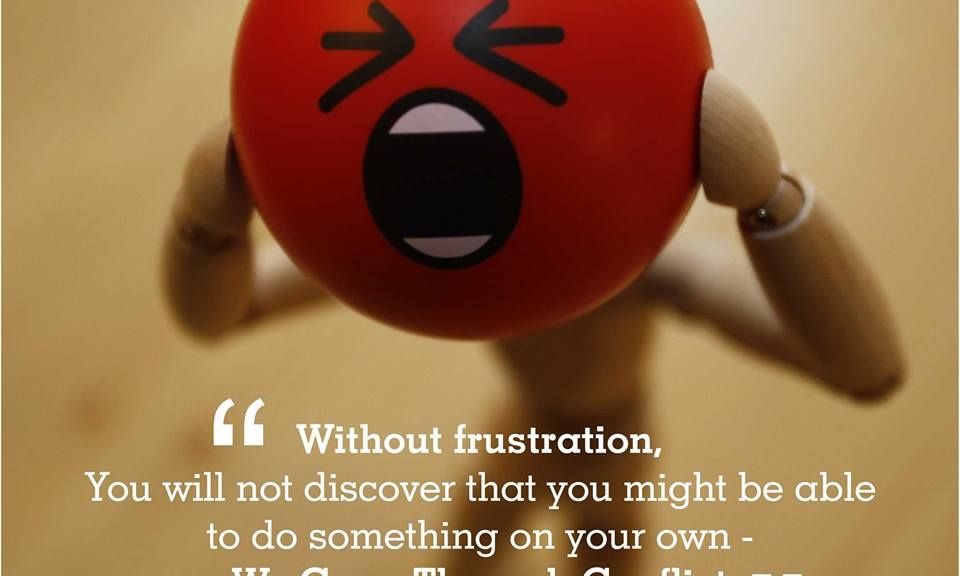
Frustration describes a state of mind which is exists when you are upset or annoyed because of your inability to change or achieve something.  As a general rule, frustration does not lead to productive behaviour. 

Most if not everyone experiences frustration on and off.  Obvious examples are things like how you felt in a long line waiting for something or the when the actions of other drivers lead you to anger (road rage). 

bAnimosity

At the core of the frustrating experience is desire and caring.  You are seeking a result and unhappy it is not readily attainable or perhaps not attainable at all.  

Animosity, dislike or hostility toward your objective makes it less appealing and your desire to change something or achieve a goal diminishes.

That is, anomisty toward something, a repulsion to it, will diminish your frustration although it may turn to anger.  Developing anomosity may eliminate frustration but anger driven behaviour is probably not optimal.

Root Cause

Frustration derives from a barrier.  You are blocked from a sought after change or achievement.  There must be a cause of this barrier.

Determining the underlying reasons for your inability to succeed is the first step toward resolving them.  Of course you can just let anomosity kick in but I suspect removing the cause of your frustration will be more satisfying.

This does require a pause, analysis, a plan and then action to confront and remove the cause of your frustrations.  My recommendation would be to employ finesse.

The direct approach can work but often has some negative side effects.  

Prioritize

Our daily activities include many options.   What we choose to do at any moment is our choice.   In this context, the activity can be related to work, leisure or just rest (sleeping).

Often the environment or other people influence the choice of action to such a strong degree we declare “I had to do it” or “You made me do it”.  This is a fair comment, as overriding influences external to yourself is not always easy but it is not accurate. 

Ultimately, it’s up to you

At one extreme, if you are being robbed at gunpoint, it is arguable there is only one right behavioural choice, give the robber what they want.  While that might be the most common response to this situation, different responses have been known to happen (e.g., resistance, attack). 

The way you choose to behave or respond in any given situation may well feel like it was situational, often simply because the circumstances dictate it is the best response.  

However, notwithstanding all the influences present,  you make the decision.  Whether made in the moment or time is available for consideration having an advance understanding of your priorities can really help shape whatever you decide to do. 

Personal Priorities

Personal priorities stem from your personal life goals and values.  In many cases, you will apply these without forethought.  For example in the robber situation, it is very common for our personal value to preserve life to kick in. 

For some, preserving personal wealth is a higher priority and the response may be to resist giving the robber what they seek.  Having an advance sense of our priorities can enable us to make better choices.  Or at least be very comfortable in the choice we make.