Tag Archives: value

Eisenhower Decision Matrix

Yesterdays post about patience got me thinking  a littlebit more about when it is appropriate for the urgency/ impatience balance to favour urgency.

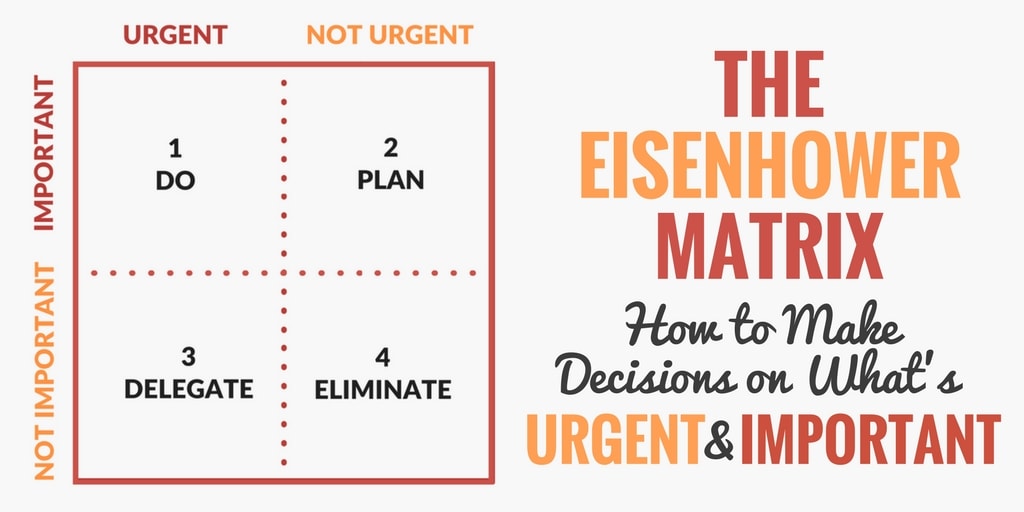
This reminded me of the Eisenhower matrix which classifies activity based on it’s urgency and importance.  The simple question to ask is, how important is what I am going to do  (i.e.,  task, activity, strategy, behavior and so on)?

The combination of urgency/importance can help guide the best mix of patience or perhaps impatiece, that is need to get it done right now.

Importance speaks to value, spending lots of time on less important activities is obviously less value than spending little time on important actions.

Definitions

Important tasks are things that clearly contribute to our strategy and objectives.  We know they add value because they specifically solve a specific defined objective.

Urgent refers to any activity or task that seems to require require immediate attention. These are the things that we percieve to be  shouting “Now!”.

The Matrix

Eisenhower’s matrix classifies things we want to do based on a Y axis of low to high urgency.  The x axis is low to high importance.  This results in four main quadrents:

  • Low importance/low urgency – spend a lot a patience on these, in fact why even do them at all.
  • High Importance/High Urgency – based on the classification obviously worth doing quickly, don’t waste patience on these.  It is not appropriate and maybe detrimental.
  • Low Importance/ High Urgency – You kind of wonder whats the urgency if it is not important.  This is a category to be carefull with and a modicum of patience does not hurt.
  • Low Urgency/ High Importance – there is good value here, they are important but be patient as you complete the work.  Focus on getting the best value, patience is an asset.


Fending for Ourselves

Taxes are a compulsory contribution to the revenue of your governing body or bodies as the case may be (country, province, city, municipality and so on)

The government, regardless of type, i.e., democratic, autocratic or even royalty , enforces the compulsory part through consequences.  These can range from fines to incarceration.

I wonder if the contributions would continue without the consequences.  If your taxes purchase something of value to you, the consequences should be irrelevant.

Spending Money

To a greater degree (more than half but not by much) most of us choose what to spend our money on.  There is a direct correlation between the expenditure and our perception of value.

Whether you are paying for a road or to build a jail to house people you fear, or whom don’t behave according to expectations,  if you perceive these expenditures of value, consequences are not required. You will contribute.

Accountability

The troubling aspect of taxation centres around who controls what the revenues are used for.  Consequences are needed as an incentive to pay because their is no direct correlation between what you put in and what is received in return.

It would be an interesting but highly difficult exercise to calculate what your tax contribution was actually used for in any given year.

Compiling the contribution of the populations provides scale theoretically improving the efficiency and effectiveness of each individuals contribution.

That is, in theory, if you paid directly for all the services you receive from governments directly instead of cooperatively you would pay more to get less.

In practical fact,  if you were accountable for the spending and so only paid for what you wanted, you might get less things and pay more but overall considering all the things you pay for now but don’t actually need or want, you would probably be better off.


Rethinking the Monetary System

Yesterdays post ended with a question – Can this avoidance of economic collapse continue without a major resdesign of the monetary system?

Reworded, is there a major devaluation of money coming if we don’t change something?   Remember, in and of itself money has little value.  You could burn it to keep warm, use it as toilet paper or to make paper clothes but there are better materials for these things than money.

Money is an instrument or tool critical in the exchange of goods and services.  If money was not accepted in return for a good or service it is basically useless.

Demand for Money

Money is only in demand because it has a percieved value.  If money suddenly has no percieved value or is of greatly diminished value some hope it will be replaced, by say gold or diamonds or bitcoins.

Ultimately though all these things are artifical constructs with a requirement for a perceived value.  If the perception changes or dissappears so does the value.

Outside the box thinking

My thought is not to replace money, but rather to standardize it, one currency for the entire world, and fix how much is available and do not allow any manipulations like fractional reserve systems to exist (finally backto that, hope you were not holding your breath).

The currency then does not fluctuate in value and given it is world wide becomes the same everywhere.  Hoarding it or trying to manipulate supply and demand via regulated interest charges or other such machinations would not work.

Goods and services (e.g., housing and food prices – basic necessities ) would not vary in value because the amount of currency was fixed and there would be no more available.  That is, the money suplly would be an irrelevant economic factor.

Inflation, deflational, economic collapse, would all become all things of the past.

The Sales Rant Continues

One of the foundations of our economy is sales.  It is a very simple equation.  On one side is a producer with a product or service to sell and on the other is the consumer who needs the product or service.

When the price the producer wants equals what the consumer wants to pay a sale occurs.  No sale, no economic activity.  The buy and sell transactions can be linked in chain.

In these cases, failure to sell at the bottom of the chain can impact a long string of financial activity.  For example, the steel sales falls through, the car is not built, so no gas or oil need be purchased.

Sales are Good for All

Logically then, from this perspective, sales are good for everyone and important for a growing and/ or thriving economy.  Yet sales people have a bad reputation.

Many feel, don’t sell me, if I want to buy it I will seek you out.  The problem with this is the fact sales are a fundemental driver of our economic prosperity and the submit and hope approach really doesn’t cut it.

In short, the economy needs  sales activities and not just neccessities like food but unnecessary things like junk food sales are a key factor in vibrant economy.

Valuing the Sales Person

Over the years my wife and I have bought and sold seven homes.  We paid for the services of a professional sales person in every case (i.e.a real estate agent).

If we had not recieved value from these agents we would have stopped using them.  However, seven times without fail they helped us get better faster deals, with less effort on our part.

A service well worth paying for.  Like most I don’t like dealing with sales people, but I sure see the value.