Wasting Time

In simple terms devoting time to a useless activity is a waste of time.  I would expand this to include time and effort spent on low priority, low impact items.

In our lives, when we wait another day we waste another moment.  Everyone’s lives will end, your moments are limited.  It is trite to say so but make every moment count.

Recharging

It is important to acknowledge those moments we spend recharging (e.g, sleep, meditation, inactive) are as important as those active moments when we are challenging, stretching, searching, learning, growing.

These moments, when in essence we are recharging our batteries, are not wasted time.   The balance between living to the fullest and be ready to live to the fullest (i.e., resting) is different for everyone.

Focus on the Mostest

Given our limited number of living, moments will expire choosing how to spend your time should focus on your personal goals.  For most people, this entails some form of achieving maximum pleasure.

Things that make us happy, provided they don’t make others unhappy provide the greatest value.  Sometimes we can’t be sure what the value of something will be, these things we should not shy away from.

However, mundane tasks we choose to undertake to fill time are often just a waste of time.  Is that something we really want to do?  Instead of wasting time, maybe we could just undertake a recharging activity (perhaps a moment of rest and silence).

This recharging prepares us to charge forward and seize the moment and opportunity to experience the joys life offers when we can.
Using your Hidden Power

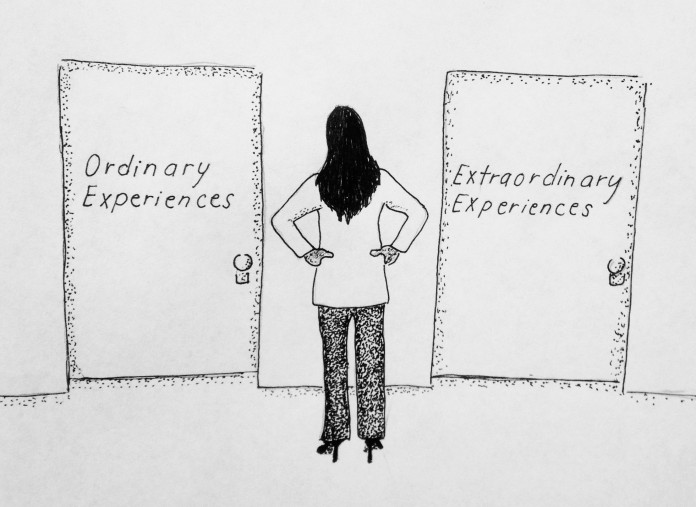
Perhaps it is a bit of an overgeneralization, however, my personal experience is everyone has capabilities that remain unused for most or even all of their lives.

These hidden abilities are often related to things outside our comfort zone.   That is they are not a situation where one feels safe or at ease and without stress.  Just the opposite.

Satisfaction Guaranteed

The power to overcome obstacles and achieve great things is usually available to you.  Embracing and unleashing these powers which lie dormant, perhaps  even purposely buried by social and environmental constraints, can be extremely pleasurable.

It requires effort and self motivation to gain the confidence to use unfamiliar and uncomfortable skills and behaviours.  Going outside of your “go-to” behaviours is never easy.  It is however almost always satisfying.

Stretching Yourself

It can be frightening to try something new, to boldly go where no one has gone before.  Lots of things can go wrong.  There could be physical and mental anguish involved.

The benefits of expecting yourself to perform beyond expectations, are not always obvious.  This limits the motivation to do things we are not sure we can do.

Hence, as I noted a majority of us just stay in our comfort zones, safe and secure.  It may be we do not even realize we have hidden talents.  We are not motivated to seek them from within, rather to rely on others to see us through.

Sadly by not doing everything we are capable of, by self imposing unneeded constraints so much valuable and joyfull life experience can be missed.

What will be will be

With the recent death of Doris Day and associated public remembrances, I was reminded of one of her keynote song performances, from Hitchcock’s film ” The Man who knew too Much”

Que Sera Sera, literally translated from French to English as What will be, will be (Whatever will be, will be in the song lyrics) has always been a really cool pragmatism for me.

The future is not ours to see

Although I have not come across any connection between this song and Paul McCartney’s “Let it Be” both include references to a wise mother providing advise to a troubled soul.

Personally, I have found this technique of acceptance which involves convincing myself it is what it is and it will be what it will be,  is a great way to basically just let it be.

This is a very practical approach to avoiding needless worry. We are not able to see what is coming and although influencing the future to achieve our desires can be tempting, and a valid approach sometimes it is smarter to just let it be and see what happens.

Not a Universal Approach

Of course, letting whatever will occur or just letting something be is not always the best way to proceed.  There are cases where influence and impact behaviors are better used.

Submit and hope or not even submit, just hope or not even hope just let it happen are approaches best used when things are out of your control or  it’s not worth the effort.

In those cases, remember, whatever will be, will be.


Disinformation

Misinformation is the sharing of false or inaccurate facts.  It may be unintentional.  When spread deliberately to deceive it becomes disinformation (i.e., a subset of misinformation).

Sometimes misinformation can consist of a very accurate statement but not the whole story.  On the surface, the statement is easily believable because of the element of truth.

Relating what you know, which might lead to incorrect conclusions but not intentionally, is quite different from purposely only telling part of the story to create results that map to your agenda (i.e., disinformation).

For Example

You might be a contractor building a new home.  Although the laying of the foundation went well and finished on time skilled worker and material shortages you are aware of are about to become an important factor.

In your status updates to the homeowners you elect to report only on the success, (i.e., the foundation) keeping the bad news about future prospects to yourself.

The desired effect is a positive response by the future homeowners and a potentially difficult discussion is avoided.  This disinformation will work in your favour to a point.  If you can resolve the issues before the next report all could work out fine.

If not it could be worse than sharing the full information up front.  Disinformation can lead to declining trust and even punitive action if discovered.

Caveat Emptor

Technically this translates to buyer beware.  I take license and extend it to information consumer beware.

Although those that practice disinformation are not of high moral standards or strong believers in integrity, they do exist and we need to shield ourselves from becoming their target.

Hence don’t readily accept all information shared with you.  Questions, probe, analyze and check.  To work disinformation needs willing recipients.  You want to avoid being one.


Building Teams

As I have commented in numerous past posts we are not alone.  Working with others, leveraging their skills and abilities as they leverage ours is an optimal approach to getting things done.

That is not to say solitary behaviors (i.e., solely individual activities) are not important and don’t play a role in how we live our lives.  However,  living without interacting with others is almost impossible.

Optimizing the Experience

While,at the core, your life is about you, unquestionably in my mind, we need to be aware of and sensitive to other peoples needs wants and desires.

This could simply be because of  your own committment to personal integrity, (i.e., being honest and showing consistent and uncompromising adherence to strong moral and ethical principles and values which include respecting others.)

Or it could be more selfishly motivated.   Positive engagement with others well is needed to influence them and achieve your goals.

Teamwork

If a group of people work together effectively (usually for a common objective but not necessarily)  there is a higher probability of a positive outcome for all.

However when its not effective, that is everyone is acting as an individual, it is worse than going it alone.

Basically effective teamwork relies on the all the team members practicing one core value, “everyone is important.  Everyone believes and acts like everyone else is valued (highly valued).

Teams are not mandated they are founded on this simple value.  If everyone practices it results are extraordinary.

Failure

If you don’t try to achieve a goal you will not fail (also, of course, it is unlikely you will succeed).  Although failure is defined as a lack of success, this is only true relative to achievement of expected or required action.

In fact, failure is evidence of an attempt.  Trying to achieve something without the possibility of failing is rare and usually means there is only a little challenge if any.

Boldly Go

Overcoming a tense and frightening experience leads to a feeling of exhilaration.  Allowing the fear of failure to overcome your motivation to make the attempt limits your capability to experience the thrill of the win.

Failure is something to embrace.  That is not to imply we should attempt to fail but rather recognize that failure is not a bad thing.  Without failure, there can be no success.

Minimize Risk

Raising the level of confidence with achieving positive results (minimizing the likelihood of failure) can be done through use of risk management.

Consider the things that lead to failure and plan to avoid or mitigate the likelihood they will occur.  Be ready to modify your approach if something unexpected occurs.

Risk management is really just putting forethought into your activities and being prepared to prevent failure by acting accordingly.

Of course, even a rigorously thought out risk mitigation plan does not mean the possibility of failure is eliminated.  That is okay.  Failure just means you have to regroup, reassess and try again.

The positive fact, even if success is not achieved,  is that you made the attempt at all.  No attempt, no failure.

Common Understanding

For the majority of people, life is not a hermitage.   We regularly interact with others.  Our reality is controlled by us but shaped by others.

Living is smoother and more enjoyable when we are able to achieve a common understanding, without too much effort.  When this is not the case we consider others difficult or visa verse.

Flexibility

The key to reaching a common understanding is resisting the adversarial approach.   When you are not clear what is being communicated just say so.

It is important this is done without rancour, condescension or negativity.  All of these approaches immediately set the context as adversarial.  Others perceive the interchange as a personal attack.

From seeking to understand, using  adversarial behaviours moves  you into a battle mode, even if unintended and this can make the achievement of mutual understanding much more difficult.

All about Us

In a way, I feel strange admitting it is not always about me (but most of the time it is so I guess it’s okay).  To achieve a common understanding the only effective approach is all about us.

A common understanding requires a state of affinity or harmony between people. Standing on your hill alone, willing to die for you right to be right, won’t ever lead to a harmonious understanding.

The motivation to seek mutual consensus about things is simply pleasuring.   It feels good to agree with others, they feel good agreeing with you, ergo, everyone feels good.

Thank you, James Brown

Toxicity

A toxic environment is one where the activities, the atmosphere, the people, or any combination of those things cause serious disruptions in the rest of your life.

When you are stuck in a context that is uncomfortable or unpleasant, the solution needs to come from within.  You can make a change that resolves the toxicity

Deal with It!

Living through a toxic environment without an unpleasant effect on your daily life ultimately having permanent long term impact is unlikely.

Doing nothing is not a good approach.  Either leave the environment, or influence a change to the activities, atmosphere, and people that has a real impact.

Of course, acceptance and embracing the toxicity is an option.  In this case, the environment is not considered toxic anymore because you mitigate that impact by adoption.  (This type of resolution does occur although not my personal choice – the Stockholm syndrome is kind of an example of this)

Influence and Impact

Leaving a toxic environment is not always a feasible option.  Livelihood considerations and even the impact of changes in your ongoing routine, need to be considered.

Influencing a change to the environment might also not be a practical choice and sometimes a combination of seeking change, targeting to exit and acceptance are all in play over time.

In the end, though, either one of these things occurs or the negative impacts of the environment take charge and you are permanently affected, in a negative way.

If the environment you spend the majority of your waking hours is toxic, consider action.  You may well regret it if you don’t


Coaching

When we are lucky enough for someone to take the time to instruct or train us on how to improve the way we act or behave in order to enable us to attain greater achievements, we should embrace the opportunity.

People in these roles are often called coaches or mentors.  Surprisingly many of us resist a coaching or mentoring opportunity.  To some extent, this is due to personal pride and a strong feeling of independence.

I Don’t Need Help

Unfortunately or maybe it is fortunate, we all need help.  Humans are described as social animals for a reason.  With few exceptions, we need to interact with others.

None of us are so great as to not benefit from others knowledge and ideas.  This does not mean we need to accept or adopt them but sharing/collaborating has been demonstrated in study after study to lead to better results.

Even the outstanding individual athletes require and also have coaches.  Filtering what helps and what does not is a task for the coachee, not everything is of value but if you refuse the instruction or training you miss the chance to be the best.

Coaching Quality

How we coach or mentor others very much determines the receptivity to the teaching.  Not just knowing what is the best method is needed for good coaching.

More importantly, you need to know how to communicate in a way that is understood.  Providing clear benefits in a way that is understood will motivate the trainee much better than telling them to “just do it” or as some coaches are want to be “just fucking do it”.

Micro-manage

Taking charge and control over every part, however small, of your assigned accountabilities (i.e., micromanage) can be stressful if you have a broad mandate.

Typically, the larger your span of control, the more support you have available to draw on.  Micro-managing in this case is not only stressful to you but harmful to others.

Turn-over

If you are a leader, those associated with you will typically dislike micro-management.  It leads to the question “ Why am I here?”  It also demonstrates a lack of trust.

The result is team members leave, at a high rate.  You replace them but the replacements leave, and so on.  Turn over off 100% in the course of a year would not be unheard of.

Quality

The efficiency and effectiveness of a group become greatly diminished when the expectation of them is clearly do this or do that.

Creativity and innovation are quashed.  The leader seeks to control everything and is not open to others ideas or methods.  Alternate methods, even if they are a more amenable way  to the person performing them are not allowed.

The theme that prevails is the leaders way or the highway.  High turn over rates illustrate this is not just a saying but reality.

Do it Yourself

Many workplace studies of new leaders challenges have found one of the greatest difficulties they have is getting things done through others.  Doing it yourself, your way is so much easier and often more self satisfying.

Sadly though this approach is neither sustainable nor as noted does it result in high quality, innovation or creativity.  However, the leader may feel good about themselves.