Tag Archives: right

The Right Answer

Living your live is all about doing stuff.  There are a wide range of activities we do every day, each has an outcome, that is they produce something.  For example we could be thinking, behaving, reacting, creating and so on.

A very interesting and important question about all the things we do, “Is it right?”.   Do our actions conform with fact, reason, truth, or some standard or principle?

Subjective Analysis

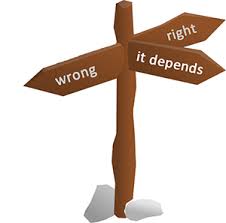
Usually the right answer does not exist in a consistant and absolute sense.  It would be unusual for a group to be in complete agreement about whether an approach or outcome was right, largely that assessment is dependant on majority or by consensus of the group.

The questions leading to the right answer always have a subjective component, hence the individual perspectives colour any assessment of “right”.

The word right implies correctness, the challenge is the fact this almost always has an individual spin.

This does not mean the right answer does not exist, rather just that it might not be the same for everyone.  The key aspect of determining “right” is to acknowledge it is not necessarily unique.

Finding the Answer

Acting the right way, (i.e., appropriate, logical, reasonable, accurate, etc) is founded on knowledge.  Understanding can be a guide to determining the right option and the greater the knowledge and understandibg the smaller the risk of being wrong.

Assuming there is an absolute right way can lead down a tumultuous path.  Seeking the best way for you , recognizing  there is often more than one choice will often lead to the best results.


Making Conclusions

Everyday all of us gather data, analyze it and act.  The resulting actions could be nothing (also a default), gathering more data, or behaving in a way we conclude is appropriate to the facts.

Same Facts, Same Conclusions – Not!

Conclusions are very dependent on perceptions, preconceived notions, personal baggage – basically your filters for helping you understand a set of facts.

The really scary part is in many cases the same set of facts can lead to multiple conclusions and all can be right.  And of course on occasion this principle does not apply.

Consider an individual on trial for murder.  The jury have all been presented the same facts, but interpret them with their filters and could come to different conclusions, that is guilty, not guilty or even not enough information to decide (which in our system is not guilty).  Hung juries do occur so we know this circumstance can happen (some jurors say guilty, some say not).   The thing is someone was murdered and the person on trial either did it or they did not.  In this case, clearly there is only one right answer.

Flawed Analysis

It is not possible to be one-hundred percent sure your conclusions are correct or that they are the best approach to handle a given set of facts.  This could be just a decision about what to do next as opposed to a yes or no conclusion like the murder trial but you will still never know for sure if the conclusions was on the mark.

So where does that leave us?

Some helpful ideas

  • keep an open mind as much as possible – i.e., resist your per-conceived ideas and personal behavioral filters to the greatest extent possible.
  • collaborate to validation – use as many sources as you can to review the facts, and present them from alternate views to support or deny your conclusions.
  • test conclusions – before acting construct approaches to confirm the conclusions are the best.  This can take a little time and is not always possible but for key decisions, it is time well spent.
  • admit your wrong when it turns out your conclusions were incorrect  (I did this a couple of times today. )
  • don’t force a conclusion – if the facts are not leading you down a path to a action decision, pause, reflect and come back at the problem later.